In a groundbreaking study published in Nature Chemical Biology, researchers have unveiled the intricate mechanisms regulating the nuclear mitotic apparatus protein (NuMA) and its pivotal role in driving mitotic spindle assembly and dynamics. NuMA, a key player during cell division, orchestrates the focusing of microtubule minus-ends at spindle poles and generates cortical forces on astral microtubules, ensuring accurate chromosome segregation. This investigation leverages state-of-the-art in vitro reconstitution, cryo-electron microscopy, and live-cell imaging to dissect how NuMA interacts with dynein motors, microtubules, and other cellular constituents, shedding light on its regulation and activation during mitosis.
The dynein–dynactin–NuMA (DDN) complex lies at the heart of spindle pole organization, and the researchers have succeeded in determining its high-resolution structure. This advancement reveals how the NuMA N-terminal domain is instrumental in propelling dynein motility, thereby facilitating effective transport within live cells. Dynein, a molecular motor moving towards microtubule minus-ends, is essential for dynamic spindle mechanics, but its activation and precise modulation have remained somewhat elusive until now. The cryo-EM data provide the first detailed glimpse into the processive DDN complex, showing the molecular choreography that drives spindle pole focusing.
Complementing this structural insight, the study probes the function of the NuMA C-terminus, which directly engages with microtubule minus-ends to suppress their dynamic instability. This stabilization function is critical during mitosis when robust spindle architecture is required to withstand pulling forces. By dampening microtubule minus-end dynamics, NuMA ensures the structural integrity of spindle poles, effectively anchoring microtubules and fostering reliable chromosome segregation. This dual role of NuMA — motor activation at its N-terminus and microtubule stabilization at its C-terminus — underscores its multifunctional nature and centrality in mitotic regulation.
However, full-length NuMA adopts an autoinhibited conformation under interphase conditions that masks its interactions with both dynein and microtubules. This autoinhibition likely prevents premature or erroneous engagement with spindle components, safeguarding cellular fidelity. Intriguingly, the team discovered that mitotic phosphorylation relieves this autoinhibited state, activating NuMA and enabling it to recruit and boost dynein motor activity. The phosphorylation-mediated conformational switch represents a precise regulatory checkpoint that ties NuMA’s functions to cell cycle progression, ensuring activation exclusively during mitosis when spindle formation is necessary.
Functional assays in vitro demonstrated that this activated, full-length NuMA is capable of driving dynein-dependent transport and microtubule focusing. When paired with dynein, phosphorylated NuMA orchestrates the convergence of microtubule minus-ends into distinctive aster-like structures, reminiscent of the spindle poles observed in dividing cells. This reconstitution of microtubule organization in a cell-free system recapitulates key features of spindle assembly, confirming that NuMA activation is not only necessary but sufficient for its mitotic roles.
Live-cell imaging offered compelling visual evidence that enhances these biochemical findings. The N-terminal domain of NuMA facilitated dynein-mediated transport along microtubules in living cells, verifying its motor-activating function in a physiological context. These dynamic imaging studies captured the intricate interplay between dynein motors and NuMA at spindle poles and the cell cortex, illuminating the spatial regulation of force generation essential for correct spindle positioning and orientation. Importantly, perturbing NuMA phosphorylation compromised dynein activation and spindle pole focusing, underscoring the essential regulatory role of this modification in mitosis.
This research significantly advances our understanding of mitotic spindle mechanics by connecting structural, biochemical, and live-cell perspectives into a coherent model of NuMA regulation. The precise modulation of NuMA states—from autoinhibited interphase conformations to active mitotic assemblies—emerges as a critical switch controlling spindle assembly and function. Moreover, the demonstration that NuMA directly suppresses microtubule minus-end dynamics and couples this to dynein-driven transport reveals a sophisticated molecular toolkit underpinning spindle pole architecture.
Given the fundamental necessity of accurate chromosome segregation for genomic stability, insights into NuMA and dynein regulation have far-reaching implications. Defects in spindle assembly and mitotic dynamics are linked to aneuploidy and tumorigenesis. Thus, understanding how NuMA phosphorylation and complex formation steer mitotic events could open new avenues for therapeutic intervention targeting proliferative diseases like cancer. Indeed, disrupting or modulating NuMA activation pathways might selectively impact rapidly dividing cells with mitotic vulnerabilities.
Beyond mitosis, these findings also highlight the versatile regulation of cytoskeletal motors through accessory proteins like NuMA. The elucidation of autoinhibitory states and phosphorylation-dependent activation could represent broader paradigms applicable to other motor complexes. This work exemplifies how multivalent protein interactions and post-translational modifications coordinate complex cellular behaviors such as spindle morphogenesis, force generation, and intracellular transport.
In summary, the study provides a detailed mechanistic framework for the activation and regulation of the dynein–dynactin–NuMA complex essential for mitotic spindle assembly. Through a combination of structural biology, reconstitution assays, and live-cell analyses, it delineates how NuMA toggles between inactive and active states, coupling dynein motor function to microtubule minus-end stabilization. These findings offer crucial insights into cell division’s fundamental processes, laying a foundation for future exploration into therapeutic targeting of mitotic apparatus components.
The integration of cryo-EM structural data with functional imaging exemplifies the power of multidisciplinary approaches to unravel cellular complexity. As our understanding of NuMA’s role deepens, so too does our appreciation for the elaborate molecular coordination required for life’s most elemental event: cell division. This study not only illuminates the finely tuned molecular machinery driving mitosis but also sets the stage for innovative strategies to manipulate cell division in health and disease.
Subject of Research: Regulation and activation of the dynein–dynactin–NuMA complex involved in mitotic spindle assembly and microtubule minus-end focusing during cell division.
Article Title: Activation and regulation of the dynein–dynactin–NuMA complex.
Article References:
Aslan, M., d’Amico, E.A., Cho, N.H. et al. Activation and regulation of the dynein–dynactin–NuMA complex. Nat Chem Biol (2026). https://doi.org/10.1038/s41589-026-02156-7
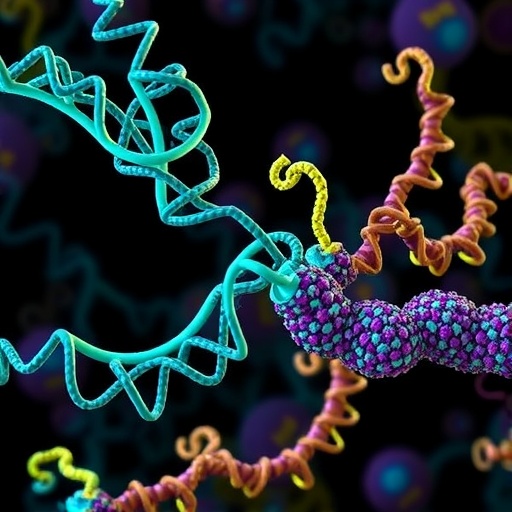
Image Credits: AI Generated
DOI: https://doi.org/10.1038/s41589-026-02156-7
Tags: cortical force generation on astral microtubulescryo-electron microscopy of spindle proteinsdynein motor protein dynamicsDynein–dynactin–NuMA complex activationin vitro reconstitution of spindle complexeslive-cell imaging of mitotic processesmicrotubule minus-end focusingmitotic spindle assembly regulationmolecular motor modulation in cell divisionNuMA N-terminal domain role in dyneinNuMA protein function in mitosisspindle pole organization mechanisms