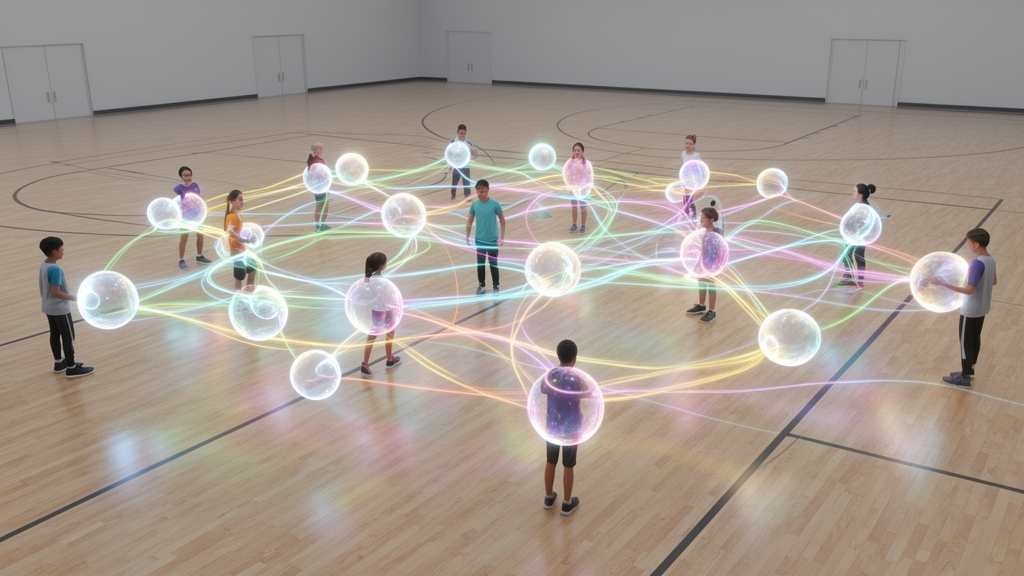
A dynamic graph neural network architecture incorporating a spatio-temporal edge-decay mechanism and an interactive selection gating mechanism has demonstrated improved accuracy in tracking and forecasting teacher-student behavioral interactions during physical education lessons. Developed to resolve the challenge of quantitatively tracking relational structures that shift continuously across fast-paced physical activities, the model was evaluated on video recordings spanning 76 distinct public physical education lessons totaling approximately 68 hours and 30 minutes. Across these diverse instructional environments, the specialized framework achieved an Area Under Curve of 0.893, an F1-score of 0.841, and a Normalized Discounted Cumulative Gain of 0.815 in predictive interaction tasks. These structural representations reflect automated behavioral proxy measures derived from spatio-temporal tracking rules rather than direct evaluations of instructional pedagogy or academic learning outcomes.
Traditional research examining classroom dynamics in physical education has predominantly depended on manual visual observation and retrospective video playback. While informative, manual techniques face significant constraints when attempting to systematically capture high-frequency physical movements, quantify rapid multi-agent behavioral correlations, or trace the temporal dissipation of transient classroom contacts. Physical education sessions present unique observational challenges because participants disperse broadly across wide gymnasiums or sports fields, execute rapid spatial movements, and engage in diverse pedagogical interactions ranging from collaborative game play to formal technique demonstrations. Although static graph neural networks have demonstrated utility in mapping relational structures across social networks and traffic flows by aggregating node and edge features, they assume stationary structural connections. Standard dynamic graph neural networks introduce temporal sequence modeling, yet they remain vulnerable to feature distortion when processing high-noise environments where fleeting, redundant, or accidental spatial proximity can obscure underlying instructional relationships.
To overcome these limitations, the newly designed DyGNN with Spatio-Temporary Edge-Decay Mechanism, designated as DyGNN-STE, integrates two primary algorithmic adaptations into the dynamic graph neural network framework. First, an exponential edge time-series attenuation function adjusts the effective connection strength between participants based on the elapsed time since their last recorded contact. By calculating the precise time interval from the prior interaction, the network systematically downweights older connections using an exponential decay coefficient, preventing expired classroom encounters from improperly biasing the contemporary state representation. Second, an interactive selection gating mechanism operates during the neighbor information aggregation phase. This gating network jointly evaluates current node states, neighbor characteristics, and edge attributes, assigning a mutual confidence coefficient between zero and one that adaptively filters out redundant connections and momentary noise before node embeddings are updated through residual time-series fusion.
The training and empirical evaluation of the architecture utilized public video recordings from the New Curriculum Standard Physical Education Open Classes, encompassing elementary through senior high school instruction across six distinct subject categories: ball games, track and field, physical fitness and skills, martial arts, gymnastics, and interdisciplinary courses. In this graph formulation, the instructor and each identifiable student are treated as individual graph nodes, explicitly avoiding aggregated group nodes. Video streams originally recorded at 25 frames per second were uniformly sampled at 5 frames per second, with individual participants tracked across consecutive frames using YOLOv8m object detection coupled with the BoT-SORT multi-object tracking algorithm. If an individual target was obscured or temporarily lost for 30 frames or fewer, trajectory interpolation maintained identity consistency; tracking failures exceeding 30 frames triggered identity reallocation. Spatial coordinates, movement velocities, and key-point posture embeddings were mapped to a 128-dimensional node representation, while edge representations incorporated normalized distances, relative body orientations, active duration frames, and computed interaction confidence scores.
Interaction edges between participants were established using strict objective behavioral criteria within non-overlapping five-second time windows. A valid interaction required individuals to remain within an image-normalized distance equivalent to 1.5 meters under classroom camera conditions, paired with an observable directional behavior such as face-to-face orientation, direct movement feedback, or physical demonstrations. Sensitivity analyses examining alternate spatial thresholds of 1.2 meters and 1.8 meters produced stable Area Under Curve values of 0.888 and 0.890 respectively, compared to 0.893 at 1.5 meters, confirming that minor distance calibration variations did not compromise overall model stability. The model’s formal prediction objective focused on determining whether an interactive edge would emerge between any given pair of participants in the subsequent time window based strictly on dynamic snapshots observed up to the current moment.
Controlled ablation experiments confirmed the operational necessity and complementary nature of both architectural components. When benchmarked against a baseline dynamic graph neural network lacking enhancements, the complete DyGNN-STE configuration increased the Area Under Curve by approximately 7.7 percent, while elevating the F1-score by 6.4 percent and Normalized Discounted Cumulative Gain by 8.0 percent. Variants isolating single mechanisms revealed distinct functional roles: retaining only the edge time-series decay mechanism enhanced the model’s ability to track long-term temporal dependencies and purge expired relational history, whereas isolating the interactive gating mechanism effectively suppressed transient misidentifications and redundant spatial clutter. Operating concurrently, the dual mechanisms enabled the network to preserve temporal continuity while maintaining strict selectivity over noisy visual signals.
Comparative evaluations against established temporal graph architectures further evidenced the performance gains offered by the proposed design. Across identical data splits partitioned by lesson at a ratio of 7:1.5:1.5 to prevent temporal and structural leakage, DyGNN-STE was benchmarked against the Temporal Graph Network, Temporal Graph Attention Network, and Evolving Graph Convolutional Network. Compared directly with the Temporal Graph Attention Network, DyGNN-STE improved Area Under Curve by approximately 3.6 percent, increased F1-score by 4.0 percent, boosted Normalized Discounted Cumulative Gain by 5.4 percent, and reduced root-mean-square error by 0.016. Across multiple independent evaluations utilizing five distinct random seeds, paired two-sided t-tests verified that the performance advantages across Area Under Curve, F1-score, and ranking quality were statistically significant, with standard deviations constrained within 0.010 and non-overlapping 95 percent confidence intervals relative to alternative baselines.
Structural network analyses across the distinct instructional categories revealed clear variations in relational topology that aligned with the physical demands of each sports curriculum. Ball games and interdisciplinary courses exhibited the highest interaction activity, recording elevated node centrality change rates and high information transmission densities indicative of rapid feedback loops and decentralized peer collaboration. Conversely, martial arts classes demonstrated elevated clustering coefficients reflecting synchronized group movement patterns. Physical fitness and gymnastics classes displayed lower interaction densities alongside highly stable teacher influence weights, reflecting instructional regimes dominated by individual guidance, direct supervision, and teacher-led execution rather than peer-to-peer exchanges.
Temporal continuity analyses across successive five-second snapshots demonstrated that ball games and interdisciplinary lessons achieved temporal correlation metrics of 0.836 and 0.829, underscoring a continuous and rapid interactive rhythm. Physical fitness and skill-oriented courses exhibited the longest average response delays at 1.834 seconds, accompanied by slower information decay rates, reflecting extended instructional feedback windows during strenuous repetitive exercises. Feature retention rate assessments indicated that while informational decay expectedly accelerated across wider analysis windows, ball sports and interdisciplinary courses sustained retention rates above 85 percent, confirming network stability even under high-frequency interactive transitions.
Despite its predictive precision, the authors documented important technical and interpretative constraints inherent to the current modeling strategy. Node representations presently rely on visual detections, trajectories, and geometric body poses without incorporating contextual modalities such as spoken instructional dialogue, acoustic whistle signals, or physiological sensors. Furthermore, model validation was restricted to internal algorithmic metrics including Area Under Curve, F1-score, and ranking accuracy. Because these predicted interaction records represent algorithmic proxies constructed from observable geometric heuristics, the researchers caution that network centrality, edge densities, and interaction counts must not be interpreted as direct evaluative measurements of pedagogical quality or student learning efficacy.
Subject of Research: Dynamic graph neural network modeling of teacher-student interactions in physical education classrooms
Article Title: Dynamic graph neural network model of student–teacher interaction in physical education teaching scene
Article References: Zhang, Y. (2026). Dynamic graph neural network model of student–teacher interaction in physical education teaching scene. Discover Artificial Intelligence, 6(1), Article 1927. https://doi.org/10.1007/s44163-026-02769-w
Image Credits: AI Generated
DOI: 10.1007/s44163-026-02769-w
Keywords: dynamic graph neural network, physical education, classroom interaction, teacher student interaction, educational technology, computer vision, spatio temporal modeling, edge decay mechanism, interactive gating, behavior tracking, YOLOv8m, BoT-SORT, interaction prediction, time series analysis, multimodal learning, educational evaluation, graph representation learning, deep learning in education
News Source: Blake Davidson. (November 25, 2026). Dynamic Graph Neural Network Tracks Teacher-Student Interactions in Physical Education Classes. Scienmag.