A laboratory investigation evaluating temporary orthopedic fixation hardware has demonstrated that dynamic fluid flow and surrounding solution chemistry strongly dictate the degradation rate and surface mineralization of biodegradable magnesium alloy screws. Published in Biomedical Materials and Devices, the study investigated how fluid transport and physical confinement influence the dissolution behavior of magnesium-calcium-zinc alloy screws known as ZX00. In conventional preclinical evaluations, biodegradable metallic implants are typically tested under static immersion conditions, where specimens remain stationary in a fixed volume of simulated physiological fluid. However, stationary liquid baths fail to replicate the continuous interstitial fluid movement and mechanical confinement encountered within living skeletal tissue. To bridge this experimental gap, researchers configured a dynamic flow-through corrosion reactor and porous synthetic bone environments, tracking transient changes in solution chemistry, ion release kinetics, and the microscopic formation of surface corrosion products across seven days of continuous testing.
Biodegradable metals have attracted substantial interest in orthopedic, trauma, and cranio-maxillo-facial surgery because they provide temporary mechanical support during bone healing and are subsequently absorbed by the human body. Traditional permanent metallic fixation devices, such as titanium plates or stainless steel screws, carry long-term drawbacks that include mechanical stress-shielding, local corrosion debris generation, imaging artefacts, and the frequent requirement for secondary removal surgeries. Magnesium is particularly suitable for temporary fracture repair because its mechanical properties match those of natural bone more closely than traditional metals, while released magnesium ions play active physiological roles in metabolic regulation, muscle function, and tissue regeneration. Nonetheless, managing the rapid initial corrosion of magnesium remains a primary engineering hurdle, as corrosion produces magnesium hydroxide, soluble magnesium salts, hydroxide ions, and gaseous hydrogen that can disrupt surrounding healing tissues if generated too rapidly.
To investigate these degradation kinetics under standardized laboratory conditions, the research team utilized short cannulated ZX00 screws composed of ninety-nine percent magnesium, zero point fifty-five percent calcium, and zero point forty-five percent zinc by weight. The screws were tested in two standardized lengths, fourteen millimeters and eighteen millimeters, which simplified geometric modeling showed had comparable effective surface areas. The team evaluated the hardware in two widely accepted physiological testing media: Hank’s Balanced Salt Solution, which was left unbuffered without glucose and exhibits physiological ionic species, and Simulated Body Fluid, which was buffered to an initial physiological pH of seven point four at thirty-seven degrees Celsius using fifty millimolar tris(hydroxymethyl)aminomethane and hydrochloric acid. Simulated Body Fluid closely mimics the inorganic ion concentrations found in human blood plasma and is conventionally used to measure calcium phosphate and apatite precipitation on biomaterial surfaces.
The experimental matrix encompassed both static immersion and dynamic flow environments to assess how transport conditions govern chemical evolution. For direct static immersion, individual screws were placed in forty-eight milliliters of solution within sealed polypropylene containers and maintained at thirty-seven degrees Celsius inside an orbital shaking incubator. To simulate the mechanical confinement and varying pore networks of natural human bone, additional screws were fixed into synthetic polyurethane bone blocks. Cortical bone confinement was modeled using solid foam blocks with closed-cell porosity and a pre-drilled central channel that allowed restricted solution contact with the implant threads. Cancellous bone was modeled using softer polyurethane foam blocks with open-cell interconnected porosity, allowing the screw to be inserted directly without pre-drilling. These block assemblies were immersed in either forty-eight or fifty-eight milliliters of medium, with regular small-volume liquid sampling and replenishment carried out over one week.
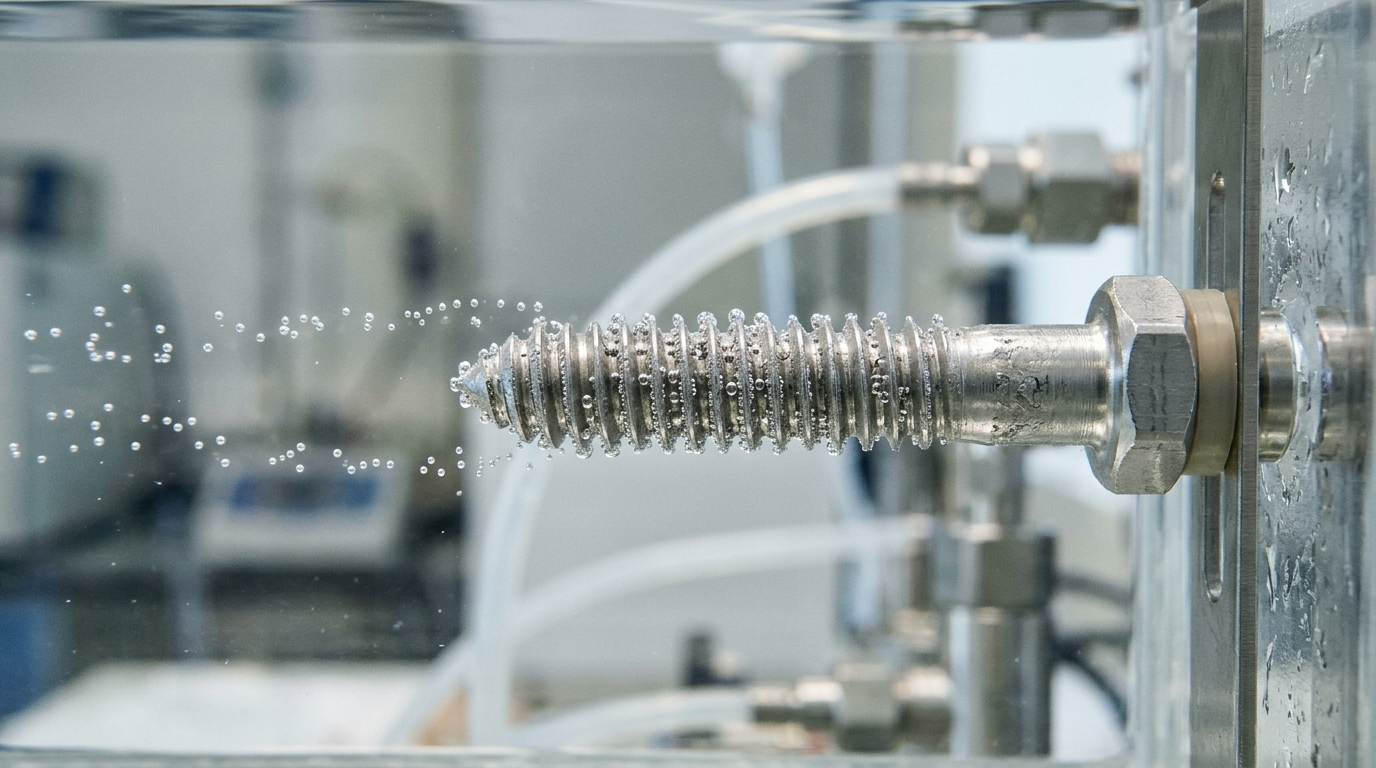
To simulate extracellular fluid movement through bone, the researchers designed a continuous flow-through system consisting of a small cylindrical polypropylene reactor with an internal chamber volume of approximately eight hundred thirty-seven cubic millimeters. Individual screws were mounted head-first facing the inlet, and a precision multichannel peristaltic pump drove test media along the length of the screw at a controlled flow rate of zero point zero thirty-three milliliters per minute. This rate was chosen to approximate reported maximum intraosseous blood and fluid perfusion rates of twenty milliliters per minute per one hundred grams of bone tissue, translating to approximately forty-eight milliliters of fresh solution passing over the implant every twenty-four hours. Outflow fractions were collected at designated hourly intervals and subsequently analyzed alongside the static immersion extracts to directly contrast dynamic mass transport against closed static equilibrium.
Liquid analysis revealed pronounced differences between dynamic and static environments, as well as stark contrasts between the two testing media. Solution pH and elemental concentrations of magnesium, calcium, and phosphorus were tracked using calibrated glass electrodes and inductively coupled plasma optical emission spectroscopy. Under static conditions, magnesium ion concentrations accumulated gradually over the course of the week. In contrast, the dynamic flow system recorded a rapid burst release of magnesium ions during the very first hour of liquid contact, reaching an acute peak concentration of approximately forty milligrams per liter in dynamic Hank’s Balanced Salt Solution and approximately two hundred twenty milligrams per liter in dynamic Simulated Body Fluid. Following this initial surge, dynamic magnesium concentrations declined steadily toward the baseline concentration of the incoming feed as surface reactions settled into steady-state dissolution.
Solution composition exerted a primary influence on the overall magnitude of metallic dissolution. In every experimental configuration, Simulated Body Fluid accelerated screw corrosion compared to Hank’s Balanced Salt Solution, yielding a peak dynamic magnesium concentration that was roughly five point five times higher. This marked acceleration occurred primarily because the Tris buffer incorporated within Simulated Body Fluid consumed newly released hydroxide ions, attenuating the local rise in solution pH. While the unbuffered Hank’s Balanced Salt Solution experienced wider alkaline swings that fostered a thicker, protective magnesium hydroxide passivating film, the buffered Simulated Body Fluid maintained a lower local pH of around seven point seven, destabilizing passivating layers and facilitating rapid metal dissolution. Consequently, dynamic Simulated Body Fluid recovered approximately eight percent of the screw’s total initial magnesium content in the liquid phase over one week, whereas dynamic Hank’s Balanced Salt Solution recovered only about zero point one percent.
The physical confinement provided by the porous synthetic bone blocks also modulated the local chemical environment. In static Hank’s Balanced Salt Solution, screws fixed within the closed-cell polyurethane blocks exhibited the lowest overall solution pH values throughout the week, yet simultaneously generated the highest accumulated magnesium concentrations among the static groups. The researchers attributed this distinct profile to restricted mass transport through the tight, pre-drilled channel. Restricted fluid exchange within the closed-cell matrix prevented rapid diffusion of dissolved species, fostering localized chemical gradients where dissolved ions and degradation products remained concentrated near the implant interface. Conversely, the open-cell synthetic bone model provided an interconnected porous network that permitted broader fluid exchange, resulting in higher overall extract pH and promoting calcium and phosphorus surface precipitation comparable to that seen in Simulated Body Fluid.
Surface and cross-sectional investigations using scanning electron microscopy and energy-dispersive X-ray spectroscopy confirmed that morphological degradation and mineral deposition varied widely across test conditions. All screws exhibited macroscopic and microscopic corrosion compared to unexposed reference hardware, with cross-sections revealing a characteristic two-layer surface architecture. The inner region adjacent to the bulk metallic substrate consisted primarily of magnesium, oxygen, and chlorine corrosion products, reflecting early surface oxidation and the attack of chloride ions on initial hydroxide films. The outer surface layer was enriched with precipitated calcium and phosphorus captured from the surrounding media, where liquid concentrations of both elements dropped below baseline levels immediately upon exposure as mineral phases nucleated on the corroding metal surfaces.
Microchemical analysis of these surface deposits demonstrated that fluid transport and media chemistry directly altered the elemental stoichiometry of mineral precipitates. Across most screw surfaces, the atomic ratio of calcium to phosphorus remained near one, falling below the theoretical ratio of one point sixty-seven characteristic of stoichiometric hydroxyapatite. In cross-sectional analyses of outer surface deposits, however, the atomic ratio of magnesium plus calcium to phosphorus ranged between one point four and two point four, with specimens exposed to dynamic Hank’s Balanced Salt Solution yielding a ratio of one point seventy-two. The substantial magnesium content detected within these outer mineral crusts indicates that the precipitates formed as complex multi-phase mixtures of calcium phosphate, magnesium phosphate, carbonates, and magnesium-substituted apatite rather than pure hydroxyapatite phases alone.
The authors noted that the dynamic flow-through corrosion system successfully captured transient dissolution kinetics and early ion release bursts that remain entirely obscured during standard static immersion testing. While static tests allow corrosion products to accumulate unnaturally around an implant and shift the liquid toward early chemical saturation, continuous liquid renewal maintains active concentration gradients that more accurately mirror in vivo clearance. The investigators highlighted several methodological limitations, noting that dynamic testing introduced both fluid shear and continuous volumetric liquid replenishment that could not be evaluated separately. Furthermore, the experiments were acellular and did not measure hydrogen gas evolution rates directly. The study concluded that while buffered Simulated Body Fluid provides an effective platform for rapid comparative screening, dynamic flow-through testing in balanced salt solutions offers a much more realistic assessment of sustained in vitro degradation behavior.
Subject of Research: In vitro degradation and surface mineralization kinetics of biodegradable magnesium implant screws under static and dynamic fluid flow conditions
Article Title: Comparison of Static and Dynamic in Vitro Degradation of a Biodegradable Magnesium Implant Screw
Article References: Siekkinen, M., Vainio, E., Heino, T. J., Vallittu, P., & Hupa, L. (2026). Comparison of Static and Dynamic in Vitro Degradation of a Biodegradable Magnesium Implant Screw. Biomedical Materials & Devices. https://doi.org/10.1007/s44174-026-00800-3
Image Credits: AI Generated
DOI: 10.1007/s44174-026-00800-3
Keywords: biodegradable metals, magnesium alloy, ZX00 screw, in vitro degradation, dynamic flow-through system, static immersion, Hank's Balanced Salt Solution, Simulated Body Fluid, synthetic bone models, peristaltic pump, inductively coupled plasma optical emission spectroscopy, scanning electron microscopy, energy-dispersive X-ray spectroscopy, calcium phosphate precipitation, apatite formation, mass transport, orthopedic implants
News Source: Drew Townsend. (November 23, 2026). Dynamic Fluid Flow Alters Initial Degradation Behavior of Biodegradable Magnesium Implants. Scienmag.