A four-week parallel-arm randomized controlled trial published in the Bulletin of Faculty of Physical Therapy found that adding dynamic dry cupping therapy to conventional calf muscle exercises provided no superior improvements in athletic performance compared to exercise training alone in competitive male basketball players. The investigation, led by Shilpi Sasmal, Kalpana Zutshi, Farkhunda Jabin, and Ifra Aman, evaluated thirty male athletes to examine whether applying negative pressure suction over the calf muscle alongside targeted rehabilitation drills would enhance dynamic balance, power, and agility beyond standard exercise protocols. While both intervention groups demonstrated statistically significant improvements in vertical jump height, the control group performing exercise alone showed a statistically significant improvement in left-leg dynamic balance that was not observed in the cupping group, while agility scores remained statistically unchanged across both cohorts.
Basketball is recognized by the authors as a physically demanding sport combining aerobic and anaerobic energy systems that requires players to sustain high levels of physical fitness, explosive power, agility, muscular balance, and strength through rapid, multidirectional movements. Prior research cited by the investigators indicates that players cover approximately 4,500 to 5,000 meters during a single practice session, spending an estimated 56.8 percent of their time walking, 34.1 percent running and jumping, and 9.1 percent stationary. The lower extremity bears the predominant physical load during these movements, with high injury rates documented in the knee and ankle joints regardless of athlete gender. The gastrocnemius and soleus muscles undergo continuous concentric and eccentric contractions across varying joint angles during sprints, abrupt stops, directional shifts, jumps, and landings, while previous literature by Samraiz Mughal and colleagues identified that myofascial cupping and stretching could alleviate gastrocnemius muscle pain and enhance ankle dorsiflexion range of motion.
To rigorously test whether dynamic cupping provides functional performance gains, the researchers recruited thirty male basketball players between 18 and 35 years of age who each possessed at least five years of competitive playing experience across sports stadia in Delhi. The sample size was determined through statistical power software using an alpha value of 80 percent. The trial protocol established strict exclusion criteria to isolate the intervention effects: players who had experienced any musculoskeletal injury in the preceding six months, individuals with a history of Achilles tendon repair, and athletes with diagnosed systemic diseases, vascular conditions, or neurological disorders were excluded. Eligible participants provided written informed consent following oral briefings that outlined potential mild reactions to dynamic cupping, including temporary mild discomfort, skin discoloration, ecchymosis, erythema, and circular cup marks.
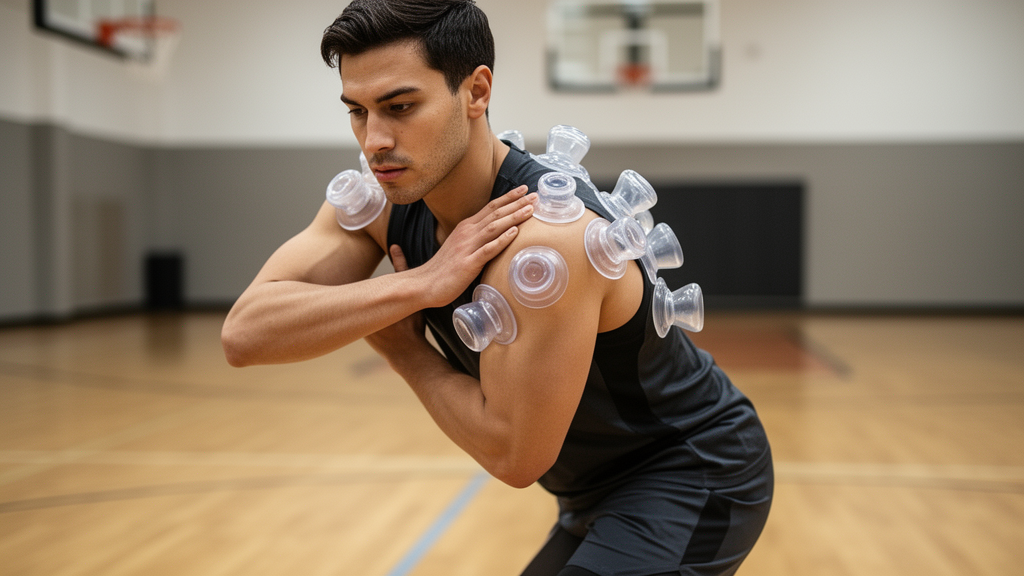
Participant allocation was carried out using a lottery method with a 1:1 allocation ratio, placing fifteen participants into Group 1 as the experimental cohort and fifteen into Group 2 as the control cohort. Allocation concealment was maintained by a blinded researcher utilizing sequentially opened sealed opaque envelopes. For the experimental group, a qualified therapist administered dynamic dry cupping using Kangzhu biomagnetic Chinese cupping sets (Model B1 x 6, Beijing, China). A plastic cup placed on the skin had negative pressure suction generated with a manual pump, and the therapist systematically moved the cup over the entire calf muscle for ten minutes per session. Following cupping, experimental participants performed a structured exercise program comprising ten ankle pumps, ten clockwise and counterclockwise ankle rotations, three sets of 30-second calf muscle stretches, ten heel raises, ten toe raises, and lunges, resulting in a total session time of approximately 25 minutes.
The control group engaged exclusively in conventional exercise therapy for approximately 20 minutes per session without any cupping intervention. Their program matched the movement components, consisting of gastrocnemius and soleus muscle stretching repeated three times with 30-second holds, ten repetitions of ankle pumps, ten clockwise and anticlockwise ankle circles, ten heel raises, ten toe raises, and lunges. Both cohorts underwent their assigned interventions three days per week over a total duration of four weeks. Functional outcome testing was conducted at baseline and at the four-week completion mark by blinded assessors who were independent from the intervention delivery. Dynamic balance was evaluated using the Y-Balance Test (Y-BT), muscular power was measured through the vertical jump test, and agility was quantified using the standardized T-test.
Data analysis was conducted using SPSS Version 21. Before executing inferential tests, the investigators evaluated the assumption of normality for all continuous outcome variables through the Shapiro-Wilk test and visual inspections of quantile-quantile (Q-Q) plots, confirming normal distributions across all variables with p-values exceeding 0.05 to validate the application of parametric statistics. Descriptive baseline evaluations and paired t-tests were utilized for within-group and between-group comparisons, with findings reported as means, standard deviations, Cohen’s d effect sizes, and 95 percent confidence intervals. The authors reported that all enrolled participants completed the protocol without any adverse incidents or participant-reported harms throughout the four-week timeline.
Within-group measurements revealed subtle functional changes between the baseline and post-intervention evaluations. In Group 1, dynamic balance for the left leg shifted from 101.07 ± 6.19 at baseline to 100.84 ± 5.95 post-test (Cohen’s d = 0.04, 95% CI: -0.35 to 0.43), while right leg balance moved from 102.7 ± 5.79 to 102.2 ± 5.57 (d = 0.09, 95% CI: -0.30 to 0.48). Group 1 vertical jump scores changed from 45.2 ± 5.52 cm to 44.8 ± 5.37 cm (d = 0.08, 95% CI: 0.01 to 0.55), and agility times were recorded at 11.1 ± 0.94 seconds at baseline compared to 10.9 ± 1.23 seconds at the four-week assessment (d = 0.18, 95% CI: -0.21 to 0.57). In Group 2, left leg dynamic balance recorded values of 103.4 ± 6.06 pre-test and 102.9 ± 5.72 post-test (d = 0.08, 95% CI: -0.31 to 0.47), and right leg balance shifted from 104.3 ± 6.60 to 104.1 ± 6.84 (d = 0.03, 95% CI: -0.36 to 0.42). Group 2 vertical jump was measured at 42.4 ± 7.51 cm pre-test and 41.86 ± 7.25 cm post-test (d = 0.08, 95% CI: 0.01 to 0.56), while agility scores remained constant at 11.1 ± 1.02 seconds at baseline and 11.1 ± 1.10 seconds at follow-up (d = 0.00, 95% CI: -0.39 to 0.39).
The between-group comparative analysis identified distinct statistical patterns between the two regimens. Group 1 achieved a statistically significant within-group improvement only in vertical jump performance (p = 0.029), whereas changes in agility (p = 0.294), left-side dynamic balance (p = 0.425), and right-side balance (p = 0.060) failed to reach statistical significance. In contrast, Group 2 demonstrated statistically significant improvements in both vertical jump (p = 0.006) and left-leg dynamic balance (p = 0.006), while showing no significant differences in agility (p = 0.795) or right-leg balance (p = 0.419). Because the control group achieved superior statistical improvement in left-side dynamic balance compared to the cupping cohort, the researchers concluded that dynamic cupping therapy did not confer any additive advantage for balance outcomes in this athletic cohort.
In interpreting the findings, the authors emphasized that observed functional improvements in athletic performance were primarily driven by conventional exercise rather than cupping therapy supplementation. While theoretical mechanisms discussed in the literature suggest that cupping may raise creatine kinase levels, enhance ATP generation, accelerate lactate clearance, stimulate mechanoreceptors, and improve local microvascular perfusion and muscular flexibility, the authors urged caution against overstating these physiological claims. The evidence indicates that such localized vascular and tissue-level reactions do not directly translate into enhanced global athletic outputs such as explosive jumping or speed agility. Furthermore, agility performance remained completely unaffected across both cohorts, aligning with prior research that demonstrated no significant difference in shuttle-run agility between plank conditioning and self-myofascial foam rolling.
The researchers outlined several critical limitations that frame the generalizability of their trial. The study was conducted on a relatively small cohort of thirty male athletes from a single geographic region, limiting broader applicability to female basketball players and larger athletic populations. Additionally, the intervention period was restricted to four weeks at three sessions weekly, which may have provided insufficient duration for higher-order neuromuscular adaptations, motor learning, and agility gains to materialize. The authors also noted that applying cupping solely to the calf musculature rather than across the entire kinetic chain of the lower extremity may have restricted its potential functional impact, recommending that future investigations implement longer intervention timelines of six to eight weeks and incorporate comprehensive lower-extremity kinetic protocols.
Subject of Research: Comparative effects of dynamic cupping therapy and conventional exercise on calf muscle performance in basketball players
Article Title: Comparative effects of dynamic cupping therapy and conventional exercises on calf muscle on athletic performance in basketball players: randomized controlled trial
Article References: Sasmal, S., Zutshi, K., Jabin, F., & Aman, I. (2026). Comparative effects of dynamic cupping therapy and conventional exercises on calf muscle on athletic performance in basketball players: randomized controlled trial. Bulletin of Faculty of Physical Therapy, 31(1), Article 13. https://doi.org/10.1186/s43161-026-00348-9
Image Credits: AI Generated
DOI: 10.1186/s43161-026-00348-9
Keywords: dynamic cupping, basketball, athletic performance, vertical jump, dynamic balance, exercise therapy, calf muscle, randomized controlled trial, Comparative, effects, dynamic, cupping
News Source: Ophelia Keating. (November 9, 2026). Dynamic Cupping Yields No Athletic Performance Advantage Over Exercise in Basketball Trial. Scienmag.