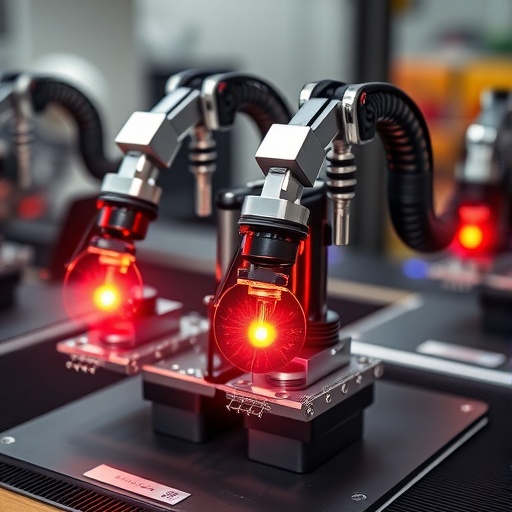
In a groundbreaking leap for robotic manipulation and magnetic field technology, researchers have unveiled a novel approach to magnetic field control through dual robotic tunable magnetic end effectors. This innovation, spearheaded by a team including Abolfathi, Zhu, and Chandler, promises to revolutionize precision in magnetic manipulation, impacting fields from biomedical engineering to advanced manufacturing. The study, set to be published in Communications Engineering in 2026, introduces an unprecedented level of dynamic control over magnetic fields by integrating sophisticated robotics with tunable magnetic materials.
At the heart of this advancement lies the concept of robotic end effectors equipped with tunable magnetic components capable of modulating magnetic field strength and geometry in real time. Traditional magnetic manipulation often relies on fixed magnet arrangements or bulky electromagnetic setups with limited adaptability. The dual robotic tunable magnetic end effectors, however, provide a versatile platform where magnetic intensity and gradient can be precisely adjusted through coordinated robotic movement and magnetic tuning, offering a multifaceted tool for intricate applications.
The technology marries robotics’ meticulous positional accuracy with the adaptability of tunable magnetic materials. These end effectors utilize materials whose magnetic properties can be finely adjusted by external stimuli or internal structural changes, allowing the system to dynamically reshape the magnetic landscape it operates within. This contrasts starkly with conventional rigid magnets or single-mode electromagnets, which lack the ability to swiftly reconfigure magnetic field patterns without physical rearrangement or switching electrical inputs.
One of the most striking aspects of this system lies in its dual nature—two independently controlled end effectors enable the generation of complex magnetic field interactions. This duality facilitates a range of programmable magnetic field configurations that include varying gradient directions, strength modulations, and spatial distributions. As a result, users can tailor magnetic forces for specific tasks that were previously impossible or highly inefficient.
The potential applications are vast and transformative, particularly within biomedical engineering, where magnetic fields are employed for targeted drug delivery, minimally invasive surgery, and remote actuation of micro-robots within the human body. Utilizing dual tunable magnetic end effectors, medical practitioners could achieve unmatched control over magnetic microcarriers or instruments, precisely guiding them through complex biological environments while minimizing collateral tissue impact.
In the realm of advanced manufacturing and materials science, this novel magnetic control system offers new avenues for manipulating magnetic particles, assembling micro- and nanoscale structures, and enabling complex material patterning. By adjusting magnetic fields in real time, the system could direct self-assembly processes with unprecedented precision or orchestrate the collective behavior of magnetic microbots to perform delicate tasks such as surface cleaning or targeted repairs.
The research team employed state-of-the-art robotic platforms integrated with tunable magnet assemblies comprising smart materials responsive to electric or thermal stimuli. These materials exhibit magnetization properties that shift dynamically, responding to localized environmental changes or control signals. The robotic arms enable precise spatial positioning and orientation of each magnetic end effector, amplifying the system’s ability to configure fields in three dimensions with fine granularity.
This integration required overcoming significant challenges associated with synchronizing magnetic tuning and robotic motion. The researchers developed advanced control algorithms capable of interpreting real-time feedback from magnetic sensors and robotic position encoders. These algorithms precisely coordinate dynamical adjustments to magnetization levels alongside robotic movements, ensuring that the magnetic field configuration matches the desired pattern with high fidelity.
To evaluate the performance of this dual-end-effector system, the team conducted extensive simulations and experimental validations. They demonstrated that the system could generate complex magnetic field gradients, offer rapid reconfiguration speeds, and maintain stability during dynamic operations. The experimental results not only confirmed theoretical predictions but also revealed new capabilities in sculpting the spatial distribution of magnetic forces.
Moreover, the system’s modular design offers scalability and adaptability. By varying the number and arrangement of tunable magnetic end effectors, the platform can be customized for diverse environments and applications—from compact microsurgery setups to large-scale industrial manipulators. This flexibility places the technology at the forefront of next-generation magnetic control systems seeking to break free from traditional static configurations.
Beyond technological innovation, this work also underscores the importance of multidisciplinary collaboration, combining robotics engineering, material science, control theory, and applied physics. It characterizes a convergence of fields, each pushing the other forward, to realize what was once conceptually envisioned: robotic systems capable of living, breathing magnetic fields that adapt fluidly to their environment and mission.
This development could herald a paradigm shift in how we think about and utilize magnetic forces, transforming magnetic manipulation from a rigid, pre-set tool to a dynamic, smart instrument finely tuned through robotic precision. The researchers envision future iterations incorporating machine learning to autonomously adapt magnetic field patterns based on real-time operational contexts, further enhancing efficacy and versatility.
Given the rapid pace of emerging applications requiring high-precision magnetic manipulation, the introduction of dual robotic tunable magnetic end effectors is likely to inspire a wave of innovation. Fields such as soft robotics, lab-on-a-chip devices, and targeted therapy could see particularly strong impacts, where the nuanced control of magnetic forces translates directly into better performance, safety, and outcomes.
As this technology matures, challenges remain in miniaturizing components, integrating with other sensory modalities, and ensuring robustness under varying operational conditions. Nonetheless, the foundation laid by Abolfathi and colleagues sets a clear path toward magnetic control systems that are as dynamic and responsive as the tasks they undertake.
In essence, this novel approach marks a pivotal moment for magnetic field manipulation. By harmonizing the high precision of robotics with the adaptable power of tunable magnetic materials, the dual end effector system redefines what is possible. It transforms magnetic fields from static phenomena into dynamically sculpted tools, capable of navigating and interacting with the world in ways previously confined to theoretical speculation.
This pioneering research not only paves the way for new technologies but offers a glimpse into future landscapes where machines manipulate forces invisible to the naked eye with elegance, responsiveness, and unprecedented dexterity.
Subject of Research: Magnetic field control using dual robotic tunable magnetic end effectors.
Article Title: Magnetic field control with dual robotic tunable magnetic end effectors.
Article References:
Abolfathi, K., Zhu, J., Chandler, J.H. et al. Magnetic field control with dual robotic tunable magnetic end effectors. Commun Eng (2026). https://doi.org/10.1038/s44172-026-00629-0
Image Credits: AI Generated
Tags: advanced manufacturing magnetic applicationsbiomedical engineering magnetic toolscoordinated robotic magnetic tuningdual robotic magnetic end effectorsdynamic magnetic field modulationflexible magnetic end effector designintegrated robotics and magneticsmagnetic gradient control technologymagnetic materials in roboticsreal-time magnetic intensity adjustmentrobotic manipulation precisiontunable magnetic field control