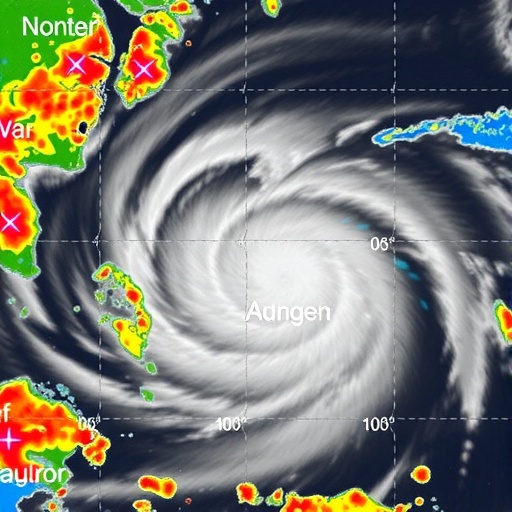
In a rapidly changing climate, predicting extreme weather events has never been more crucial. Recent advancements in meteorological technology have enabled scientists to hone in on the specifics of weather phenomena with unprecedented accuracy. One of the most significant breakthroughs in this field comes from research focused on the integration of dual-polarization radar technology for short-term heavy precipitation warnings during typhoons. Researchers Fang, Wang, and Liu from their new study emphasize the utility of this innovative approach, setting new standards for weather forecasting as we know it.
Heavy rainfall during typhoons can lead to catastrophic consequences, including flooding, landslides, and property damage. As these storms become more frequent and intense due to climate change, there is an urgent need to improve warning systems for affected regions. The study from these researchers underscores the potential for dual-polarization radar technology to enhance forecasts by providing insights into the vertical distribution of precipitation particles. The capabilities of this advanced radar system could dramatically change how meteorologists approach storm prediction and response.
Dual-polarization radar operates by transmitting and receiving signals that can characterize the shape, size, and phase of precipitation particles. Traditional radar systems typically only measure the reflectivity of precipitation, making it challenging to discern the types of particles involved. In contrast, dual-polarization radar can differentiate between raindrops, snowflakes, and even hailstones, providing a more comprehensive view of what is happening within a storm system. This rich dataset is vital for improving predictions, especially in the chaotic environment of a typhoon.
The researchers conducted an extensive evaluation of dual-polarization radar data, focusing specifically on precipitation particle vertical distribution during typhoon events. By analyzing data from multiple storm instances, they were able to identify critical patterns that corresponded to heavy precipitation events. These patterns enabled the development of refined algorithms that could predict short-term rainfall intensity more accurately than existing models. The implications of this work could be profound, as timely and accurate predictions can facilitate more efficient evacuation plans and disaster response strategies.
One of the unique aspects of dual-polarization radar is its ability to capture detailed three-dimensional profiles of storm systems. This capability enables meteorologists to visualize how precipitation changes in various altitudes as storms progress. The researchers found that certain signatures in the radar data were consistently associated with severe rainfall, allowing for the establishment of a predictive framework that can issue warnings with a lead time of several hours—crucial time that can save lives and mitigate damage.
Furthermore, the research highlights the potential for integrating machine learning with radar observations. By employing sophisticated algorithms, scientists can train models on historical radar data to recognize weather patterns and predict upcoming events with remarkable precision. This intersection of meteorology and artificial intelligence marks a turning point in how climate data is processed and utilized, paving the way for real-time analyses that could revolutionize weather forecasting.
Community engagement is a critical component in improving disaster preparedness. The study also emphasizes the importance of disseminating accurate information derived from sophisticated forecasting technologies to local populations. Building trust and promoting understanding of warning systems can lead to more effective response measures. The research underlines that the ultimate objective is not just to predict the weather more accurately but also to translate those predictions into actionable guidance for communities at risk.
Another significant angle of this research is its potential impact on agricultural planning. Farmers often rely on rainfall forecasts to make critical decisions about planting and harvest times. The authors discuss how improved precipitation predictions can translate to better crop management, ensuring food security in an increasingly unpredictable climate. Timely warnings can allow farmers to take protective measures or adjust their practices to minimize losses, demonstrating the far-reaching implications of this meteorological advancement.
Given the rising costs associated with natural disasters, improving the precision of heavy rainfall predictions during typhoons is not just an academic exercise. Economically vulnerable communities are disproportionately affected by such events. The commercial and economic ramifications tied to agricultural productivity, infrastructure maintenance, and emergency response are profound. Thus, the findings from this study serve as a catalyst for both scientific inquiry and societal action.
Moreover, international collaboration is critical in advancing these radar technologies. The authors advocate for a global network of meteorologists who can share data, methods, and insights regarding typhoon forecasting. Such a collaborative framework would enable countries to learn from one another’s experiences, pooling resources for more robust forecasting systems. The fight against extreme weather is a shared global challenge that requires coordinated efforts at all levels.
Although the future looks promising with these advancements in radar technology, there remain challenges in adapting existing infrastructure to utilize such sophisticated tools. Policymakers need to address resource allocation for meteorological services, ensuring that both urban and rural areas benefit from enhanced forecasting capabilities. Investment in training personnel and upgrading technology can set the stage for a new era in disaster preparedness and response.
The researchers conclude by reiterating that the true value of their findings lies not only in improved weather predictions but also in the broader implications for public safety and economic stability. As they anticipate further research and collaboration, the call to action is clear: an integrated approach that combines cutting-edge technology, community engagement, and global solidarity is essential for navigating the complexities of future weather challenges. The implications of their study could pave the way toward a safer, more resilient world, capable of adapting to the unrelenting forces of nature.
With the onslaught of climate change and its myriad effects on weather patterns, the need for advanced forecasting has never been more pressing. The potential for dual-polarization radar to reshape meteorological practices represents a beacon of hope in an increasingly uncertain future.
Subject of Research: Dual-polarization radar observations for precipitation particle vertical distribution during typhoons.
Article Title: Typhoon short-term heavy precipitation warning based on dual-polarization radar observations of precipitation particle vertical distribution.
Article References:
Fang, R., Wang, T. & Liu, H. Typhoon short-term heavy precipitation warning based on dual-polarization radar observations of precipitation particle vertical distribution.
Sci Rep (2025). https://doi.org/10.1038/s41598-025-31842-0
Image Credits: AI Generated
DOI: 10.1038/s41598-025-31842-0
Keywords: Dual-polarization radar, heavy precipitation, typhoons, weather forecasting, climate change, meteorology, disaster preparedness, agricultural planning.
Tags: climate change impact on stormsdual-polarization radar technologyenhanced weather warning systemsextreme weather predictionflooding and landslides riskheavy rainfall forecastinginnovative storm prediction methodsmeteorological technology advancementsprecipitation particle characterizationresearch on meteorological breakthroughsshort-term weather forecastingtyphoon precipitation warnings