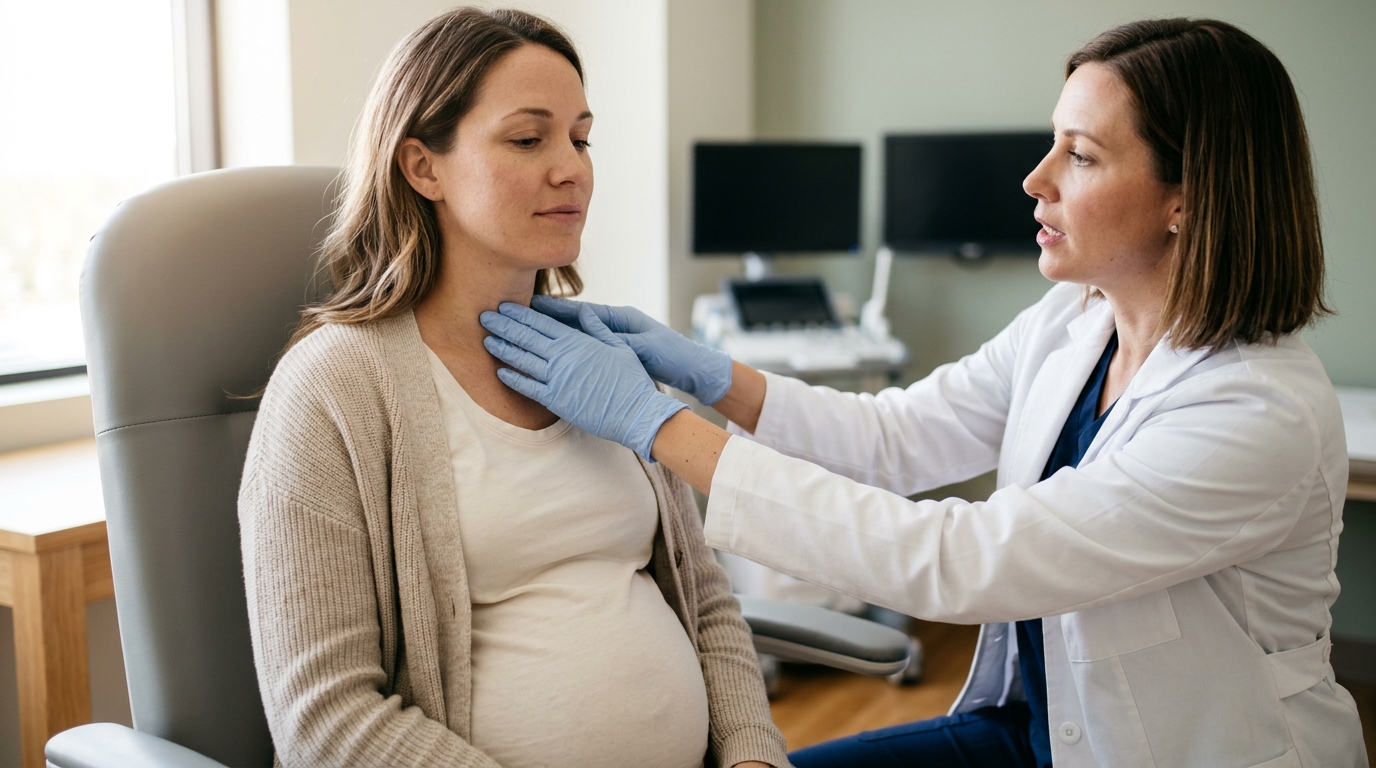
In a retrospective cohort study evaluating early gestational endocrine markers, pregnant women positive for both thyroid peroxidase and thyroglobulin antibodies during the first trimester showed an increased risk of developing later thyroid dysfunction. The study, conducted among 728 pregnant women at Foshan Women and Children Hospital in China, classified participants into four distinct immunological phenotypes based on early antibody status. Women with an isolated thyroglobulin antibody positive profile showed higher crude rates and nominally elevated odds of gestational diabetes mellitus, though this signal lost significance after false discovery rate correction. Multivariable models revealed that neonatal outcomes among evaluable live-born infants showed no independent associations with maternal antibody phenotypes. These findings indicate that early antibody testing identifies baseline immunological patterns rather than serving as an independent predictor of maternal complications.
Thyroid function during early gestation is critical for maternal metabolic equilibrium and fetal development. Throughout the first trimester, pregnancy exerts significant physiological demands on the maternal hypothalamic-pituitary-thyroid axis, necessitating major hormonal adjustments to accommodate embryonic growth and placental function. Even subtle perturbations in circulating thyrotropin or free thyroxine concentrations can coincide with adverse obstetrical and perinatal events. Within this setting, maternal thyroid autoimmunity represents an area of intense clinical interest, as antibodies against thyroid peroxidase or thyroglobulin may indicate underlying glandular hyporesponsiveness or localized immune dysregulation. Nevertheless, major endocrine and obstetrical professional organizations maintain divergent clinical recommendations regarding the management of gestational autoimmunity. International guidelines reflect ongoing debate over universal antibody screening and the effectiveness of levothyroxine supplementation in euthyroid pregnant women with detectable thyroid autoantibodies.
Much of the existing epidemiological literature on gestational autoimmunity suffers from important methodological gaps. Many previous investigations focused exclusively on thyroid peroxidase antibodies, omitting thyroglobulin antibodies entirely. Other studies grouped all seropositive women into a single composite category, masking potential immunological distinctions between isolated antibody presentations and dual seropositivity. Furthermore, research examining metabolic disorders has yielded conflicting results; some cohorts linked thyroid antibodies to gestational diabetes, whereas larger harmonized meta-analyses found that associations disappeared after controlling for thyroid hormones. In addition, few studies have examined maternal complications, late thyroid dysfunction, and neonatal outcomes simultaneously within the same analytical cohort. To overcome these limitations, the authors evaluated whether separating women into four mutually exclusive first-trimester antibody phenotypes could provide prognostic insights before routine second-trimester complications arise.
The research was designed as a single-center retrospective cohort study using integrated clinical records from Foshan Women and Children Hospital, affiliated with Guangdong Medical University. From an initial screening of 840 medical files, the research team assembled a final maternal cohort of 728 pregnant women who completed baseline serum testing between November 1, 2022, and February 1, 2023. Glandular assessments took place at a median gestational age of 12 weeks, with an interquartile range from 11 to 13 weeks, ensuring that antibody classification preceded routine glucose tolerance testing and subsequent clinical diagnoses. Patient follow-up extended through delivery until October 6, 2023. De-identified clinical data were extracted from laboratory information systems, antenatal metabolic logs, admission records, and delivery charts. The study protocol was approved by the hospital ethics committee, which waived written informed consent due to the minimal-risk, retrospective design.
Using assay thresholds of 34 international units per milliliter for thyroid peroxidase antibodies and 115 international units per milliliter for thyroglobulin antibodies, participants were classified into four exposure groups. Among the 728 women, 588 (80.8 percent) were double-negative, 44 (6.0 percent) were positive for thyroid peroxidase antibodies only, 36 (4.9 percent) were positive for thyroglobulin antibodies only, and 60 (8.2 percent) were double-positive. Demographic and clinical traits were balanced across groups at enrollment. Median maternal age spanned 29.0 to 30.5 years, pre-pregnancy body mass index ranged from 20.5 to 21.4 kilograms per square meter, and median gestational age at testing was 12.0 weeks across all categories. Baseline metabolic indices, including fasting glucose, oral glucose challenge results, and glycated hemoglobin, showed no significant variations. However, median thyrotropin differed significantly across groups, reaching 2.16 milli-international units per liter in the isolated thyroid peroxidase antibody group.
Analysis of unadjusted clinical outcomes identified notable differences in several maternal conditions. Gestational diabetes occurred in 13.6 percent of double-negative women, 11.4 percent of women with isolated thyroid peroxidase antibodies, 30.6 percent of women with isolated thyroglobulin antibodies, and 11.7 percent of double-positive women, yielding a statistically significant crude difference. Similarly, recorded comorbidities varied significantly across groups, appearing in 38.9 percent of the isolated thyroglobulin antibody group versus 17.0 percent of double-negative controls. Documented diagnoses of mid- or late-pregnancy thyroid dysfunction also differed, emerging in 1.2 percent of double-negative women, 11.4 percent of isolated thyroid peroxidase antibody women, 2.8 percent of isolated thyroglobulin antibody women, and 10.0 percent of double-positive women. In contrast, other obstetrical outcomes showed no significant differences, including hypertensive disorders of pregnancy, premature rupture of membranes, preterm birth, cesarean delivery, and postpartum hemorrhage.
To account for potential confounding, the authors fitted multivariable logistic regression models adjusting for maternal age, pre-pregnancy body mass index, gestational age at testing, and log-transformed concentrations of thyrotropin and free thyroxine. In this fully adjusted model, the isolated thyroglobulin antibody phenotype displayed a nominal association with gestational diabetes (odds ratio 2.81, 95 percent confidence interval 1.31 to 6.05, p-value 0.008). However, after Benjamini-Hochberg false discovery rate correction across all phenotype comparisons, the association yielded an adjusted q-value of 0.068, exceeding the significance threshold. Exploratory continuous antibody analyses further demonstrated no dose-response relationship between log2-transformed antibody titers and gestational diabetes risk. The remaining antibody phenotypes demonstrated no meaningful associations with gestational diabetes, confirming that the isolated thyroglobulin antibody signal must be regarded as preliminary and hypothesis-generating.
For subsequent mid- or late-pregnancy thyroid dysfunction, the double-positive phenotype exhibited the strongest signal, yielding an adjusted odds ratio of 12.27 (95 percent confidence interval 2.57 to 58.52, p-value 0.002, false discovery rate q-value 0.042). Women with isolated thyroid peroxidase antibodies displayed a nominally elevated odds ratio of 6.22, but this attenuated after adjustment, yielding an adjusted q-value of 0.068. The authors stressed that these findings must be interpreted with caution because only 19 thyroid dysfunction events occurred across the entire cohort. An exploratory pairwise comparison of crude rates showed that thyroid dysfunction occurred in 10.0 percent of double-positive women compared to 11.4 percent of isolated thyroid peroxidase antibody women, with Fisher’s exact test showing no significant difference. Thus, the adjusted association reflects statistical precision rather than clinical evidence of a greater disease severity gradient.
Perinatal outcomes were examined among 715 clinically evaluable live-born mother-infant dyads, after excluding 13 records involving non-live births, birth weights below 500 grams, or non-evaluable status. This neonatal cohort included 580 double-negative, 42 isolated thyroid peroxidase antibody, 36 isolated thyroglobulin antibody, and 57 double-positive pairs. Median infant birth weights were virtually identical across groups, ranging between 3,105 grams and 3,140 grams. Incidence rates of low birth weight ranged from 5.2 to 9.5 percent, and macrosomia occurred in zero to 3.5 percent of cases, showing no crude differences. Median 1-minute Apgar scores were 10 across all categories, with only one infant scoring below 7. Multivariable linear regression indicated no significant birth weight differences, with beta coefficients from minus 50.0 grams to plus 26.6 grams. Similarly, adjusted odds ratios for low birth weight ranged between 1.33 and 1.86 with confidence intervals crossing unity, confirming no stable neonatal associations.
The divergence between mechanistic hypotheses and observational data underscores the challenge of translating laboratory findings into clinical obstetrics. Experimental studies have linked thyroid autoimmunity to placental structural alterations, reduced placental dimensions, and heightened oxidative stress, even when overt maternal thyroid dysfunction is absent. Lipidomic research in euthyroid women also suggests that antibody positivity correlates with altered phospholipid profiles and subclinical insulin resistance. However, in general clinical cohorts, these biological perturbations may be buffered by maternal compensatory mechanisms, resulting in little measurable clinical impact. Furthermore, earlier meta-analyses reporting heightened risks of preterm delivery frequently evaluated higher-risk reproductive populations, including women undergoing assisted reproduction or experiencing recurrent pregnancy loss. Because baseline obstetric risk is substantially lower in general cohorts, early serological positivity alone may not produce the adverse manifestations previously observed in specialized reproductive settings.
The authors noted several important limitations inherent to their retrospective observational investigation. Due to its non-interventional design, unmeasured residual confounding cannot be excluded, and the observed relationships cannot prove causality. The analysis lacked data regarding maternal micronutrient intake, including iodine, selenium, and vitamin D, as well as placental histological findings. In addition, medical records did not capture post-test thyroid hormone therapy, which may have modified subsequent thyroid function or obstetrical outcomes. Crucially, exposure was based solely on a single first-trimester test, leaving later gestational antibody dynamics unmeasured. The small size of antibody-positive subgroups and the limited number of adverse events produced wide confidence intervals and statistical instability for rare endpoints. Consequently, first-trimester antibody phenotyping should be regarded as a baseline contextual marker rather than a definitive predictor or an independent basis for medical treatment or intensive surveillance.
Subject of Research: First-trimester thyroid autoantibody phenotypes and pregnancy complications
Article Title: First-trimester TPOAb/TgAb autoimmunity phenotypes and pregnancy complications and neonatal outcomes: a single-center retrospective cohort study
Article References: Liu, W., Zhou, D., Fan, D., & Guo, X. (2026). First-trimester TPOAb/TgAb autoimmunity phenotypes and pregnancy complications and neonatal outcomes: a single-center retrospective cohort study. Frontiers in Medicine, 13, Article 1976859. https://doi.org/10.3389/fmed.2026.1976859
Image Credits: AI Generated
DOI: 10.3389/fmed.2026.1976859
Keywords: thyroid peroxidase antibodies, thyroglobulin antibodies, thyroid autoimmunity, first-trimester screening, gestational diabetes mellitus, pregnancy complications, neonatal outcomes, retrospective cohort study, thyrotropin, free thyroxine, maternal-fetal medicine, obstetric outcomes, birth weight, subclinical hypothyroidism, antibody phenotyping, endocrine disorders in pregnancy, false discovery rate, Foshan Women and Children Hospital
News Source: Harold Sullivan. (November 20, 2026). Dual First-Trimester Thyroid Antibodies Linked to Later Gestational Thyroid Dysfunction. Scienmag.