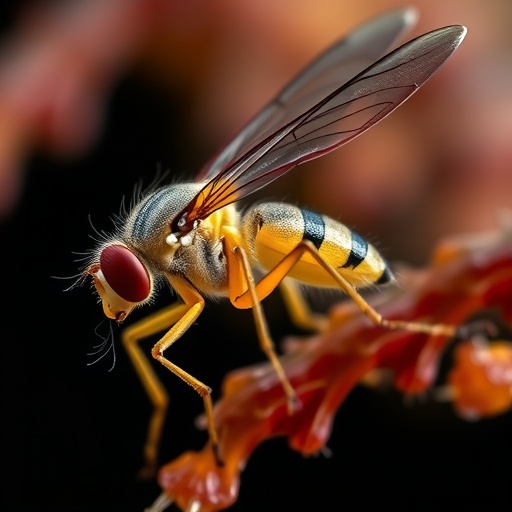
In the relentless pursuit of understanding complex host-pathogen interactions, a pioneering protocol has emerged that positions the fruit fly, Drosophila melanogaster, at the forefront of infectious disease research. This novel approach meticulously simulates Pseudomonas aeruginosa intestinal infections through oral feeding, offering unprecedented insights into epithelial barrier pathogenesis. Building on existing needle-pricking and hemocoel injection methods, the new feeding infection model harnesses the natural ingestive behavior of flies, underscoring the versatility and relevance of Drosophila as a model organism in translational microbiology.
Traditionally, Drosophila has been exploited for its genetic tractability and cost-effectiveness, but inducing host infections has largely relied on invasive techniques such as microinjections. These approaches, while effective for systemic infections, fall short in replicating the intricacies of intestinal colonization and mucosal immunity encountered in clinical scenarios. The transition to a feeding model thus represents a significant leap, allowing researchers to mimic the nuanced steps of bacterial adherence, invasion, and host response within the gut milieu, a critical site of pathogen-host interplay.
The published protocol meticulously outlines the dual preparatory phases: the priming of flies for infection and the culture of bacterial inocula. The latter involves growing P. aeruginosa, a notoriously opportunistic pathogen, to defined concentrations and tailoring the consistency of the infectious mixture. This degree of control is crucial—it enables the modulation of bacterial virulence, a feature that can either exacerbate or abrogate infection outcomes. Such versatility adds layers of experimental finesse, permitting investigations into bacterial load thresholds that can trigger diverse host responses.
Simultaneously, the preparation of adult Drosophila for the feeding assay demands nuanced management of physiological states. Variables such as age, genetic background, and baseline microbiota are carefully standardized, ensuring reproducibility and interpretability of infection phenotypes. This meticulous fly handling culminates in a feeding setup that closely mimics natural exposure routes, facilitating pathogen entry through ingestion, and thereby reflecting infection dynamics more akin to human gastrointestinal encounters with P. aeruginosa.
Outcome assessments post-infection are diverse and extensive, encompassing survival analyses, quantitative bacterial load measurements, systemic spread evaluations, and explorations of intestinal regeneration. These multifaceted readouts furnish a panoramic view of the host-pathogen tug-of-war, revealing insights into virulence factors, host immune defenses, and tissue repair mechanisms. The protocol’s comprehensive design accommodates tens of bacterial species, either singly or in synergy, further broadening its applicability across infectious disease research.
One remarkable feature of this feeding infection protocol lies in its capability to dissect the pathogen’s virulence modulation. The infectious dose’s consistency adjustment essentially allows researchers to dial the infection’s severity, illuminating the thresholds of bacterial pathogenicity and host resilience. This capacity facilitates dissecting not only lethal infection dynamics but also chronic or subclinical manifestations that are critical in understanding persistent infections seen in clinical settings.
The method also pioneers the measurement of bacterial loads within the hemolymph, an analog to the mammalian bloodstream, providing direct evidence of systemic dissemination post-gut infection. This ability to track bacterial translocation from the gut underscores the model’s potential for exploring sepsis and systemic inflammatory responses following breach of epithelial barriers. Coupled with histopathological analyses, particularly in tumor-prone fly lines, researchers gain a granular understanding of intestinal tissue damage, immune cell infiltration, and regenerative responses.
Furthermore, the inclusion of transcriptomic profiling elevates this protocol beyond standard infection assays. By analyzing host gene expression in response to oral P. aeruginosa infection, researchers can decipher molecular pathways triggered during pathogen challenge, delineating immune signaling circuits, stress responses, and metabolic adjustments. This molecular interrogation reveals potential therapeutic targets and host factors critical for defense and tissue homeostasis.
The time frame for preparing flies and bacterial cultures is designed to be efficient yet thorough, spanning a maximum of one week for fly priming and two days for infection mix preparation. This balance ensures high-quality experimental setups without imposing prohibitively long preparative periods, making the protocol accessible to laboratories with standard expertise in microbiology and fly handling. Importantly, the downstream measurements of survival and bacterial load are within reach of researchers after short training, while advanced analyses like histopathology and transcriptomics require a more prolonged commitment to mastery.
Practicality and scalability are hallmarks of this feeding assay, as it accommodates various experimental permutations across multiple infection durations. Typically, studies span up to ten days or continue until all virulent infection-challenged flies succumb. This adaptability facilitates both acute and longer-term infection studies, offering insights across temporal disease progressions. Moreover, the ability to assess bacterial loads and gut physiology within two days per time point streamlines data acquisition without sacrificing depth.
Another layer of sophistication emerges in the protocol’s capacity to introduce co-infections, enabling studies of microbial interactions within the host environment. By allowing simultaneous infection with multiple bacterial species, researchers can explore competitive dynamics, synergy in virulence, or modulation of host immunity by bacterial communities. This complexity mirrors polymicrobial infections encountered in clinical practice, positioning Drosophila as a versatile and relevant proxy for human disease.
The impact of this protocol extends beyond academic curiosity; it directly informs clinical and therapeutic strategies against Pseudomonas aeruginosa, a pathogen infamous for multi-drug resistance and opportunistic infections. By unraveling host-pathogen dialogue in a genetically tractable and experimentally amenable organism, the feeding infection model accelerates discovery of novel antimicrobial targets and host-centric therapies that enhance barrier integrity and immune defense.
Importantly, this approach ushers in refined ethical research practices by reducing the reliance on mammalian models in early infection studies. The Drosophila feeding infection protocol exemplifies the principles of reduction and refinement, providing robust mechanistic insights while adhering to high standards of animal welfare. As a result, it holds promise to reshape infection biology research paradigms, marrying scientific rigor with ethical responsibility.
Incorporating both classical microbiological expertise and modern molecular techniques, the protocol stands out as a comprehensive framework for dissecting the multifactorial nature of gut infections. Its design anticipates variabilities inherent to both host and pathogen, offering researchers a powerful tool to dissect complex infection biology with fine resolution.
Ultimately, this groundbreaking protocol invites the scientific community to harness the power of simplicity and innovation through Drosophila. By faithfully recapitulating Pseudomonas aeruginosa intestinal infection via feeding, it opens avenues for discoveries that transcend model boundaries, illuminating pathways toward mitigating the burden of infectious diseases in humans.
Subject of Research: Drosophila melanogaster as a model organism for studying intestinal infections caused by Pseudomonas aeruginosa.
Article Title: Drosophila melanogaster as a model host for studying Pseudomonas aeruginosa feeding infection.
Article References:
Pitsouli, C., Apidianakis, Y. Drosophila melanogaster as a model host for studying Pseudomonas aeruginosa feeding infection. Nat Protoc (2026). https://doi.org/10.1038/s41596-025-01311-z
Image Credits: AI Generated
DOI: https://doi.org/10.1038/s41596-025-01311-z
Tags: bacterial colonization in DrosophilaDrosophila melanogaster infection modelepithelial barrier pathogenesisgenetic tractability of Drosophilahost-pathogen interactions in gutintestinal host response mechanismsmucosal immunity in fruit fliesnon-invasive infection methodsopportunistic pathogen researchoral feeding infection protocolPseudomonas aeruginosa intestinal infectiontranslational microbiology models