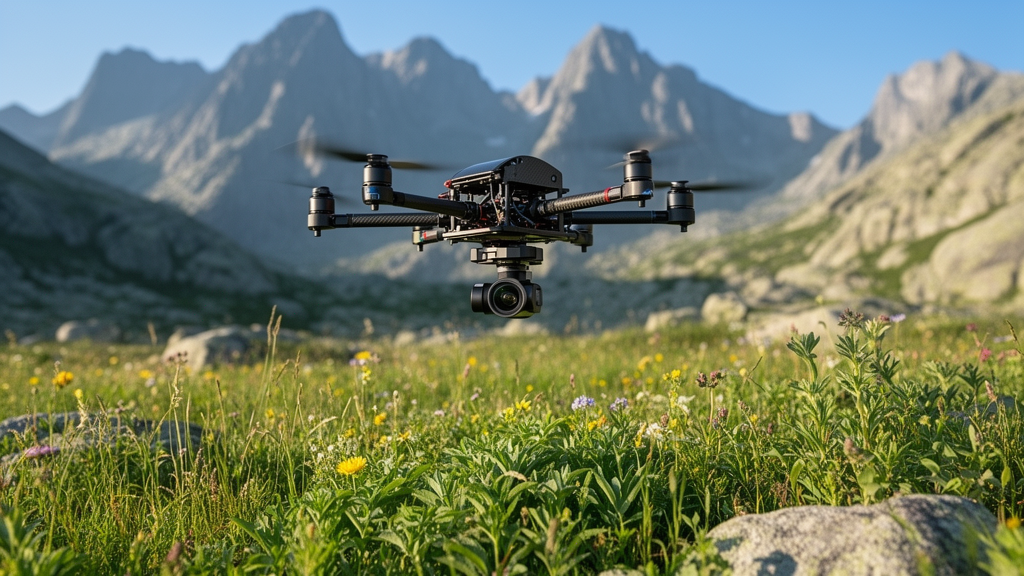
Agricultural scientists evaluating cultivated grasslands across the high-elevation Tibetan Plateau have demonstrated that low-altitude drone imagery can quantify critical canopy nutrients in forage crops, although predictive accuracy varies markedly depending on plant species and chemical elements. Conducting synchronized aerial surveys and ground sampling across alpine agro-pastoral ecotones, researchers deployed multispectral sensors aboard unmanned aerial vehicles to estimate concentrations of aboveground organic carbon, total nitrogen, and total phosphorus in maize, alfalfa, and oat. The investigation revealed that remote sensing performance was not uniformly distributed across crops or biochemical targets. High estimation accuracies were achieved for maize organic carbon, alfalfa total nitrogen, alfalfa total phosphorus, and oat total nitrogen, whereas predictions for alfalfa organic carbon, maize total nitrogen, and oat total phosphorus exhibited substantial statistical constraints. By systematically testing spectral bands, spatial textural features, and fused analytical frameworks across ten distinct machine learning algorithms and an ensemble integration, the findings illuminate how structural differences in plant canopies govern the quality of information captured from the air.
The study addresses a pivotal operational bottleneck in modern livestock production, where the sustainable intensification of cultivated forages has become essential for meeting expanding nutritional demands for meat, milk, and fiber. In fragile alpine regions such as Tibet, traditional pasture management is steadily transitioning toward high-yielding forage cropping systems that demand rigorous precision nutrient management. Farm managers require timely, spatially continuous intelligence regarding crop nutritional status to schedule optimal harvest windows, formulate livestock rations, and guide balanced fertilizer applications. Historically, monitoring aboveground organic carbon, total nitrogen, and total phosphorus required destructive field harvesting followed by laborious laboratory chemical assays. These conventional testing workflows are financially demanding, slow, and incapable of mapping fine-scale spatial variability across extensive fields. Although previous remote sensing studies demonstrated the utility of aerial multispectral platforms for nitrogen mapping in single staple cereals such as wheat, rice, and corn, substantial empirical uncertainties persisted regarding whether these aerial diagnostic models could perform reliably across morphologically diverse forage species and multiple essential nutrient pools simultaneously.
To rigorously resolve these questions under demanding environmental conditions, the research team conducted controlled field campaigns during the 2026 summer growing season within the Lhasa and Shannan prefectures of the Tibet Autonomous Region in southwestern China. The experimental sites were established at high elevations, with the Lhasa sampling plots situated near the Chinese Academy of Sciences Lhasa Plateau Ecosystem Research Station in Dagze District at roughly 3,752 meters above sea level, while Shannan plots were located in Naidong District at an elevation of approximately 3,610 meters. The study selected three forage species displaying contrasting physiological and morphological traits: Tieyan 53 maize, an annual broad-leaved grass employing C4 photosynthesis; Zhonglan 2 alfalfa, a perennial legume with compound foliage and symbiotic nitrogen-fixing capabilities; and Qinghai 444 oat, an annual C3 cereal grass characterized by narrow, drooping leaves. Within these high-altitude trial plots, the team established precisely delimited 3-meter by 3-meter quadrats assigned unique identifiers to guarantee exact spatial alignment between ground-truth chemical analyses and aerial image pixels.
Aerial imagery was gathered on June 30, 2026, using an unmanned aerial vehicle platform equipped with a five-band multispectral camera capturing blue, green, red, red edge, and near-infrared wavelengths. Flights were conducted around solar noon under clear, cloud-free atmospheric conditions at an operational altitude of 28.70 meters and a flight velocity of 3.00 meters per second. The flight plan maintained 80 percent forward overlap and 75 percent lateral side overlap, yielding an ultra-high ground spatial resolution of approximately 1.50 centimeters per pixel. Radiometric calibration panels were measured on site to ensure stable reflectance values, and raw scene data were geometrically and radiometrically corrected in DJI Terra software to assemble orthomosaics projected to the regional UTM coordinate system. Immediately following the drone flights, field crews harvested all aboveground plant biomass within every quadrat at ground level. Samples were transported to the laboratory and oven-dried at 68 degrees Celsius for 48 hours until reaching constant mass before being ground in a ball mill through a 100-mesh sieve for rigorous chemical quantification.
Analytical chemical protocols ensured strict quality control across all experimental samples, utilizing certified citrus leaf matrix reference standards, processing blank controls, and maintaining parallel replicate deviations within 5 percent. Organic carbon concentrations were measured through potassium dichromate and sulfuric acid wet oxidation under controlled oil-bath heating followed by ferrous sulfate titration. Total nitrogen was determined through automated Kjeldahl distillation after sulfuric acid and hydrogen peroxide digestion, while total phosphorus was quantified spectrophotometrically using the molybdenum antimony ascorbic acid colorimetric method. The resulting ground-truth dataset encompassed 147 maize samples for carbon and 100 each for nitrogen and phosphorus; 100 alfalfa samples for carbon, 223 for nitrogen, and 169 for phosphorus; and 100 oat samples for carbon, 118 for nitrogen, and 100 for phosphorus. When dry matter elemental distributions were compiled, the species exhibited pronounced biochemical divergence. Maize exhibited a wide organic carbon concentration range spanning from 21.84 to 39.71 percent with a coefficient of variation of 16.68 percent, whereas alfalfa and oat exhibited tightly clustered carbon concentrations averaging 36.22 and 37.15 percent with low variation coefficients of roughly 2.5 percent.
To evaluate the predictive utility of airborne data, the researchers extracted 31 candidate spectral features per quadrat, encompassing the five calibrated multispectral reflectance bands and 26 published vegetation indices designed to capture plant pigment dynamics and vegetative vigour. Concurrently, they computed 160 spatial textural features using gray-level co-occurrence matrix algorithms applied to each multispectral band across four nominal window scales ranging from 10 to 80 centimeters. These metrics calculated statistical distributions of canopy brightness, including spatial mean, variance, homogeneity, contrast, dissimilarity, entropy, angular second moment, and correlation. The modeling framework compared three distinct information modes: a purely spectral mode, a purely textural mode, and a combined fused mode. Analytical workflows deployed ten distinct machine learning algorithms—ranging from random forests, gradient boosting, and support vector machines to artificial neural networks and penalized regressions—alongside a non-negative least squares ensemble. Model validation relied on a rigorous three-times-repeated five-fold outer cross-validation design, partitioning data into training, development, internal selection, and independent test subsets to avoid optimistic selection bias.
The predictive outcomes revealed that remote sensing performance was highly dependent on the specific nutrient and plant species evaluated. For aboveground organic carbon, the maize model demonstrated the highest predictive power, achieving a mean cross-validation coefficient of determination of 0.81, a root mean square error of 2.33 percentage points, and a mean absolute relative error of 6.22 percent. In stark contrast, aerial estimation of alfalfa carbon proved challenging, recording an explanatory coefficient of determination of only 0.20, while oat carbon reached an intermediate coefficient of determination of 0.53. In nitrogen estimation, alfalfa models performed exceptionally well with an average coefficient of determination of 0.78, accompanied by oat nitrogen models achieving a coefficient of determination of 0.75 and a low mean absolute relative error of 4.27 percent. Conversely, maize nitrogen retrieval struggled, yielding a coefficient of determination of just 0.33. Phosphorus models also exhibited distinct interspecific divergence, where alfalfa achieved a high coefficient of determination of 0.77 but showed a relative error of 10.76 percent, while maize achieved a coefficient of determination of 0.67 and oat recorded 0.38.
A critical statistical finding from the comparative feature evaluations was that the non-negative least squares ensemble was selected in 21 out of 135 outer training configurations, with individual base algorithms outperforming the ensemble in the remaining 114 instances. Furthermore, while descriptive rankings showed subtle performance differences among spectral, textural, and fused inputs across tasks, none of the 27 pairwise comparisons among feature modes achieved statistical significance after applying Holm correction for multiple testing. Variable importance analyses demonstrated that the optimal information domain differed across botanical architectures. Maize models drew primarily upon visible reflectance bands and vegetation indices, with the blue band serving as a primary predictor for organic carbon. For alfalfa, red-edge correlation textures and near-infrared metrics were heavily prioritized during nutrient modeling.
The authors explain that these predictive patterns reflect fundamental biophysical interactions governed by plant canopy architecture, which regulates light penetration and canopy radiative transfer as formalized in classic optical models. In broad-leaved crops such as maize, aboveground carbon reflects a fluctuating composite of thick, fibrous stalks and leafy foliage, creating a wide natural concentration gradient that machine learning algorithms can exploit effectively, even though thick stems dilute the visible leaf nitrogen signal and induce spectral saturation. In alfalfa, flat compound leaflets present a relatively open canopy structure with high chlorophyll concentrations, enabling direct spectral reflectance to capture leaf nitrogen and phosphorus dynamics with minimal structural interference. In contrast, oat canopies form dense, overlapping structural layers with narrow, drooping leaves that quickly cause top-of-canopy spectral reflectance to saturate. Under such high canopy closure, spatial textural metrics provide crucial surrogate information by capturing micro-scale shadow heterogeneity, leaf inclination, and stem crowding that spectral bands alone cannot distinguish.
While confirming the viability of low-altitude agricultural remote sensing in alpine environments, the researchers identified clear operational constraints that govern practical farm implementation. Across all evaluated prediction tasks, linear calibration slopes between observed and predicted values remained below 1.0, ranging from 0.37 to 0.82. This systematic slope compression demonstrates an inherent tendency of these machine learning configurations to overestimate low nutrient concentrations while underestimating high concentrations near extreme physiological thresholds. Furthermore, because sampling occurred during a single 2026 growing season within two Tibetan valleys, the authors emphasize that multi-year observations across diverse soil regimes, climate gradients, and phenological stages will be necessary before deploying fixed algorithms across broader agricultural regions. Incorporating shortwave infrared sensors to track structural lignin and cellulose, alongside developing autonomous drone trajectory algorithms to conserve battery life at high altitudes, represents the next critical frontier for translating airborne remote sensing into robust, daily decision tools for livestock producers.
Subject of Research: UAV multispectral remote sensing for forage crop nutrient estimation in alpine agro-ecosystems
Article Title: A UAV-based spectral and textural retrieval framework for estimating aboveground carbon, nitrogen, and phosphorus concentrations in forage crops: species- and element-specific feature-mode performance
Article References: Ding, R., Zhao, C., & Fu, G. (2026). A UAV-based spectral and textural retrieval framework for estimating aboveground carbon, nitrogen, and phosphorus concentrations in forage crops: species- and element-specific feature-mode performance. Smart Agricultural Technology, 15, Article 102705. https://doi.org/10.1016/j.atech.2026.102705
Image Credits: AI Generated
DOI: 10.1016/j.atech.2026.102705
Keywords: unmanned aerial vehicles, multispectral imagery, forage crops, precision agriculture, canopy architecture, vegetation indices, gray-level co-occurrence matrix, organic carbon, total nitrogen, total phosphorus, machine learning, non-negative least squares, Tibet Autonomous Region, Zea mays, Medicago sativa, Avena sativa, radiative transfer, crop nutritional status
News Source: Alan Morgan. (November 12, 2026). Drones Track Alpine Forage Nutrients with Species-Specific Accuracy. Scienmag.