• HOME
  • NEWS
  • EXPLORE
    • CAREER
      • Companies
      • Jobs
    • EVENTS
    • iGEM
      • News
      • Team
    • PHOTOS
    • VIDEO
    • WIKI
  • BLOG
  • COMMUNITY
    • FACEBOOK
    • INSTAGRAM
    • TWITTER
Saturday, February 7, 2026
BIOENGINEER.ORG
No Result
View All Result
  • Login
  • HOME
  • NEWS
  • EXPLORE
    • CAREER
      • Companies
      • Jobs
        • Lecturer
        • PhD Studentship
        • Postdoc
        • Research Assistant
    • EVENTS
    • iGEM
      • News
      • Team
    • PHOTOS
    • VIDEO
    • WIKI
  • BLOG
  • COMMUNITY
    • FACEBOOK
    • INSTAGRAM
    • TWITTER
  • HOME
  • NEWS
  • EXPLORE
    • CAREER
      • Companies
      • Jobs
        • Lecturer
        • PhD Studentship
        • Postdoc
        • Research Assistant
    • EVENTS
    • iGEM
      • News
      • Team
    • PHOTOS
    • VIDEO
    • WIKI
  • BLOG
  • COMMUNITY
    • FACEBOOK
    • INSTAGRAM
    • TWITTER
No Result
View All Result
Bioengineer.org
No Result
View All Result
Home NEWS Science News Chemistry

Dresden physicists develop printable organic transistors

Bioengineer by Bioengineer
September 22, 2020
in Chemistry
Reading Time: 2 mins read
0
IMAGE
Share on FacebookShare on TwitterShare on LinkedinShare on RedditShare on Telegram

IMAGE

Credit: Copyright: IAPP

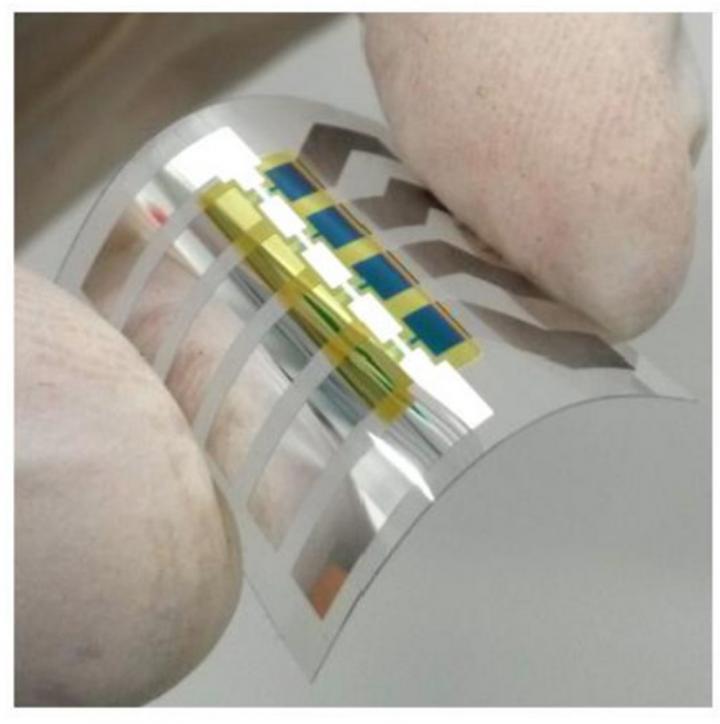
High-definition roll-up televisions or foldable smartphones may soon no longer be unaffordable luxury goods that can be admired at international electronics trade fairs. High-performance organic transistors are a key necessity for the mechanically flexible electronic circuits required for these applications. However, conventional horizontal organic thin-film transistors are very slow due to the hopping-transport in organic semiconductors, so they cannot be used for applications requiring high frequencies. Especially for logic circuits with low power consumption, such as those used for Radio Frequency Identification (RFID), it is mandatory to develop transistors enabling high operation frequency as well as adjustable device characteristics (i.e., threshold-voltage). The research group Organic Devices and Systems (ODS) at the Dresden Integrated Center for Applied Photophysics (IAPP) of the Institute of Applied Physics headed by Dr. Hans Kleemann has now succeeded in realizing such novel organic devices.

„Up to now, vertical organic transistors have been seen as lab curiosities which were thought too difficult to be integrated in an electronic circuit. However, as shown in our publication, vertical organic transistors with two independent control electrodes are perfectly suited to realize complex logic circuits while keeping the main benefit of vertical transistors devices, namely the high switching frequency”, says Dr. Hans Kleemann.

The vertical organic transistors with two independent control electrodes are characterized by a high switching frequency (a few nanoseconds) and an adjustable threshold voltage. Thanks to these developments, even single transistors can be used to represent different logical states (AND, NOT, NAND). Furthermore, the adjustable threshold voltage ensures signal integrity (noise margin) and low power consumption.

With this, the research group has set a milestone with regard to the vision of flexible and printable electronics. In the future, these transistors could make it possible to realize even sophisticated electronic functions such as wireless communication (RFID) or high-resolution flexible displays completely with organic components, thus completely dispensing with silicon-based electronic components.

###

Media Contact
Dr. Hans Kleemann
[email protected]

Related Journal Article

http://dx.doi.org/10.1038/s41467-020-18576-5

Tags: Chemistry/Physics/Materials Sciences
Share12Tweet8Share2ShareShareShare2

Related Posts

blank

Breakthrough in Environmental Cleanup: Scientists Develop Solar-Activated Biochar for Faster Remediation

February 7, 2026
blank

Cutting Costs: Making Hydrogen Fuel Cells More Affordable

February 6, 2026

Scientists Develop Hand-Held “Levitating” Time Crystals

February 6, 2026

Observing a Key Green-Energy Catalyst Dissolve Atom by Atom

February 6, 2026
Please login to join discussion

POPULAR NEWS

  • Robotic Ureteral Reconstruction: A Novel Approach

    Robotic Ureteral Reconstruction: A Novel Approach

    82 shares
    Share 33 Tweet 21
  • Digital Privacy: Health Data Control in Incarceration

    63 shares
    Share 25 Tweet 16
  • Study Reveals Lipid Accumulation in ME/CFS Cells

    57 shares
    Share 23 Tweet 14
  • Breakthrough in RNA Research Accelerates Medical Innovations Timeline

    53 shares
    Share 21 Tweet 13

About

We bring you the latest biotechnology news from best research centers and universities around the world. Check our website.

Follow us

Recent News

Palmitoylation of Tfr1 Drives Platelet Ferroptosis and Exacerbates Liver Damage in Heat Stroke

Oxygen-Enhanced Dual-Section Microneedle Patch Improves Drug Delivery and Boosts Photodynamic and Anti-Inflammatory Treatment for Psoriasis

Scientists Identify SARS-CoV-2 PLpro and RIPK1 Inhibitors Showing Potent Synergistic Antiviral Effects in Mouse COVID-19 Model

Subscribe to Blog via Email

Enter your email address to subscribe to this blog and receive notifications of new posts by email.

Join 73 other subscribers
  • Contact Us

Bioengineer.org © Copyright 2023 All Rights Reserved.

Welcome Back!

Login to your account below

Forgotten Password?

Retrieve your password

Please enter your username or email address to reset your password.

Log In
No Result
View All Result
  • Homepages
    • Home Page 1
    • Home Page 2
  • News
  • National
  • Business
  • Health
  • Lifestyle
  • Science

Bioengineer.org © Copyright 2023 All Rights Reserved.