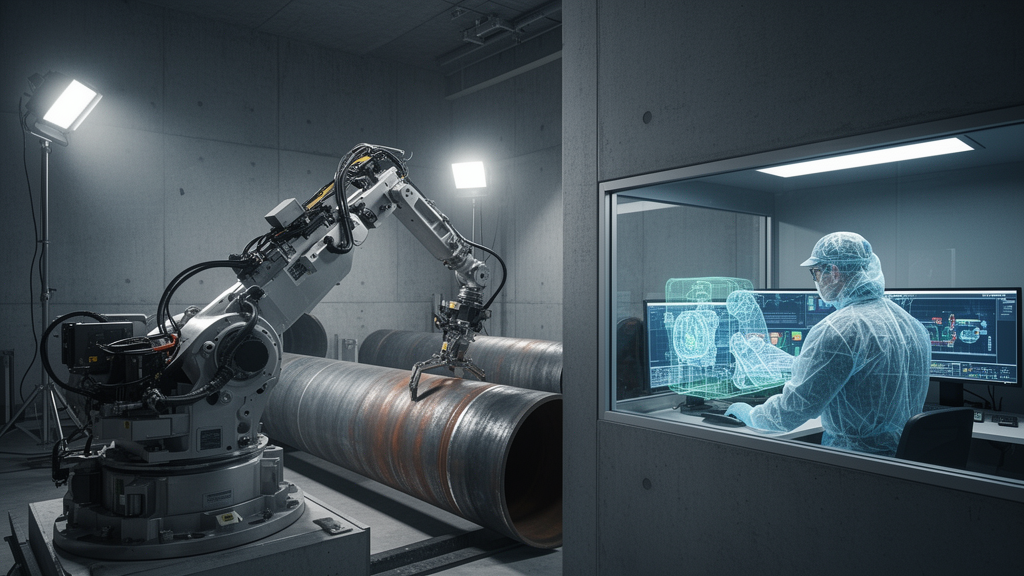
Nuclear decommissioning operations across the United States and Europe face growing technical complexity as aging commercial reactors reach the end of their design lifetimes without original structural provisions for dismantling. In response to these operational constraints, an international consortium funded by the Euratom research program has introduced the DORADO framework, an integrated digital architecture uniting Building Information Modelling, real-time digital twins, robotic systems, and domain ontologies. Detailed in Frontiers in Nuclear Engineering, the project seeks to establish a standardized data-driven environment capable of orchestrating complex decommissioning activities while curbing collective ionizing radiation exposure. Rather than treating physical demolition and radiological surveys as isolated manual tasks, the platform establishes continuous bidirectional links between physical plant components and virtual computational replicas.
The scale of the nuclear decommissioning challenge stems directly from the historical construction timeline of global reactor fleets, where facilities built decades ago were rarely engineered for automated clearance or structural deconstruction. Decommissioning projects combine the physical demolition hurdles of conventional civil infrastructure with strict radiological protection mandates, radioactive waste segregation protocols, and hazardous remote manipulation requirements. In conventional nuclear site handling, planning models frequently diverge from actual field arrangements due to undocumented physical modifications, inaccurate legacy blueprints, or progressive dismantling interventions. By integrating digital twin technologies previously proven in industrial manufacturing and architecture, the DORADO framework provides a structured pathway to reduce operational errors, limit human presence in contaminated areas, and maintain complete digital traceability across decades-long remediation lifecycles.
At the center of the DORADO technological implementation is a dedicated nuclear decommissioning ontology designed to resolve the historical fragmentation of proprietary nuclear software databases. Earlier industry workflows relied on closed internal data structures, preventing cross-platform data exchange among operators, contractors, and safety regulators. Building upon foundational data models established during the earlier Euratom PLEIADES initiative, DORADO harmonizes metadata taxonomies from the International Atomic Energy Agency and the European Commission Joint Research Centre. This common semantic layer connects directly to international knowledge bases such as the International Nuclear Information System and the IAEA Nuclear Wiki. Operating at an estimated technology readiness level of five and targeting technology readiness level seven, this shared ontology allows artificial intelligence algorithms to execute transparent, explainable inferences over heterogeneous physical, geometric, and radiological datasets.
Physical data acquisition within hazardous facility compartments relies on heterogeneous robotic platforms, including agile quadruped machines and high-payload wheeled rovers equipped with synchronized sensing packages. Wheeled robots provide spatial stability and carrying capacity for heavy radiometric instruments, whereas quadruped systems traverse degraded concrete staircases, uneven debris fields, and narrow access corridors. The onboard payload arrays incorporate light detection and ranging sensors, depth-sensing color cameras, thermal imagers, and gamma-spectrometry detectors. Because different sensing instruments often operate on isolated clock cycles and disparate spatial frames, DORADO introduces multimodal sensor-data fusion algorithms that register LiDAR points, visual features, and radiometric measurements into a single unified temporal and coordinate frame. For handheld or body-worn inspection cameras lacking direct laser positioning, server-side algorithms register incoming color images directly against master environmental point clouds via representational state transfer application programming interfaces.
Simultaneous localization and mapping systems maintain the spatial trajectory of autonomous platforms through changing radiation zones, providing the local positional references necessary to anchor environmental scans to global facility coordinates. In facilities where reliable reference drawings no longer exist, robotic agents construct fresh metric spatial maps before registering their paths into the overarching building information model. To mitigate the risk of localization drift caused by repetitive concrete geometry, low-texture surfaces, suspended dust particles, and metallic glare, the DORADO workflow incorporates real-time tracking confidence metrics. Whenever calculated spatial confidence drops beneath pre-established quality thresholds, the software enforces relocalisation routines or pauses execution until remote human supervisors verify the environmental position, preventing corrupted positional data from polluting the shared digital twin.
Radiation protection planning within the platform is governed by an adaptive dose-estimation module designed to replace static manual calculation sheets with dynamic ALARA modeling. Developed through the integration of the VRdose platform from Norway’s Institute for Energy Technology and the ANUBIS planning system from Belgium’s SCK CEN research center, the system simulates three-dimensional radiation transport through fluctuating shielding geometries. Machine learning components track and forecast changes in radioactive source distributions as concrete biological shields and contaminated piping circuits undergo mechanical cutting. While earlier published literature demonstrated the mathematical feasibility of CAD-based point-kernel dose models, DORADO couples real-time radiometric field feedback with predictive source-term updates, allowing radiation protection officers to simulate worker transit routes and optimize shielding configurations before technicians enter controlled zones.
Structural clearance and progress monitoring depend on semi-automated point-cloud change detection algorithms that compare sequential three-dimensional laser scans against reference digital models. In current demolition practice, verifying component dismantling relies on labor-intensive manual inspections that expose surveyors to ambient radiation fields. DORADO automates these analytical pipelines by deploying artificial intelligence to detect geometric discrepancies, flag component removals, and generate tolerance-based analytical heatmaps. Scan-to-BIM reconstruction pipelines convert raw point collections into editable parametric primitives such as cylindrical pipes and planar walls, which are subsequently structured under the Industry Foundation Classes schema. By targeting technology readiness level eight, this module minimizes manual geometric drafting, triggering supervisory alerts only when automated segmentation algorithms encounter low point density or severe visual occlusions.
Field communication in contaminated enclosures is reinforced by a specialized industrial voice-assistant interface developed by Spix Industries, designed to function reliably while technicians wear full respiratory protection and protective suits. Generic commercial speech-recognition systems regularly fail in nuclear containment zones due to acoustic echoes, respirator air flow, background noise, and specialized technical vocabularies. DORADO overcomes these operational hurdles by coupling the speech-recognition engine directly to the plant ontology and building information models, combining verbal reports with optical character recognition and local spatial coordinates. Field operators can hands-free log equipment anomalies, report discrepancies between physical installations and digital models, and document safety deviations, thereby improving immediate data capture without compromising protective equipment seals.
Coordinating multiple autonomous machines in volatile industrial spaces requires advanced mission control and route-optimization software that accounts for dynamic environmental hazards. Rather than dispatching robots via preprogrammed coordinates, DORADO uses its semantic ontology to assess the specific functional capabilities, battery endurance, dimensions, and payload capacities of available ground platforms. The software balances robotic assignments against ambient radiation fields, mission priorities, and real-time personnel locations to prevent human-robot interference. Operators define top-level inspection goals within an interactive building information model interface, while automated planners compute collision-free, dose-minimized transit paths, enabling coordinated multi-robot inspections across complex multi-room nuclear facilities.
Platform validation is structured around four comprehensive demonstration use cases utilizing empirical datasets from operational and decommissioned nuclear facilities across Europe. Field sites include the Halden Research Reactor in Norway, the dismantled FiR 1 research reactor in Finland, the BR3 pressurized water reactor in Belgium, and the Ignalina Nuclear Power Plant in Lithuania. Historical radiological characterizations from Halden provide baseline data for evaluating remote survey accuracy, while post-dismantling datasets from FiR 1 supply validation material for point-cloud change detection and sensor fusion. The Ignalina plant contributes vital high-dose-rate measurement campaigns necessary for validating automated route planning under severe radiation conditions, while automated waste-drum inspection scenarios demonstrate the robotic detection of anomalous activity profiles against stored legacy inventories.
Despite promising component demonstrations, the researchers emphasize that significant operational limitations must be addressed before the integrated architecture can be deployed commercially. Decommissioning environments are fundamentally unstable, characterized by progressive structural removal, evolving radiological hotspots, and missing historical engineering records. Data corruptions or misclassifications in point-cloud processing risk propagating into building information models, potentially distorting calculated radiation doses or causing mission planning errors. Consequently, the authors conclude that DORADO functions strictly as an advanced decision-support architecture rather than a fully autonomous system, requiring systematic human oversight, stringent ISO-compliant cybersecurity controls, and extensive multi-site field trials to verify its long-term reliability.
Subject of Research: Digital twin and robotics integration platform for nuclear decommissioning operations
Article Title: Applying digital twins and ontology to robot-assisted decommissioning operations: the Euratom project DORADO
Article References: Räty, A., Honkamaa, P., Ridao, J., Zahra, O., Benkrid, A., & Daniska, D. (2026). Applying digital twins and ontology to robot-assisted decommissioning operations: the Euratom project DORADO. Frontiers in Nuclear Engineering, 5, Article 1920600. https://doi.org/10.3389/fnuen.2026.1920600
Image Credits: AI Generated
DOI: 10.3389/fnuen.2026.1920600
Keywords: nuclear decommissioning, digital twins, robotics, building information modelling, sensor-data fusion, DORADO project, Euratom, ALARA dose estimation, point clouds, change detection, nuclear ontology, radiological characterisation, autonomous mission planning, voice-assisted reporting, IFC schema, radiation protection, nuclear engineering
News Source: Denise Maddox. (November 20, 2026). DORADO Framework Combines Digital Twins and Robotics for Nuclear Decommissioning Operations. Scienmag.