• HOME
  • NEWS
  • EXPLORE
    • CAREER
      • Companies
      • Jobs
    • EVENTS
    • iGEM
      • News
      • Team
    • PHOTOS
    • VIDEO
    • WIKI
  • BLOG
  • COMMUNITY
    • FACEBOOK
    • INSTAGRAM
    • TWITTER
Thursday, December 4, 2025
BIOENGINEER.ORG
No Result
View All Result
  • Login
  • HOME
  • NEWS
  • EXPLORE
    • CAREER
      • Companies
      • Jobs
        • Lecturer
        • PhD Studentship
        • Postdoc
        • Research Assistant
    • EVENTS
    • iGEM
      • News
      • Team
    • PHOTOS
    • VIDEO
    • WIKI
  • BLOG
  • COMMUNITY
    • FACEBOOK
    • INSTAGRAM
    • TWITTER
  • HOME
  • NEWS
  • EXPLORE
    • CAREER
      • Companies
      • Jobs
        • Lecturer
        • PhD Studentship
        • Postdoc
        • Research Assistant
    • EVENTS
    • iGEM
      • News
      • Team
    • PHOTOS
    • VIDEO
    • WIKI
  • BLOG
  • COMMUNITY
    • FACEBOOK
    • INSTAGRAM
    • TWITTER
No Result
View All Result
Bioengineer.org
No Result
View All Result
Home NEWS Science News Biology

Dodder genome sequencing sheds light on evolution of plant parasitism

Bioengineer by Bioengineer
July 11, 2018
in Biology
Reading Time: 2 mins read
0
Share on FacebookShare on TwitterShare on LinkedinShare on RedditShare on Telegram
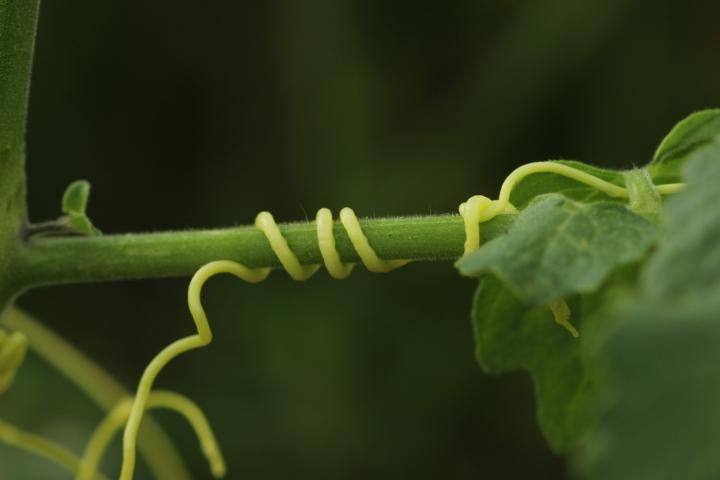
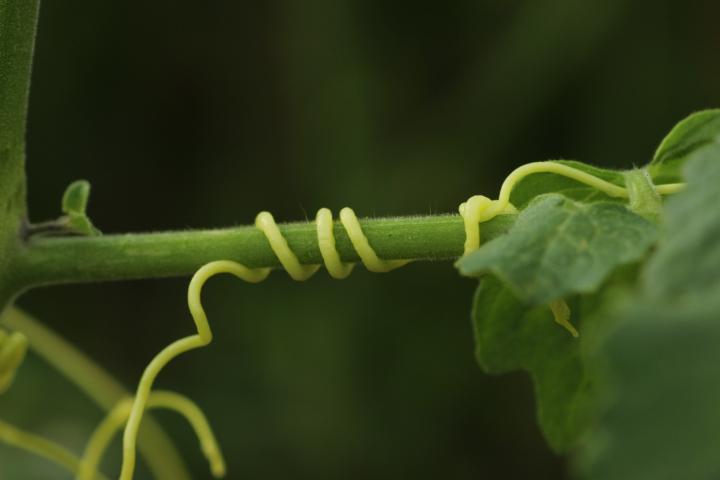
IMAGE

Credit: XU Yuxing

Most plants absorb sunlight and CO2 with their leaves, take up water and minerals from the soil through roots, and are fully autotrophic. However, parasitic plants are a special class of plants that extract water and nutrients from other plants.

The origin and evolution of plant parasitism as well as the specific physiology and ecology of parasitic plants are very interesting topics and much remains to be studied.

Dodders (Cuscuta spp., Convolvulaceae) are globally distributed holoparasites (i.e., they conduct no or very little photosynthesis), and they are root- and leafless. In recent years, dodders have become an important model for studying parasitic plants (Figure).

To gain insight into the evolution of dodders, and provide important resources for studying the physiology and ecology of parasitic plants, the laboratory of Dr. WU Jianqiang from the Kunming Institute of Botany, Chinese Academy of Sciences, combined PacBio sequencing and Illumina transcriptome sequencing technology to obtain a high-quality genome of the dodder Cuscuta australis.

WU's lab further performed comparative genomic and molecular evolutionary analyses on the C. australis genome. The researchers detected an intriguing pattern of genome evolution in this parasite.

Using genome-wide phylogenetic analysis and synteny information, they found that the ancestor of Cuscuta split from the common ancestor of Cuscuta and Ipomoea 750 million years ago and the common ancestor experienced a genome triplication event. The Cuscuta genome then rapidly evolved and many genes were lost during evolution.

The scientists developed a strict and precise bioinformatic pipeline to screen for the lost genes in the C. australis genome. They found that about 11.7% of the well-conserved genes in autotrophic plants do not exist in the C. australis genome, and many of the missing genes are important for photosynthesis, functions of root and leaf, resistance to environmental stresses, and regulation of transcription.

Interestingly, several genes critical for flowering time control are also missing, such as FLC, FRI, SVP, AGL17, and CO. The gene loss is correlated with the major body plan changes in the dodder.

The scientists also studied possible genes related to the evolution of the haustorium, a parasite-specific organ. They found that about 1/3 of highly expressed genes in the haustorium are also strongly expressed in the roots of autotrophic plants.

Evidence from transcriptomic data, positive selection, and gene families with expanded members indicate that a number of genes are possibly involved in haustorium formation, including a pectin esterase, a serine carboxypeptidase, and transporters, as well as novel genes with unknown functions.

###

This study, entitled "Large-scale gene losses underlie the genome evolution of parasitic plant Cuscuta australis," was published in Nature Communications.

Media Contact

YANG Mei
[email protected]

http://english.cas.cn/

Original Source

http://english.kib.cas.cn/rh/rp/201807/t20180710_194977.html http://dx.doi.org/10.1038/s41467-018-04721-8

Share15Tweet8Share2ShareShareShare2

Related Posts

blank

Rice miRNA: Key Regulator in Fungal Interactions

December 3, 2025
Human Impact Alters Leopard and Ungulate Dynamics

Human Impact Alters Leopard and Ungulate Dynamics

December 3, 2025

Adaptive Microsatellite Variants in Indian Yak Populations

December 2, 2025

Guide to Single-Cell RNA Transcriptomics Unveiled

December 2, 2025
Please login to join discussion

POPULAR NEWS

  • New Research Unveils the Pathway for CEOs to Achieve Social Media Stardom

    New Research Unveils the Pathway for CEOs to Achieve Social Media Stardom

    204 shares
    Share 82 Tweet 51
  • Scientists Uncover Chameleon’s Telephone-Cord-Like Optic Nerves, A Feature Missed by Aristotle and Newton

    120 shares
    Share 48 Tweet 30
  • Neurological Impacts of COVID and MIS-C in Children

    107 shares
    Share 43 Tweet 27
  • MoCK2 Kinase Shapes Mitochondrial Dynamics in Rice Fungal Pathogen

    69 shares
    Share 28 Tweet 17

About

We bring you the latest biotechnology news from best research centers and universities around the world. Check our website.

Follow us

Recent News

Boosting Cancer Immunotherapy by Targeting DNA Repair

Evaluating eGFR Equations in Chinese Children

Metformin-Alogliptin Combo vs. Monotherapy in Diabetes

Subscribe to Blog via Email

Success! An email was just sent to confirm your subscription. Please find the email now and click 'Confirm' to start subscribing.

Join 69 other subscribers
  • Contact Us

Bioengineer.org © Copyright 2023 All Rights Reserved.

Welcome Back!

Login to your account below

Forgotten Password?

Retrieve your password

Please enter your username or email address to reset your password.

Log In
No Result
View All Result
  • Homepages
    • Home Page 1
    • Home Page 2
  • News
  • National
  • Business
  • Health
  • Lifestyle
  • Science

Bioengineer.org © Copyright 2023 All Rights Reserved.