


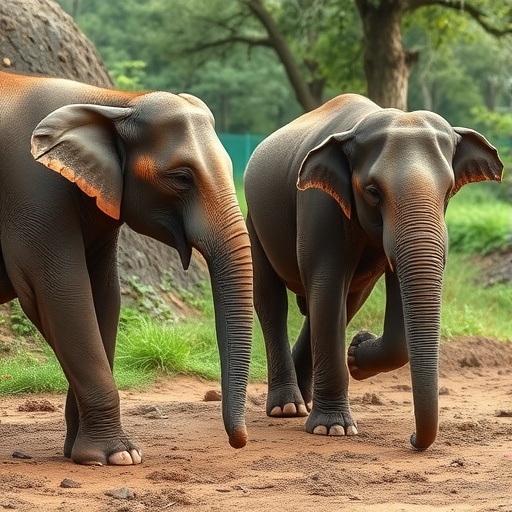
In an extraordinary exploration of animal cognition, recent research delves into the complex world of Asian elephants and their remarkable ability to anticipate mutually exclusive outcomes. This groundbreaking study suggests that these majestic creatures not only navigate their environments with a sophisticated level of planning but also exhibit cognitive capabilities that challenge previously held assumptions about animal intelligence. The research sheds light on the intricacies of decision-making processes in non-human species, particularly in a context where moral and social implications emerge.
The study, led by a team of researchers including S.F. Hope, S. Dittakul, and M. Yindee, aims to uncover whether Asian elephants have the capacity to plan for outcomes that are mutually exclusive—that is, anticipating different scenarios and making choices that might affect their social dynamics and resource allocations. This work builds on a growing body of evidence suggesting that elephants possess advanced cognitive skills previously unseen in the animal kingdom.
Utilizing a carefully designed experimental setup, the research team observed the behaviors of elephants in controlled environments where they were faced with tasks that required choice-making. The experiments were crafted to provoke a unique cognitive challenge, prompting the elephants to demonstrate foresight in their behavioral strategies. A series of trials unveiled the animals’ ability to recognize the consequences of their actions and to evaluate different potential outcomes before committing to a course of action.
The findings of this study are not merely academic; they hold significant implications for our understanding of animal behavior and intelligence. The ability to plan for mutually exclusive outcomes is a hallmark of complex cognitive functioning that has, until recently, been thought to be predominantly human. This research opens the door to new perspectives on how we assess intelligence across species, particularly in social animals like elephants that operate within intricate familial and societal structures.
As the experiments progressed, researchers noted the elephants’ marked preferences for different options based on the anticipated benefits or drawbacks. This behavior suggests that these animals are not only reacting to present stimuli but are also reflecting on past experiences and projecting future scenarios. Such a nuanced approach to decision-making illustrates a level of foresight that aligns with advanced cognitive processes seen in humans and other highly intelligent species.
Moreover, the implications extend beyond the realm of cognition and into the fundamentals of animal welfare and conservation. Understanding the cognitive capabilities of elephants can inform strategies for their preservation in the wild, especially as their habitats continue to shrink and the challenges posed by human activity escalate. Improved knowledge of their decision-making processes may lead to more effective conservation efforts, ensuring that elephants can thrive in increasingly fragmented environments.
The societal structure of elephant herds plays a crucial role in the study, as it highlights the social dynamics that influence decision-making. Elephants often work collaboratively to achieve goals, which raises questions regarding their ability to assess the impact of individual choices on group welfare. The researchers pointed out that decisions made by one elephant can have far-reaching effects on the entire community, emphasizing the need for advanced cognitive abilities to navigate these social intricacies.
Importantly, these findings are also a call to action for further research into the cognitive abilities of other non-human species. If elephants are capable of such advanced planning, what does this mean for our understanding of the intelligence of other mammals? The animal kingdom is filled with diverse species that exhibit various forms of problem-solving and social interaction. There is vast potential for future studies to explore the cognitive landscapes of these animals more deeply.
Continuing this line of inquiry serves not only to enrich our comprehension of animal intelligence but also reinforces the ethical considerations surrounding wildlife conservation. As we learn more about the emotional and cognitive complexities of species like the Asian elephant, our responsibility to protect and preserve their habitats becomes ever more profound. Recognizing them as beings capable of thought, emotion, and social negotiation transforms the narrative surrounding wildlife conservation from one of mere benevolence to one that acknowledges the rights of sentient beings.
Future directions for this research might involve longitudinal studies that track cognitive development over the lifetimes of individual elephants. Such studies could yield insights into how experiences shape decision-making and cognitive flexibility. With tools of modern technology, including AI-driven analyses and behavioral tracking, researchers could gain unprecedented insights into the inner workings of elephant cognition and social dynamics.
The initial findings of the elephant research team promise to redefine our understanding of animal intelligence and expand the dialogue on species conservation and welfare. As scientists continue to explore these ideas, the work reinforces the notion that intelligence in the animal kingdom is a multi-faceted construct worthy of deep inquiry and appreciation. Through rigorous study, we can better advocate for the preservation of these magnificent creatures and their environments.
By challenging our preconceptions about animal intelligence and highlighting the sophisticated decision-making capabilities of elephants, this research not only elevates our understanding of these creatures but also encourages us to reflect on our responsibilities as stewards of the Earth. The Asian elephant, with its grandeur and complexity, stands as a testament to the intricate tapestry of life that demands our respect and protection. As the implications of this study resonate through the scientific community and beyond, it marks a pivotal moment in the quest to understand the intelligent lives of the beings with whom we share this planet.
Ultimately, as we find ourselves confronted with the urgent need to protect biodiversity amidst a backdrop of climate change and habitat loss, understanding the cognitive abilities and social structures of animals becomes critical. The vitality of species like the Asian elephant is intertwined with their capacity for advanced thought and emotional depth. As our world’s landscapes continue to evolve, recognizing and respecting the intelligence of all living beings will be essential in fostering harmonious coexistence.
In conclusion, the research into Asian elephants’ planning for mutually exclusive outcomes is a remarkable step toward understanding the cognitive capacities of non-human animals. It brings forth a multitude of questions and considerations regarding animal behavior, conservation, and the ethical implications of how we interact with these creatures. With ongoing research and acknowledgment of their intelligence, perhaps we can pave the way for a more profound connection with the natural world, where empathy and understanding guide our actions.
Subject of Research: Asian elephants and their capacity for planning and decision-making.
Article Title: Do Asian elephants plan for mutually-exclusive outcomes?.
Article References:
Hope, S.F., Dittakul, S., Yindee, M. et al. Do Asian elephants plan for mutually-exclusive outcomes?. Anim Cogn 28, 93 (2025). https://doi.org/10.1007/s10071-025-02009-1
Image Credits: AI Generated
DOI: 10.1007/s10071-025-02009-1
Keywords: Elephant cognition, decision-making, animal welfare, conservation, intelligence
Tags: advanced cognitive skills in non-human speciesanimal cognition studiesanimal intelligence researchAsian elephants cognitive abilitiesdecision-making in elephantsexperimental research on elephantsforesight in animal behaviormoral implications of animal decisionsplanning for conflicting outcomesresource allocation strategiessocial dynamics in elephantsunderstanding animal strategy



