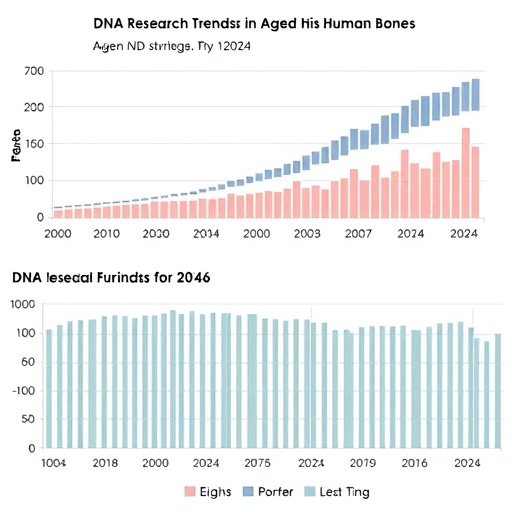
In an age where forensic science and archaeology intersect with genomic research, the latest bibliometric analysis published in the International Journal of Legal Medicine introduces a comprehensive overview of global DNA research conducted on aged human skeletal remains from 1989 to 2024. This pivotal study, authored by Luo, Hua, Chen, and colleagues, traces the scientific efforts focused on unveiling the genetic secrets locked within ancient bones and skeletons, revealing robust trends and emerging directions that shape modern forensic and archaeogenetic methodologies.
DNA retrieval from aged human skeletal remains has always posed formidable technical challenges due to degradation, contamination risks, and environmental exposure over extended timeframes. Consequently, research in this specialized domain demands sophisticated laboratory techniques coupled with refined bioinformatics strategies to reconstruct meaningful genetic data. The report meticulously dissects the evolution of these techniques, documenting advancements in sample preservation, extraction protocols, and amplification methods that have collectively intensified the accuracy and sensitivity of ancient DNA (aDNA) analysis.
Throughout the 35-year span reviewed, the authors identify a surge in interdisciplinary collaborations, reflecting a paradigm shift where forensic medicine, anthropology, molecular biology, and computational genomics converge. The bibliometric data unveil significant geographic diversification in research activity, underscoring the rising contributions from Asian and European institutions, supplementing longstanding efforts rooted in North American research centers. This trend signifies a global recognition of skeletal DNA analysis’s critical role in solving anthropological puzzles and cold cases alike.
The study delves into citation patterns and publication frequencies, highlighting landmark papers that catalyzed methodological reforms and theoretical paradigm shifts. Seminal works focusing on polymerase chain reaction (PCR) enhancements, next-generation sequencing (NGS) applications, and contamination control have formed keystones in accelerating research productivity and credibility. The authors elucidate how methodological robustness correlates strongly with research impact, as evidenced in citation clusters reflecting the validation of novel analytical pipelines addressing both forensic and archaeological specimens.
One of the core revelations from this comprehensive analysis is the nuanced differentiation between forensic and archaeological contexts in skeletal DNA research. Forensic investigations prioritize individual identification, kinship analysis, and case resolution, demanding rapid yet highly specific genetic profiling techniques. Conversely, archaeogenetic inquiry targets population dynamics, migration patterns, and evolutionary histories, often necessitating broader genomic reconstruction approaches. Understanding these dual frameworks allows better categorization and prioritization of methodological innovations tailored to each domain’s nuances.
The bibliometric study further identifies emerging genetic markers and sequencing technologies transforming aged skeletal DNA research. The widespread adoption of whole genome sequencing (WGS), mitochondrial DNA (mtDNA) haplogrouping, and single nucleotide polymorphism (SNP) arrays exemplify technological leapfrogging that enhances resolution, authenticity assessment, and comparative analyses across temporal and spatial spectra. Incorporating these emerging tools has not only refined forensic casework but also revolutionized anthropological narratives about ancient populations’ genetic legacies.
Parallel to technological advancements, the authors highlight ethical considerations increasingly shaping research agendas in the field. Issues such as consent for the use of human remains, respect for indigenous heritage, and legal frameworks governing genetic data access have risen to prominence alongside scientific discovery. The dialogue between ethical governance and methodological ambition embodies a critical interface ensuring that research progression aligns with societal values and respects cultural sensitivities inherent to skeletal sample provenance.
The article also touches upon the impact of bioinformatics and data sharing platforms that facilitate global collaboration and meta-analyses. Cloud-based repositories, open-source sequencing software, and integrated databases have democratized access to vast quantities of genomic data, fostering reproducibility and integrative research. These computational infrastructures underpin contemporary frameworks where data interoperability enables cross-study comparative insights, essential for constructing large-scale phylogenetic and forensic databases.
An intriguing dimension addressed in the analysis is the correlation between research output and major historical or archaeological discoveries fueling scientific interest. The authors note publication spikes following high-profile unearthing of mass graves, war casualties, and prehistoric burial sites. Such events act as catalysts that intensify research activity by providing freshly excavated materials for DNA scrutiny, propelling method development to meet urgent demands for identification and contextual interpretation.
In tandem with this, the review reveals that funding patterns and institutional support play decisive roles in sustaining research momentum. Public and private investments channeled into forensic genetics, archaeological science, and technology innovation have enabled the establishment of dedicated laboratories, acquisition of cutting-edge equipment, and training of specialized personnel. These strategic resources underpin the expansion of aged skeletal DNA research into diverse global regions, previously underrepresented in forensic and anthropological genomic landscapes.
Moreover, the authors argue that despite impressive progress, challenges persist regarding contamination control, DNA preservation reliability, and analytical reproducibility. Variability inherent to skeletal preservation environments necessitates continuous improvement in laboratory protocols and validation studies. The bibliometric lens emphasizes ongoing efforts to standardize methodological frameworks, which are crucial for producing legally defensible forensic evidence and scientifically robust archaeological interpretations.
Looking forward, the study envisions a trajectory propelled by further integration of multi-omics approaches, including proteomics and epigenomics, with traditional DNA analyses. The combined insights from complementary biomolecular layers promise richer reconstructions of ancient individual biographies, health status, and environmental interactions. Such holistic perspectives will elevate both forensic investigations and archaeological reconstructions to unprecedented levels of biological and contextual resolution.
In summary, this comprehensive bibliometric analysis not only maps the quantitative growth in DNA research on aged human skeletal remains but also qualitatively contextualizes its technological, ethical, and collaborative dimensions. The global trends identified underscore a vibrant research ecosystem advancing at the intersection of science, history, and justice. These insights chart a compelling roadmap for future studies aimed at unlocking the molecular secrets embedded within the skeletal remains of our past.
The implications extend far beyond academic interest, impacting forensic case resolution, human evolutionary studies, and cultural heritage preservation. As sequencing technologies evolve and multinational collaborations strengthen, the capacity to decode genetic signatures from ancient bone will transform our understanding of humanity’s complex narrative. This study exemplifies how bibliometric approaches illuminate hidden patterns and inform strategic research planning in cutting-edge scientific fields bridging the ancient and modern worlds.
With this synthesis, scientists, policymakers, and the public can grasp the multifaceted progress made over three decades, appreciating the scientific rigor and interdisciplinary synergy propelling DNA research on aged skeletal remains into a new era of discovery.
Subject of Research: DNA research on aged human skeletal remains, forensic genetics, archaeogenetics
Article Title: Global trends in DNA research on aged human skeletal remains: a bibliometric analysis (1989–2024)
Article References:
Luo, J., Hua, Z., Chen, J. et al. Global trends in DNA research on aged human skeletal remains: a bibliometric analysis (1989–2024). Int J Legal Med (2025). https://doi.org/10.1007/s00414-025-03672-2
Image Credits: AI Generated
DOI: https://doi.org/10.1007/s00414-025-03672-2
Tags: advancements in sample preservation techniquesaged human bonesancient DNA analysisbibliometric analysis 1989-2024challenges in DNA retrievalDNA research trendsemerging directions in archaeogeneticsforensic medicine and anthropologyforensic science and archaeologygenetic secrets of skeletal remainsgeographic diversification in DNA researchinterdisciplinary collaborations in genomics