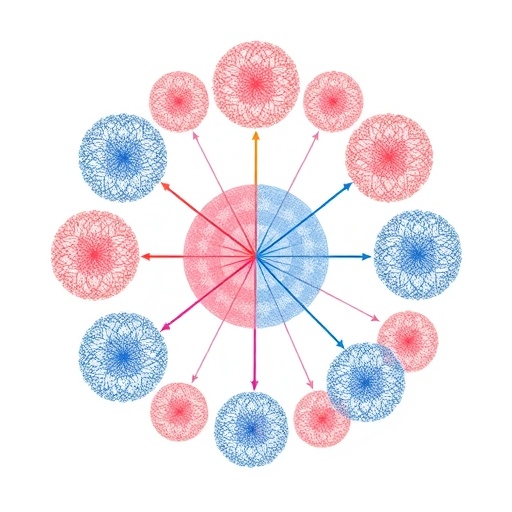
In a groundbreaking leap towards revolutionizing cancer prognosis, a team of researchers has unveiled a new distributed fusion framework tailored specifically for predicting breast cancer recurrence. This innovative framework harnesses the power of MapReduce, a paradigm widely acclaimed for processing vast data sets across distributed computing environments. Breast cancer, notorious for its potential to recur even after successful initial treatment, demands more precise and reliable predictive models to improve patient outcomes. This development marks a significant advance in this direction, promising to enhance clinical decision-making and ultimately save lives.
The study, recently published in Scientific Reports, presents a sophisticated amalgamation of distributed computing principles and machine learning techniques designed to analyze extensive breast cancer data collected from various medical institutions. Traditional centralized analytical methods often struggle to process the sheer volume and complexity of genomic, histopathological, and clinical data involved in cancer research. By contrast, the proposed framework utilizes MapReduce to divide these colossal datasets into manageable chunks, process them parallely, and then fuse the results coherently to improve predictive accuracy.
At its core, the framework tackles breast cancer recurrence prediction through a distributed fusion approach. This means that rather than relying on a single data source or model, it synthesizes outputs from multiple heterogeneous data sources and prediction models. The ensemble nature of this approach allows the system to leverage diverse perspectives on the data, accommodating various biological, pathological, and clinical factors that contribute to cancer relapse. Such fusion not only enriches the predictive power but also mitigates model bias and overfitting, common pitfalls in machine learning-based cancer prediction.
The utilization of MapReduce is pivotal to the system’s performance. Originally conceptualized by Google to streamline web indexing, MapReduce has evolved into an essential tool in big data analytics. By mapping the task of data processing into smaller sub-tasks and then reducing the outputs into final insights, the framework can scale effortlessly across multiple computational nodes. This scalability ensures that extensive datasets—including genomic sequences, medical imaging, electronic health records, and treatment histories—can be processed efficiently without overwhelming hardware resources.
Technical intricacies of the framework include the integration of various machine learning classifiers optimized for distributed execution. The framework incorporates feature extraction techniques adept at discerning patterns linked with tumor recurrence, such as gene expression profiles and radiomic signatures. Subsequently, classifiers such as support vector machines, decision trees, and neural networks are employed on different data partitions processed via the Map function. The Reduce step then merges the disparate predictions into a unified prognostic output, emphasizing consensus while resolving conflicts through weighted voting and confidence intervals.
A critical contribution of this research lies in demonstrating how distributed fusion can outperform single-model, centralized predictions both in accuracy and computational feasibility. The study reports significant improvements in sensitivity and specificity when predicting breast cancer recurrence, which are essential metrics to minimize false negatives and false positives, respectively. This level of precision has direct clinical implications, as accurate risk stratification helps oncologists tailor aggressive treatments or adopt vigilant monitoring protocols as needed.
Moreover, the distributed fusion framework addresses key challenges in medical data science such as privacy preservation and data heterogeneity. Because data processing is done locally before fusion and results are aggregated in a privacy-preserving manner, patient confidentiality is maintained without compromising analytic robustness. Additionally, the modularity of the approach allows easy integration of emerging data types or new predictive algorithms, future-proofing the system against the rapid evolution of biomedical data acquisition technologies.
The researchers also performed rigorous validation of their model using multi-center datasets encompassing diverse patient demographics and tumor subtypes. This extensive validation underpins the generalizability of the framework across different populations, reducing biases that have historically limited the applicability of computational prediction models. It also paves the way for potential deployment in clinical environments globally, potentially standardizing breast cancer recurrence prediction protocols.
From a computational infrastructure perspective, the framework is compatible with cloud-based platforms, enabling resource-efficient deployment without the need for expensive on-premises hardware. This advancement reduces barriers for hospitals and research centers, particularly in low-resource settings, to adopt advanced predictive modeling. By enabling distributed data analytics through the cloud, the system also fosters collaborative research, integrating insights from multiple institutions while respecting regulatory and ethical standards.
Notably, the study also emphasizes how the fusion framework can assimilate multi-modal data streams. Breast cancer prognosis is influenced by a plethora of factors ranging from molecular markers and histopathological images to patient lifestyle and treatment regimens. The ability to handle multi-modal data in a distributed manner equips the framework to capture the multifaceted nature of cancer biology, leading to more holistic and resilient predictions.
Beyond technical prowess, the researchers highlight the potential societal impact of deploying such frameworks. Early and accurate detection of recurrence risk can significantly improve patient quality of life by customizing treatment intensity and reducing unnecessary interventions. Health systems could benefit economically by optimizing resource allocation and minimizing costly late-stage treatments. Furthermore, personalized prediction models maintain patient agency, empowering informed decision-making through transparent risk communication.
Looking forward, this research opens numerous avenues for expansion and refinement. Future directions could involve incorporating deep learning techniques within the distributed fusion environment to capture even more complex data patterns. Additionally, extending the framework to other types of cancers or chronic diseases characterized by recurrence risk could substantially widen its clinical impact. Integration with real-time data streams, such as continuous monitoring via wearable devices, represents another exciting frontier for proactive healthcare management.
In summary, the distributed fusion framework designed by Shahare, Mahalwar, and Shahade embodies a significant stride in computational oncology, merging state-of-the-art big data processing with machine learning to predict breast cancer recurrence more accurately than ever before. Its scalable, privacy-conscious, and multi-modal nature makes it a promising contender for revolutionizing predictive analytics in cancer care. As the framework advances from the realm of research to clinical practice, it heralds a future where data-driven medicine profoundly transforms outcomes and patient lives worldwide.
This pioneering effort exemplifies how interdisciplinary collaboration—melding computer science, oncology, and data analytics—can surmount prior limitations and accelerate medical breakthroughs. It also underscores the escalating importance of distributed computing paradigms in handling the burgeoning volume and complexity of biomedical data. With breast cancer remaining a leading cause of female mortality globally, innovations such as this provide renewed hope and a blueprint for harnessing technology against the formidable challenge of cancer recurrence.
Subject of Research:
Breast cancer recurrence prediction using distributed fusion and MapReduce big data processing.
Article Title:
A distributed fusion framework for breast cancer recurrence prediction using MapReduce.
Article References:
Shahare, P., Mahalwar, A. & Shahade, A.K. A distributed fusion framework for breast cancer recurrence prediction using MapReduce. Scientific Reports (2026). https://doi.org/10.1038/s41598-026-47382-0
Image Credits: AI Generated
DOI: 10.1038/s41598-026-47382-0
Tags: advanced cancer recurrence prediction methodsbreast cancer recurrence machine learning modeldistributed computing for medical data analysisdistributed fusion framework for breast cancer predictionfusion of clinical and histopathological dataintegration of multi-institutional cancer datasetslarge-scale genomic data processingmachine learning in oncologyMapReduce in cancer prognosisparallel processing in healthcare analyticspredictive modeling for breast cancer recurrencescalable breast cancer prediction system