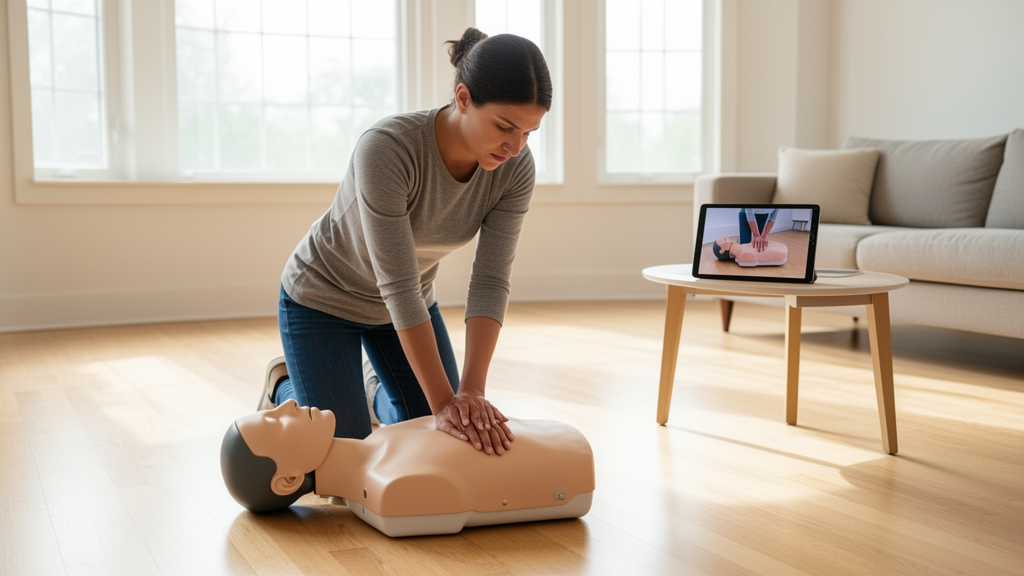
A prospective randomized study published in Advances in Simulation demonstrates that a distance-based cardiopulmonary resuscitation (CPR) training program with asynchronous feedback is non-inferior to the traditional in-person Heartsaver® First Aid CPR AED course for laypersons. The research, conducted by a team including Marcia Corvetto and Fernando Altermatt, aimed to determine whether remote training could achieve comparable proficiency in basic life support skills. The study focused on non-medical personnel recruited from educational and sports institutions in Chile, addressing the need for scalable CPR training in a country where cardiovascular diseases remain the leading cause of death.
Cardiovascular diseases account for 27% of deaths in Chile, with a notable 34% rise in heart attacks among adults aged 30 to 50 between 2017 and 2023. The survival rate after cardiac arrest decreases by 10% for every minute that passes without intervention, highlighting the critical importance of immediate bystander response. In Chile, access to CPR and automated external defibrillators (AEDs) is limited, particularly in rural areas where emergency response times can exceed 20 to 30 minutes. Only 28% of patients with out-of-hospital cardiac arrest in Santiago received bystander resuscitation, underscoring the gap between resource availability and effective use during emergencies.
The study involved 192 non-medical personnel, including teachers, psychologists, security guards, coaches, and athletes, who were randomly assigned to two training groups. One group completed the traditional in-person Heartsaver® First Aid CPR AED course, while the other participated in a distance-based course using the C1DO1 online platform. The distance-based course allowed participants to practice at their workplaces using provided materials, including a pad, resuscitation torso, and AED. Participants uploaded video recordings of their practice, and instructors provided asynchronous feedback within a 72-hour window until approval was granted.
Of the 192 participants recruited, 172 completed the training, and 158 took both pre-training and post-training assessments. The traditional course group consisted of 83 participants, while the distance-based course group included 75 participants. The distance-based course was structured into nine stages, comprising five theoretical stages, three practical exercises, and a final multiple-choice assessment. Theoretical material was delivered through short video capsules, and practical stages required participants to record and upload their performance for instructor review. The course was designed to match the educational content, practical training time, and cognitive load of the traditional in-person course.
The primary outcome was participant performance, assessed using the American Heart Association (AHA) Heartsaver Adult CPR and AED Skills Testing Checklist. Secondary outcomes included chest compression quality, evaluated based on compression rate and depth. Both groups completed pre-training and post-training assessments, during which participants were videotaped performing CPR scenarios. Two independent blinded reviewers evaluated the videos, rating performance using the AHA checklist. Additionally, chest compression quality was measured using a Prestan® mannequin with a skill reporter connected to a tablet application.
Median checklist scores improved markedly in both groups. In the traditional course, scores increased from a median of 2 (interquartile range 0–3) to 15 (14–16.5) points. In the distance-based course, scores rose from 1 (0–2.5) to 16 (15.5–17) points. The absolute difference in post-training median scores between the groups was −1 (95% confidence interval: −1.5 to −0.5). The lower bound of this confidence interval was above the pre-established non-inferiority margin of 2 points, confirming that the distance-based course was non-inferior to the traditional course in the per-protocol analysis.
Chest compression rates also improved significantly in both groups. In the traditional course, the median compression rate increased from 82 (0–106) per minute to 105 (102–110) per minute. In the distance-based course, the rate rose from 86 (0–109.5) to 105 (105–108) per minute. Similarly, chest compression depth increased from 38 (0–57.5) mm to 58 (49.5–60) mm in the traditional course and from 32 (0–56) mm to 59 (55–60) mm in the distance-based course. These post-training values met the established CPR quality metrics of 100–120 compressions per minute and a depth of 50–60 mm.
The study design included several methodological considerations to ensure validity. Randomization was performed using the GraphPad Prism calculator, and the allocation sequence was generated by a researcher responsible for statistical analysis. However, complete allocation concealment was not possible, as participants and instructors in the distance-based course knew their group assignments. The evaluators of the pre- and post-course videos were blinded to the group assignments to mitigate bias. The interrater reliability for the observers’ video checklist scores was high, with an intraclass correlation coefficient of 0.91.
Limitations of the study include the lack of control over participant characteristics such as age, sex, educational level, and digital literacy, which may influence learning outcomes. The distance-based course relied on a self-directed learning model, potentially requiring higher digital literacy and learner autonomy. Additionally, the study did not analyze the specific content of the asynchronous feedback provided, nor did it assess parameters such as hand position and complete chest recoil. The analysis was restricted to a per-protocol approach, excluding participants who did not complete the course and post-assessments, which limits the generalizability of the findings.
The findings suggest that distance-based CPR training with asynchronous feedback can be a viable alternative to traditional in-person courses, particularly in settings where geographical barriers, costs, or instructor availability limit access to face-to-face training. The study highlights the potential for remote training to extend CPR proficiency to schools, universities, and sports institutions, thereby increasing bystander resuscitation rates. However, further research is needed to determine the optimal duration for distance-based courses to maximize completion rates and to evaluate the long-term retention of skills and impact on real-world patient outcomes.
The study contributes to the growing body of evidence supporting the use of technology in medical education. Previous studies have shown that virtual reality and augmented reality-based training can be as effective as traditional methods, with similar outcomes in chest compression rate and depth. The non-inferiority of the distance-based course in this study aligns with these findings, suggesting that diverse training methodologies can achieve comparable levels of competence. The results support the implementation of remote training programs to address the global need for widespread CPR training among laypersons.
The authors emphasize the importance of promoting bystander training worldwide, as indicated by systematic reviews and meta-analyses. The study’s focus on non-medical personnel from educational and sports institutions reflects a targeted approach to increasing the number of individuals capable of providing immediate resuscitation. By demonstrating the non-inferiority of distance-based training, the study offers a scalable solution to the challenges of implementing CPR training in various settings, including remote and rural areas.
In conclusion, the distance-based CPR training program with asynchronous feedback was non-inferior to the traditional in-person Heartsaver® First Aid CPR AED course for laypersons. Both training methods significantly improved participants’ proficiency in CPR, with post-training performance meeting established quality metrics. The study provides evidence that remote training can be an effective tool for expanding access to basic life support education, potentially improving bystander resuscitation rates and survival outcomes in cardiac arrest situations.
The study was approved by the ethics committee at the Pontificia Universidad Católica de Chile, with approval number 221118007, and followed the CONSORT reporting guidelines for randomized trials. The research team calculated a required sample size of 156 subjects to detect a non-inferiority margin of 10% points on the checklist, assuming a significance level of 0.05 and a power of 0.8. To account for a 30% drop-off rate in this non-captive population, the investigators ultimately assessed 200 participants for eligibility. The non-inferiority margin was set at a difference of 2 points, representing a 10% performance difference between the training methods, based on pilot data and previous studies in medical education.
Recruitment took place at five educational and sports institutions in Chile that had automated external defibrillators on their premises. The principal investigator contacted the directors of these institutions to identify eligible participants, who were adults over 18 years old with no healthcare background. Exclusion criteria included healthcare professionals and individuals who had previously completed CPR courses. Participants were invited via email and randomly assigned to either the traditional or distance-based group using a simple randomization method generated by the GraphPad Prism calculator. The entire list of participants was randomized at the beginning of the protocol, and the allocation sequence was sent to the coordinator at the simulation center.
The distance-based course was designed by six experts, including emergency medicine physicians and anesthesiologists, who piloted the program during the COVID-19 pandemic. The team aimed to create a course equivalent to the traditional in-person Heartsaver® First Aid CPR AED course in terms of educational content, practical training time, and cognitive load. The platform allowed participants to access didactic materials and instructional videos, while instructors provided remote feedback within a 72-hour window. This asynchronous approach meant that participants could practice at their own pace over a four-week period, uploading video recordings of their performance for review by three emergency medicine instructors who were experts in healthcare simulation.
The traditional in-person course was conducted at the Simulation Center of Los Andes University, offering three hours of training by a certified instructor. A total of five courses were held to accommodate all participants assigned to this group. Some participants in the traditional course did not attend their scheduled sessions and had to be rescheduled, with some requiring up to three reschedules to complete the training. This logistical challenge increased the cost per student in the traditional group compared to the distance-based course, which allowed participants to practice at their workplaces during their free time without the need for on-site expert trainers.
Satisfaction surveys sent to participants after completing each training program showed high levels of agreement with the statements asked. However, some participants in the distance-based course suggested that the open timeframe for completing the course was too long, with some indicating that a shorter, limited timeframe would have been better. This feedback highlights the need for further research to determine the optimal duration for distance-based courses to maximize completion rates and engagement among laypersons.
Subject of Research: Non-inferiority of distance-based CPR training compared to in-person methods for laypersons
Article Title: Development and validation of a distance-based training program of basic cardiac life support for laypersons and comparison with traditional in-person methodology: a non-inferiority study
Article References: Corvetto, M., Acuña, D., Schneider, A., Rojas, J., Varas, J., Zamorano, E., & Altermatt, F. (2026). Development and validation of a distance-based training program of basic cardiac life support for laypersons and comparison with traditional in-person methodology: a non-inferiority study. Advances in Simulation, 11(1), Article 66. https://doi.org/10.1186/s41077-026-00457-4
Image Credits: AI Generated
DOI: 10.1186/s41077-026-00457-4
Keywords: CPR training, distance learning, non-inferiority study, basic life support, laypersons, asynchronous feedback, cardiopulmonary resuscitation, medical education, AED, Chile, Development, validation
News Source: Courtney Benton. (November 11, 2026). Distance CPR Training Matches In-Person Methods for Laypersons. Scienmag.