• HOME
  • NEWS
  • EXPLORE
    • CAREER
      • Companies
      • Jobs
    • EVENTS
    • iGEM
      • News
      • Team
    • PHOTOS
    • VIDEO
    • WIKI
  • BLOG
  • COMMUNITY
    • FACEBOOK
    • INSTAGRAM
    • TWITTER
Tuesday, March 31, 2026
BIOENGINEER.ORG
No Result
View All Result
  • Login
  • HOME
  • NEWS
  • EXPLORE
    • CAREER
      • Companies
      • Jobs
        • Lecturer
        • PhD Studentship
        • Postdoc
        • Research Assistant
    • EVENTS
    • iGEM
      • News
      • Team
    • PHOTOS
    • VIDEO
    • WIKI
  • BLOG
  • COMMUNITY
    • FACEBOOK
    • INSTAGRAM
    • TWITTER
  • HOME
  • NEWS
  • EXPLORE
    • CAREER
      • Companies
      • Jobs
        • Lecturer
        • PhD Studentship
        • Postdoc
        • Research Assistant
    • EVENTS
    • iGEM
      • News
      • Team
    • PHOTOS
    • VIDEO
    • WIKI
  • BLOG
  • COMMUNITY
    • FACEBOOK
    • INSTAGRAM
    • TWITTER
No Result
View All Result
Bioengineer.org
No Result
View All Result
Home NEWS Science News Health

Disruption of glycine receptors to study embryonic development and brain function

Bioengineer by Bioengineer
December 17, 2019
in Health
Reading Time: 2 mins read
0
IMAGE
Share on FacebookShare on TwitterShare on LinkedinShare on RedditShare on Telegram

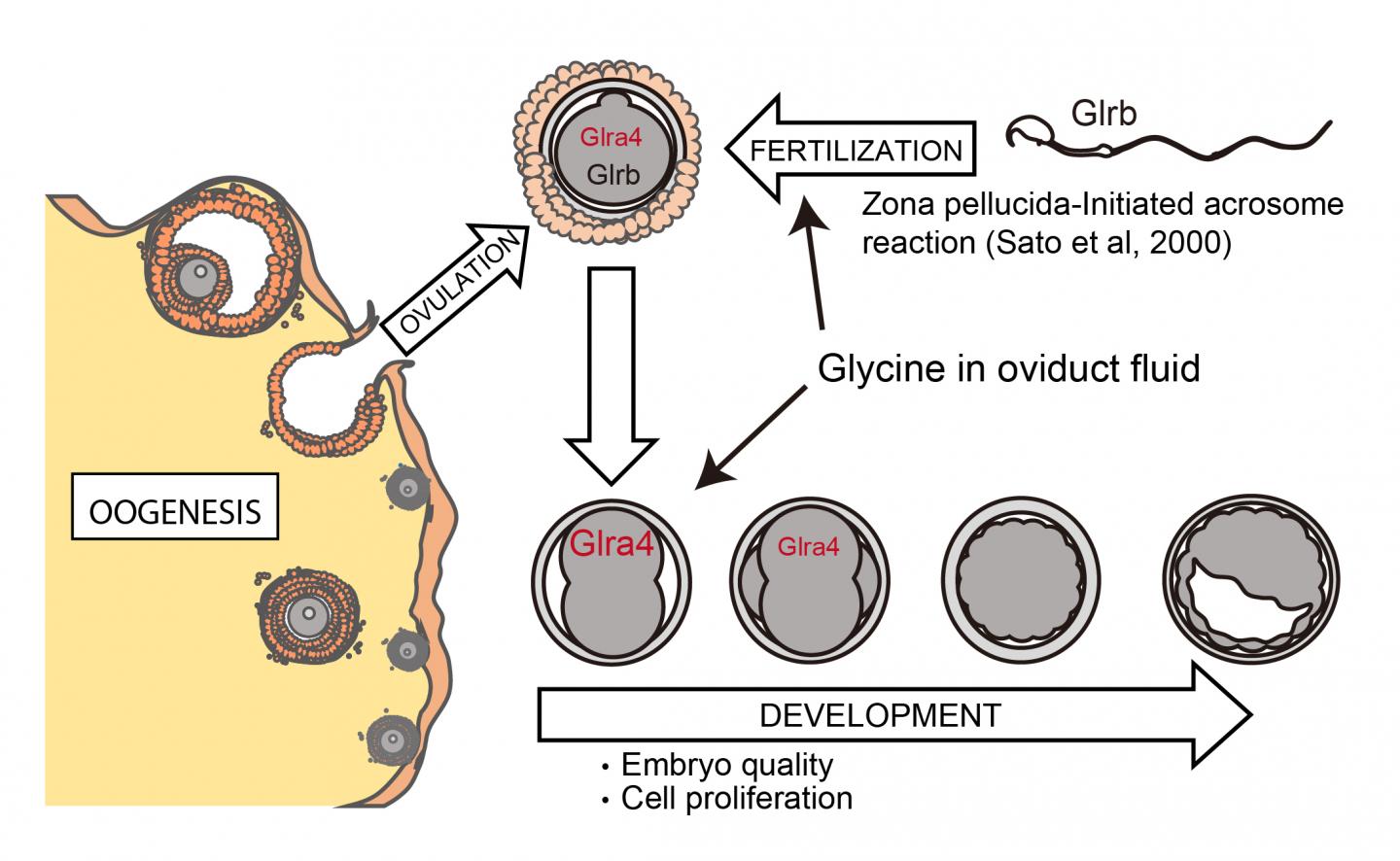
Collaborative work identified a new function for glycine receptors during embryonic development
IMAGE

Credit: Max Planck Florida Institute for Neuroscience, University of Toyama, Yamagata University, Cairo University, RIKEN Center for Integrative Medical Sciences and Setsunan University


Glycine receptors are one of the most widely distributed inhibitory receptors in the central nervous system and have important roles in a variety of physiological processes. Researchers from Max Planck Florida Institute for Neuroscience (MPFI), University of Toyama, Yamagata University, Cairo University, RIKEN Center for Integrative Medical Sciences and Setsunan University joined forces to further study glycine receptors, particularly glycine receptor alpha-4 (Glra4), during development. In a recent publication in the journal Reproduction, they demonstrated that Glra4 is not a brain exclusive gene, as was believed, but on the contrary, it facilitates the early embryonic development in mice.

Hirofumi Nishizono first author of this publication and research associate of Yasuda Lab, explained that in order to fully understand the function of a specific gene, it is necessary to study a condition where this gene is deleted. By applying in vitro fertilization in combination with CRISPR/Cas9 genome editing system to mouse embryos, the team generated a genetically modified mouse in which the Glra4 gene has been disrupted. One of the remarkable results show that Glra4 plays a critical role in the early development of fertilized eggs, facilitating the development of the blastocyst, a structure formed in the early development of mammals, maintaining embryo quality and litter size in mice. Interestingly, they have also shown that different types of glycine receptors are expressed not only in mouse fertilized eggs but also in fertilized eggs of humans and bovine, suggesting that the role of these receptors in early embryonic development is conserved across species. Moreover, while Glra4 is a pseudogene in humans, they use a different type of glycine receptors (GLRA2), which are active in humans, for this process.

Nishizono is currently investigating the effects of the disruption of glycine receptors in the brain. He is conducting behavioral tests to evaluate if the deletion of Glra4 affects brain function of mice. Some preliminary data indicate that the deletion of Glra4 is associated with phenotypes related to psychiatric disorders. Yasuda Lab will continue to produce genetically modified mice to investigate the role of different molecules involved in learning and memory as well as various brain disorders.

###

Media Contact
Helena Decker
[email protected]
561-301-9661

Original Source

http://mpfi.org/disruption-of-glycine-receptors-to-study-embryonic-development-and-brain-function

Related Journal Article

http://dx.doi.org/10.1530/REP-19-0312

Tags: BiologyCell BiologyGeneticsMolecular Biologyneurobiology
Share12Tweet8Share2ShareShareShare2

Related Posts

Global Spread of Multidrug-Resistant Ural Lineage TB

March 31, 2026

Neonatal Outcomes With Meconium: Suctioning Impact

March 31, 2026

SNHG10 Drives Pancreatic Cancer Growth and Drug Resistance

March 31, 2026

Long-Term Effects of Omicron COVID-19 in Cancer Patients: New Insights

March 31, 2026
Please login to join discussion

POPULAR NEWS

  • blank

    Revolutionary AI Model Enhances Precision in Detecting Food Contamination

    96 shares
    Share 38 Tweet 24
  • Imagine a Social Media Feed That Challenges Your Views Instead of Reinforcing Them

    1006 shares
    Share 398 Tweet 249
  • Promising Outcomes from First Clinical Trials of Gene Regulation in Epilepsy

    51 shares
    Share 20 Tweet 13
  • Advancements in EV Battery Technology to Surpass Climate Change-Induced Degradation

    45 shares
    Share 18 Tweet 11

About

We bring you the latest biotechnology news from best research centers and universities around the world. Check our website.

Follow us

Recent News

Global Spread of Multidrug-Resistant Ural Lineage TB

Neonatal Outcomes With Meconium: Suctioning Impact

SNHG10 Drives Pancreatic Cancer Growth and Drug Resistance

Subscribe to Blog via Email

Enter your email address to subscribe to this blog and receive notifications of new posts by email.

Join 78 other subscribers
  • Contact Us

Bioengineer.org © Copyright 2023 All Rights Reserved.

Welcome Back!

Login to your account below

Forgotten Password?

Retrieve your password

Please enter your username or email address to reset your password.

Log In
No Result
View All Result
  • Homepages
    • Home Page 1
    • Home Page 2
  • News
  • National
  • Business
  • Health
  • Lifestyle
  • Science

Bioengineer.org © Copyright 2023 All Rights Reserved.