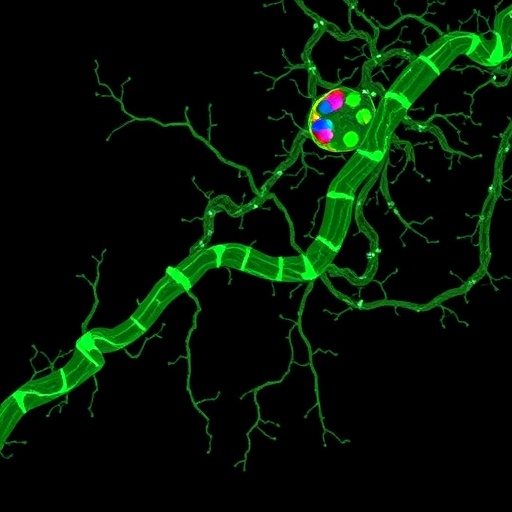
In discovering how certain chemotherapy drugs cause the nerve damage known as peripheral neuropathy, researchers at Dana-Farber Cancer Institute have found a potential approach to preventing this common and troublesome side effect of cancer treatment.
The symptoms of peripheral neuropathy, which affects about one-third of patients receiving chemotherapy, include numbness, tingling, and pain in the hands and feet. Some patients get better after treatment ends, but in others the symptoms are long-lasting. There is currently no preventive or treatment for peripheral neuropathy, which is caused by the degeneration of the long, spindly nerve cell projections called axons that transmit physical sensations to the brain.
Unlike the brain, which is protected by a physical barrier from many harmful chemicals, nerve axons – which can extend as long as two or three feet in humans — are exposed to substances that flow through the blood circulation. The new report in the journal Neuron reveals for the first time precisely how taxanes, a class of commonly used chemotherapy drugs, trigger a dying off of sensory axons. With this knowledge, it might someday be possible, the investigators say, to give patients a drug prior to chemotherapy treatment that would reduce or prevent neuropathy symptoms. Taxane drugs are routinely used in treating early-stage breast cancer, and some other cancer types.
Researchers led by Rosalind Segal, MD, PhD, discovered that a protein called Bclw plays a unique braking role in preventing the degeneration of nerve axons. Bclw blocks the action of another protein that sets off a cascade of chemical reactions ending in nerve cell death. Segal says that Bclw is part of a regulatory system that allows unnecessary nerves to be "pruned" or killed off during embryonic development. During adult life, Bclw protects nerves from degeneration – except in the case of a traumatic injury or, in cancer treatment, exposure to chemotherapy drugs.
The gene carrying the blueprint for Bclw is located in the nucleus of the nerve cell. A carrier protein, SFPQ, transports copies of the Bclw blueprint in the form of messenger RNA along the nerve axon, where the protective Bclw protein is manufactured.
Segal and her colleagues found that adding a taxane drug, paclitaxel, to sensory nerve axons in the laboratory dramatically impeded the transport of Bclw messenger RNA by the SFPQ protein. As a result, too little of the Bclw protein was made to protect the axons, and they degenerated.
This finding led the investigators to ask if adding Bclw protein to the nerve axons before exposing them to paclitaxel would prevent the nerves from dying off — and it did. Moreover, they demonstrated that a synthetic compound based on a part of the Bclw protein – a so-called "stapled peptide" made in the laboratory of DFCI researcher Loren Walensky, MD, — was able to prevent degeneration from exposure to paclitaxel. This "designer peptide provides a promising template for drugs that can prevent chemotherapy-induced peripheral neuropathy," say the scientists.
Such drugs aren't likely to become available any time soon, but Segal says having discovered the mechanism that causes peripheral neuropathy in patients treated with taxane chemotherapy might be valuable in other ways. "One possibility is that you might be able to predict which patients will develop peripheral neuropathy based on whether they have higher or lower levels of Bclw based on their genetic background."
###
First authors of the study are Sarah E. Pease-Raissi, PhD, and Maria F. Pazyra-Murphy of Dana-Farber.
The research was supported by National Institutes of Health grants R01 NS050674 and R01 CA 205255 and by an award from the Barr Weaver program.
Media Contact
Ellen Berlin
[email protected]
617-632-4090
@DanaFarber
http://www.dfci.harvard.edu