Rising global energy demands and concerns surrounding fossil fuel dependence have spurred worldwide efforts to expand sustainable second-generation biofuel production from agricultural residues. Sugarcane bagasse represents an abundant lignocellulosic byproduct generated during commercial milling operations for sucrose extraction and first-generation ethanol processing. In industrial facilities, large quantities of this fibrous residue are commonly burned in boilers to cogenerate heat and electrical power. However, bagasse can also undergo biochemical conversion into second-generation ethanol, allowing facilities to increase fuel yields significantly without dedicating additional arable land to energy crop cultivation. Despite these strategic advantages, commercial deployment of second-generation bioethanol remains challenged by high operational expenditures. Key economic hurdles include the high import and distribution costs of commercial cellulolytic enzyme cocktails, specialized chemical inputs required for biomass deconstruction, and the recurrent inability of standard industrial fermentation microbes to utilize pentose fractions alongside primary hexose sugars.
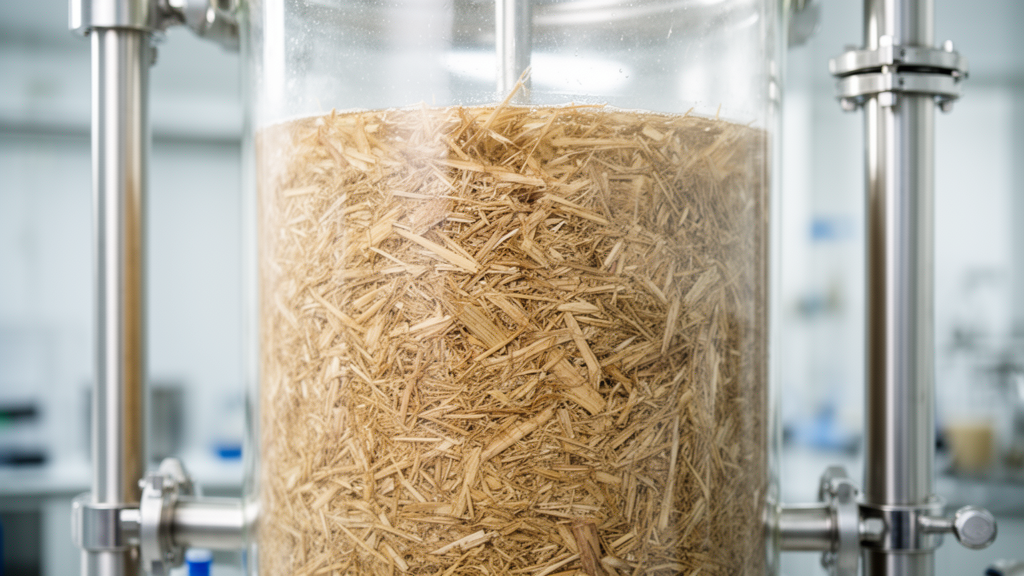
To overcome the natural structural recalcitrance of lignocellulosic feedstocks, researchers evaluated an integrated processing route utilizing a chemical-thermomechanical pretreatment combining alkaline-sulfite liquor with mechanical disc refining. In their experimental investigation, dry sugarcane bagasse containing approximately twelve percent residual moisture was impregnated with an alkaline-sulfite liquor consisting of ten grams of sodium sulfite and five grams of sodium hydroxide per one hundred grams of dry bagasse. Impregnated solids were cooked in a stainless-steel reactor at one hundred and twenty degrees Celsius for two hours at a solid-to-liquid ratio of one to ten. After cooking, the unwashed material was resuspended in water at a two-point-four percent consistency and processed through an industrial-type disc refiner. Compositional profiling showed that raw bagasse originally contained significant fractions of structural cellulose, hemicellulose, total lignin, extractives, and mineral ash. Following chemical-thermomechanical processing, total mass recovery reached eighty-one point eight percent, while total lignin content decreased by forty-seven percent and structural acetyl groups were reduced by ninety-seven percent.
Removal of acetyl substituents and partial delignification during chemical-thermomechanical refining altered the physical architecture of the sugarcane bagasse, noticeably expanding fiber swelling and enhancing water retention capacity. Because acetyl side chains attached to xylan backbones restrict productive enzyme binding, and lignin functions as a steric barrier and non-productive adsorbent, their substantial elimination created accessible carbohydrate surfaces. Glucan and xylan conservation remained exceptionally high following pretreatment, with observed mass losses limited to four percent for cellulose and thirteen percent for hemicellulose fractions. Consequently, total structural polysaccharides comprising cellulose and hemicellulose constituted seventy-one point four percent of the dry pretreated solids. Furthermore, the extensive removal of acetyl groups minimized the release of free acetic acid during subsequent processing stages, mitigating downstream chemical inhibition against fermentative microorganisms without necessitating intensive washing protocols that generate industrial wastewater.
Enzymatic saccharification of the alkaline-sulfite refined bagasse was systematically optimized using Trichoderma reesei cellulase supplemented with Aspergillus niger beta-glucosidase across three enzyme dosages. Hydrolysis experiments were conducted in Erlenmeyer flasks containing two grams of pretreated solids suspended in fifty millimolar sodium citrate buffer at pH four-point-eight with an eight percent solids loading. Reaction mixtures were incubated at forty-five degrees Celsius and agitated at one hundred revolutions per minute for forty-eight hours. The evaluation compared enzyme dosages of nine, eighteen, and twenty-seven filter paper units per gram of dry biomass. The lowest dosage yielded sixty-five percent cellulose conversion and sixty-one percent xylan conversion. Increasing enzyme loading to eighteen filter paper units per gram of biomass markedly improved saccharification, yielding thirty-one point zero grams per liter of dissolved glucose and fifteen point seven grams per liter of dissolved xylose, corresponding to cellulose and xylan conversion yields of seventy-six percent and seventy-four percent, respectively.
Advancing the enzyme dosage further to twenty-seven filter paper units per gram of pretreated biomass yielded only marginal improvements in sugar release, elevating cellulose and xylan conversion efficiencies by three and six percentage points above the values recorded at eighteen units. The researchers attributed this tapering response to restricted enzyme accessibility within the remaining lignocellulosic matrix and noted that supplemental beta-glucosidase activity had already prevented cellobiose end-product inhibition. Balancing high carbohydrate recovery against cocktail consumption, an eighteen filter paper unit dosage was established as the rational baseline condition for slurry preparation. Replicate saccharification batches conducted under this chosen operational regime generated an unseparated enzymatic slurry containing twenty-seven point nineteen grams per liter of glucose, fourteen point eighty-five grams per liter of xylose, thirteen point zero three grams per liter of arabinose, two point forty-one grams per liter of residual cellobiose, and zero point fifty grams per liter of acetic acid.
Rather than separating solid fiber residues from liquid hydrolysates, the research team directly subjected the whole enzymatic slurry to anaerobic fermentation, circumventing downstream dewatering machinery and minimizing energy requirements. A two-level factorial experimental design incorporating center points evaluated the performance of three yeast strains under differing incubation temperatures and nutritional regimes. The strains under comparison included thermotolerant Kluyveromyces marxianus Y-6860, standard industrial Saccharomyces cerevisiae PE-2, and pentose-assimilating Scheffersomyces stipitis Y-7124. Assays were conducted in one hundred and twenty-five milliliter flasks containing forty-eight milliliters of whole slurry adjusted to pH five-point-zero, supplemented with defined mineral nutrients or sterile water, inoculated at one gram per liter of yeast biomass, and agitated at one hundred and fifty revolutions per minute for twenty hours. Investigated temperatures spanned thirty to forty degrees Celsius, while nutrient supplementation comprised ammonium sulfate, potassium dihydrogen phosphate, magnesium sulfate heptahydrate, and yeast extract.
Statistical evaluation using analysis of variance and Pareto charts demonstrated distinct physiological responses among the three yeast species across the temperature and nutrient gradients. For Kluyveromyces marxianus Y-6860, nutrient supplementation exerted a strong positive effect on both ethanol yield factor and volumetric ethanol productivity, while temperature variations between thirty and forty degrees Celsius produced minimal impact, reflecting the inherent thermotolerant physiology of the organism. Saccharomyces cerevisiae PE-2 demonstrated similar operational stability across the thermal range, sustaining productivity in nutrient-rich media at both thirty and forty degrees Celsius. In sharp contrast, Scheffersomyces stipitis Y-7124 exhibited pronounced sensitivity to elevated temperatures, displaying a significant negative response in ethanol yield and productivity as operating conditions shifted toward thirty-five and forty degrees Celsius. This thermal vulnerability in shake flasks was partially attributed to diminished dissolved oxygen solubility at higher temperatures, which disrupted microaerobic redox balancing necessary for pentose catabolism.
Under the optimal operating regime of thirty degrees Celsius with complete nutrient supplementation, the fermentation kinetics differed markedly between the three microbial platforms. Both Kluyveromyces marxianus Y-6860 and Saccharomyces cerevisiae PE-2 rapidly and completely consumed all available glucose within five hours, achieving comparable ethanol concentrations near thirteen grams per liter. Kluyveromyces marxianus exhibited a peak volumetric ethanol productivity of three point twenty-five grams per liter per hour, exceeding the two point seventeen grams per liter per hour registered by Saccharomyces cerevisiae PE-2. However, neither strain consumed significant quantities of xylose, showing fifteen percent or lower uptake due to natural metabolic limitations in Saccharomyces cerevisiae and carbon catabolite glucose repression governing the multi-transporter uptake systems in Kluyveromyces marxianus.
Conversely, Scheffersomyces stipitis Y-7124 proved capable of metabolizing both hexose and pentose carbohydrates within the unseparated sugarcane bagasse hydrolysate. Although it required twenty hours of incubation to fully deplete glucose, it commenced active xylose consumption once dissolved glucose concentrations declined below approximately twelve grams per liter. By the conclusion of the twenty-hour fermentation, Scheffersomyces stipitis had consumed approximately ninety percent of available xylose, leaving only three percent of initial total sugars unfermented in the enzymatic slurry. This combined co-utilization of hexose and pentose sugars generated nineteen grams per liter of final ethanol, representing forty-six percent higher total ethanol output than the yields produced by the glucose-exclusive fermentations, although its volumetric productivity remained lower at zero point ninety-five grams per liter per hour.
To simulate high-gravity industrial conditions necessary to achieve commercially relevant ethanol titers above fifty grams per liter, the researchers supplemented the enzymatic slurry with anhydrous glucose up to a total initial glucose concentration of one hundred grams per liter. When fermented at thirty degrees Celsius with nutrient supplementation, Kluyveromyces marxianus Y-6860 and Saccharomyces cerevisiae PE-2 maintained robust metabolic activity, completely consuming the fortified glucose within sixteen hours. Final ethanol concentrations reached forty-six point zero grams per liter for Kluyveromyces marxianus and forty-seven point one grams per liter for Saccharomyces cerevisiae, corresponding to glucose-based volumetric ethanol productivities roughly three-point-five times higher than those observed for Scheffersomyces stipitis. Comparative tests using slurry derived from unwashed versus washed pretreated solids showed indistinguishable fermentation yields, confirming that residual cooking salts did not inhibit Kluyveromyces marxianus performance.
Under these high-glucose conditions, Scheffersomyces stipitis Y-7124 required fifty-six hours to metabolize the initial glucose, reaching a peak ethanol titer of thirty-eight point six grams per liter. However, competitive catabolite repression and transport competition completely suppressed xylose assimilation throughout the evaluated timeframe, leaving pentose sugars unconsumed in the broth. The authors noted that while overall ethanol concentrations approached forty-seven grams per liter, additional bioprocess optimizations such as fed-batch feeding, dual-strain co-cultivation, or adaptive laboratory evolution will be needed to relieve catabolite repression and achieve complete conversion of mixed hexose and pentose streams in high-gravity second-generation biorefineries.
Subject of Research: Direct ethanol fermentation of enzymatic sugarcane bagasse slurry using diverse yeast strains
Article Title: Comparative fermentability of a glucose/xylose enriched enzymatic slurry using different yeast strains
Article References: Durán, L. M., Flores-Alarcón, M. A. D., Milagres, A. M. F., & Roberto, I. C. (2026). Comparative fermentability of a glucose/xylose enriched enzymatic slurry using different yeast strains. Bioprocess and Biosystems Engineering, 49(8), 2303-2315. https://doi.org/10.1007/s00449-026-03399-3
Image Credits: AI Generated
DOI: 10.1007/s00449-026-03399-3
Keywords: sugarcane bagasse, second-generation ethanol, alkaline-sulfite pretreatment, disc refining, enzymatic hydrolysis, direct slurry fermentation, Kluyveromyces marxianus, Saccharomyces cerevisiae PE-2, Scheffersomyces stipitis, cellulase supplementation, beta-glucosidase, xylose fermentation, glucose consumption, catabolite repression, fermentation kinetics, biofuel processing, lignocellulosic biomass
News Source: Denise Maddox. (November 26, 2026). Direct Fermentation of Sugarcane Bagasse Slurry Generates Second-Generation Biofuel Without Solid Separation. Scienmag.