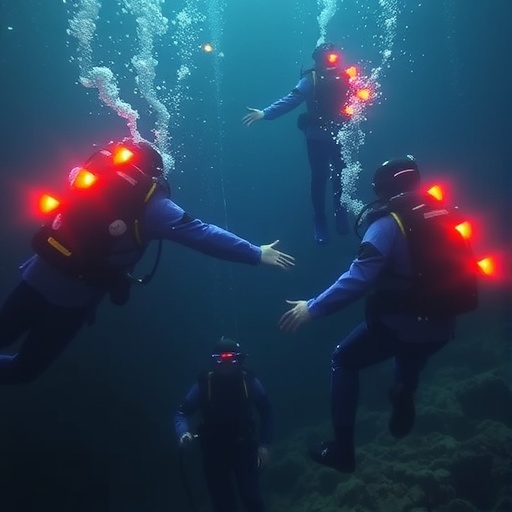
In the rapidly advancing realm of marine technology, a groundbreaking development promises to revolutionize underwater exploration: the integration of digital twin technology with swarms of autonomous underwater vehicles (AUVs). This fusion, meticulously detailed in the forthcoming study by Yan, Zhang, Guan, and colleagues, heralds a new era where the ocean’s depths can be probed with unprecedented precision, coordination, and efficiency. At the heart of this innovation lies the concept of the digital twin, a sophisticated virtual replica of physical entities that enables real-time simulation, forecasting, and control.
The oceans, vast and enigmatic, cover more than 70% of our planet’s surface yet remain among the least charted frontiers due to their complexity and inaccessibility. Traditional methods of underwater exploration, often reliant on manned expeditions or singular automated devices, face limitations in scale and risk. By deploying a swarm of AUVs, each equipped with cutting-edge sensors and communication protocols, researchers can undertake massive parallel missions that map seascapes, monitor wildlife, and gather critical environmental data. However, coordinating such numerous, independent robots in a cooperative manner introduces immense challenges in autonomy, navigation, and data integration.
This is where the digital twin framework intervenes as a transformative solution. In essence, every physical AUV in the swarm has a corresponding digital double operating within a high-fidelity simulation environment. These digital counterparts synthesize real-time data inputs, including positional coordinates, sensor readings, hydrodynamic conditions, and system health metrics, to construct a coherent and dynamic virtual model of the swarm’s collective behavior. This continual feedback loop enables adaptive mission planning and rapid response to unforeseen circumstances, such as shifting currents or mechanical malfunctions.
The power of a digital twin-driven swarm is its capacity for emergent coordination without centralized control. By leveraging machine learning algorithms housed within the virtual arena, individual AUVs negotiate movement patterns, task allocations, and collision avoidance strategies independently yet harmoniously. This decentralized intelligence allows swarms to scale effectively, deploying hundreds or even thousands of units, all while maintaining operational integrity and mission coherence. The concept draws inspiration from biological collectives such as fish schools or bird flocks, where local interactions yield complex global dynamics.
Technically, implementing this system required breakthroughs in communication and computational architecture. Underwater communication notoriously suffers from bandwidth constraints and latency issues. To overcome this, the research introduced an optimized acoustic communication protocol coupled with intermittent surface relays for data synchronization. High-performance edge computing modules embedded within each AUV process raw data locally, diminishing the load on central servers and ensuring rapid decision-making even in communication sparse regions.
The researchers also applied advanced hydrodynamic modeling to enhance the accuracy of the digital twins. Understanding fluid dynamics is critical for predicting vehicle trajectories and energy consumption in diverse underwater currents and turbulence. The virtual models continuously assimilate sensor feedback to refine these simulations, leading to more realistic and reliable predictions. As a result, energy expenditure is minimized, extending operational endurance and allowing longer, more complex missions.
One of the most remarkable achievements of this research is the swarm’s robust fault tolerance. In laboratory and field trials, individual AUV failures, whether mechanical or software-driven, did not compromise the mission. The digital twin network identifies malfunctioning units, recalibrates swarm configurations accordingly, and reallocates tasks among remaining vehicles. This resilience is vital for long-duration expeditions in harsh environments, where maintenance opportunities are scarce.
From an applications perspective, the digital twin-driven swarm paves the way for transformative advances in marine science and industry. It enables high-resolution seafloor mapping crucial for understanding geological processes and locating underwater resources such as rare minerals or archaeological artifacts. Environmental monitoring benefits immensely by detecting pollution plumes, assessing coral reef health, and tracking migratory marine species on scales unachievable by current methods.
Furthermore, the autonomous nature of the swarm significantly reduces human risk and operational costs. Deep-sea expeditions, traditionally expensive and time-consuming, can now be conducted continuously and remotely with automated oversight. This democratization of ocean exploration unlocks opportunities not only for large research institutions but also smaller entities and developing nations seeking to broaden their marine knowledge.
However, the study also acknowledges remaining challenges. The complexity of digital twin synchronization across vast spatial scales requires further refinement to handle extreme environmental variability and ensure fail-safe autonomy. Ethical considerations around autonomous systems operating in sensitive marine zones are emphasized, prompting calls for comprehensive governance frameworks balancing innovation with conservation imperatives.
Looking ahead, the intersection of digital twins and swarm autonomy raises exciting prospects beyond oceanography. Similar principles could be adapted for terrestrial robotics, atmospheric monitoring, and even extraterrestrial exploration, where distributed systems operate in hostile or inaccessible domains. The modularity of the digital twin architecture allows rapid customization and scaling for diverse tasks, signaling a paradigm shift across multiple technological sectors.
In conclusion, the digital twin-driven swarm of autonomous underwater vehicles represents a monumental leap forward in marine exploration capabilities. By harnessing the synergy of virtual-real integration, distributed intelligence, and adaptive control, this platform unveils a new epoch where the secrets of the deep sea can be unraveled comprehensively, safely, and sustainably. The visionary work by Yan, Zhang, Guan, and their team not only pushes the boundaries of engineering but also enriches humanity’s quest to understand and protect our planet’s blue heart.
As this technology continues to mature, its societal implications will be profound. Enhanced marine data will inform climate models, fisheries management, and disaster response strategies, crucial for addressing global challenges such as biodiversity loss and ocean acidification. The fusion of digital twin technology and robotic swarms encapsulates how interdisciplinary innovation can transform exploratory science from an arduous endeavor into a seamless, intelligent operation, inspiring a new generation of researchers and explorers to dive deeper than ever before.
Subject of Research: Digital twin integration with autonomous underwater vehicle swarms for enhanced marine exploration.
Article Title: Digital twin-driven swarm of autonomous underwater vehicles for marine exploration.
Article References:
Yan, J., Zhang, T., Guan, X. et al. Digital twin-driven swarm of autonomous underwater vehicles for marine exploration. Commun Eng (2026). https://doi.org/10.1038/s44172-025-00571-7
Image Credits: AI Generated
Tags: autonomous underwater vehicleschallenges in underwater navigationcooperative robotics for marine studiescoordination of underwater AUVsdigital twin technologyenvironmental data collection methodsfuture of ocean exploration technologymapping seascapes with AUVsmarine technology advancementsreal-time simulation in marine researchswarm robotics in oceanographyunderwater exploration innovations