A hybrid digital monitoring system combining a handheld squeeze device with a smartphone application demonstrated moderate overall feasibility but experienced notable declines in patient adherence over time, according to a clinical investigation evaluating postsurgical recovery following knee arthroplasty. Conducted under the Medical Research Council framework for developing and evaluating complex health interventions, the exploratory single-arm feasibility study tracked how patients and physical therapists interacted with the novel digital tool known as Grasp. The system was designed to capture categorical pain intensity through direct physical manipulation while logging broader health status parameters via mobile software, offering remote insight into individual rehabilitation trajectories during the critical early postoperative phase.
The study enrolled adult patients undergoing elective knee arthroplasty at Coastal Hospital Hagevik, part of Haukeland University Hospital in Norway, between November 2023 and May 2024. Eligible participants were between 30 and 70 years of age, fluent in Norwegian, and capable of operating a smartphone and providing informed consent. Out of 55 eligible candidates who met the inclusion criteria, 34 consented and entered the trial, representing an initial recruitment rate of 62 percent. The enrolled cohort had a mean age of 61.8 years, ranging from 47 to 70 years, and was 68 percent female. Over the planned six-week observation window, 30 of the 34 participants completed the protocol, resulting in an overall retention rate of 88 percent. Two individuals withdrew consent, one participant was excluded due to device-phone incompatibility, and another discontinued after three weeks because of an unrelated emergent medical condition.
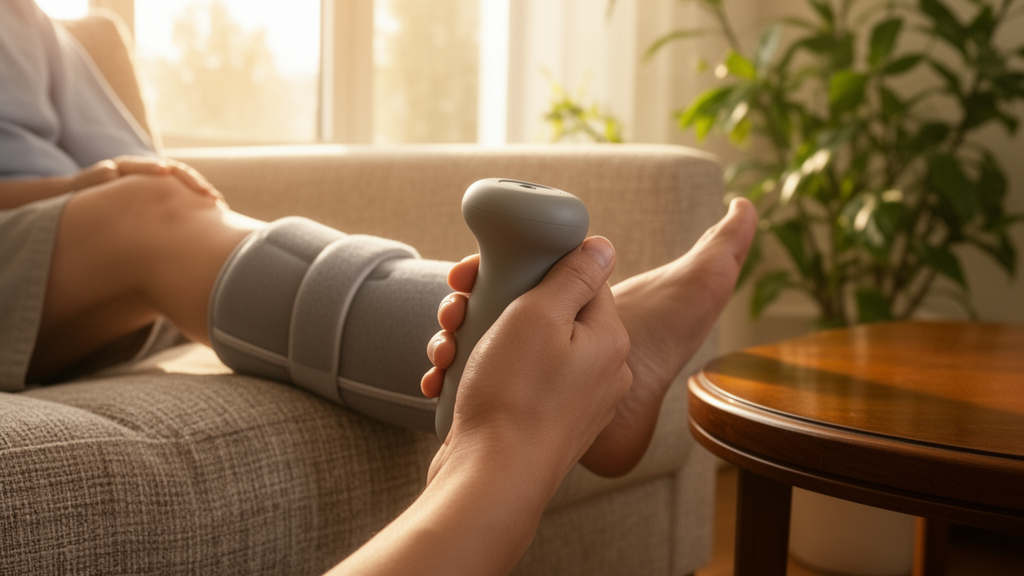
The physical intervention centered on the Grasp device, a soft, bean-shaped tangible tool constructed around a silicone core and an internal force-sensing resistor, paired via Bluetooth to the Grasp Connect smartphone application. Unlike conventional remote-monitoring interfaces that rely exclusively on touchscreens or passive biometric wearables, the tangible device logged pain through deliberate mechanical compression. Squeezes registered electrical voltage changes calibrated individually during hospital onboarding against each participant’s maximum voluntary squeeze force. An integrated light-emitting diode provided immediate visual feedback based on pressure thresholds: green represented zero to 40 percent force for no or very light pain, blue signaled 41 to 70 percent force for acceptable pain that allowed intended activities, and red indicated greater than 70 percent force reflecting unacceptable pain that disrupted activity. Participants also received a detachable sleeve allowing them to carry the hardware around the neck.
Study participants received standardized instructions to record resting pain throughout the day using the device, with a target of approximately five squeezes daily prompted by a light signal flashing every two hours. Resting pain was operationalized as discomfort experienced during routine daily living outside formal rehabilitation exercises, rather than absolute physical immobility. For structured rehabilitation, participants were instructed to record exercise pain using the same categorical system for an intended target of three exercise sessions daily, tied to standardized physiotherapy movements such as knee bending, stretching, and stair climbing. In parallel, participants completed five self-reported health status parameters directly within the smartphone application across a continuous 0 to 100 visual rating scale, reporting morning sleep quality alongside evening logs detailing medication adherence, appetite, physical activity, and general health condition.
Descriptive quantitative evaluations showed substantial reductions in reporting frequency and protocol adherence as the postoperative weeks advanced. In the initial postoperative week, participants recorded a median of 9.0 daily resting pain squeezes with an interquartile range of 3.8 to 14.8, which dropped to a median of 1.4 daily squeezes with an interquartile range of 0.6 to 4.9 by week five. Pain entries during exercise exhibited an even sharper drop, falling from a median of 3.0 daily reports with an interquartile range of 1.0 to 6.0 in the first week to 0.5 daily reports with an interquartile range of 0.0 to 1.0 in week five. To preserve analytical comparability, week six quantitative logs were excluded from adherence denominator calculations because participants completed final clinical visits on varying days across that final calendar week.
Adherence thresholds classified participant engagement into predefined categories based on the proportion of compliant days. For pain logged at rest, mean adherence to the minimum threshold of at least one report per day decreased from 88.9 percent in week one to 60.4 percent in week five, while meeting the target threshold of at least five daily reports fell from 64.2 percent to 27.9 percent. High adherence, defined as meeting requirements on more than 80 percent of monitored days, declined for resting pain from 81 percent of participants in week one to 47 percent in week five at the minimum threshold, and from 45 percent down to 17 percent at the target threshold. Exercise compliance was lower throughout the trial: mean adherence to recording at least one exercise session per day dropped from 60.5 percent in week one to 40.0 percent in week five, while high adherence to the target threshold of three daily sessions dropped to 17 percent by study completion.
In contrast to the declining mechanical device logs, engagement with the smartphone application’s health status questions remained elevated during the scheduled high-frequency phase. In weeks one and two, when twice-daily questionnaires were actively scheduled, mean survey adherence was 85.5 percent and 87.1 percent, respectively, with participants completing an average of 12 out of 14 possible weekly entries. Acceptability questionnaires administered inside the application revealed high usability ratings, completed by 96 percent of participants at two weeks and 73 percent at six weeks. The majority of respondents indicated that the Grasp hardware and software components were manageable and easy to operate. When explaining missed entries, forgetting to squeeze the device was the most frequently selected reason, while participants reported lower perceived utility for recording exercise pain compared to resting pain.
Qualitative findings derived from reflexive thematic analysis of semi-structured interviews with ten patients and a focus group with four hospital physiotherapists elucidated the behavioral mechanisms underlying these numerical patterns. Interpreted post hoc through Bandura’s Social Cognitive Theory, the tangible feedback loop and visual trend displays initially bolstered self-monitoring, symptom awareness, and personal self-efficacy. Patients reported that viewing graphical trend lines leveling out provided tangible psychological reassurance of physical healing. However, early postoperative surgical pain, physical exhaustion, medication side effects, and rigid reminder intervals introduced early friction. Over subsequent weeks, progressive pain stabilization naturally diminished the perceived need for continuous reporting. Technical and conceptual obstacles also emerged, including confusion surrounding what specific movements qualified as reportable exercise, the physical awkwardness of handling hardware during movement, and frustration that the three-level categorical squeeze scale lacked intermediate granularity and could not be corrected if compressed by mistake.
From the clinical perspective, hospital physiotherapists acknowledged the visual summaries as clear and accessible conversation starters prior to routine six-week outpatient reviews, but they raised critical questions regarding workflow compatibility and clinical utility. Clinicians expressed concern that historical pain trend graphs were occasionally misleading, noting that tall visual bars often reflected high squeezing frequency rather than elevated pain severity. Physical therapists emphasized that immediate clinical evaluations depend heavily on present-day physical status, active dialogue, and functional mobility rather than retrospective symptom logs. Furthermore, clinicians voiced apprehension that excessive pain monitoring could inadvertently counter therapeutic efforts to shift patient attention away from pain and toward active functional recovery.
The study authors highlighted several methodological limitations, noting that testing the intervention within a structured research environment may have inflated adherence due to observation bias, that adherence benchmarks were selected pragmatically in the absence of standardized digital health guidelines, and that clinical measurement validity of the squeeze force data was not directly verified. The research team concluded that while tangible mobile symptom tracking is technically feasible and capable of supporting early postoperative awareness, clinical implementation requires substantive refinements. Recommended modifications include shortening total intervention duration, eliminating or restructuring the exercise recording interface, establishing adaptable reporting schedules, introducing editable data entries, refining categorical pain gradations, and formally validating symptom outputs before testing efficacy in prospective clinical trials.
Subject of Research: Feasibility and user experience of a tangible squeeze device and mobile application for postoperative recovery monitoring after knee arthroplasty
Article Title: Using a tangible device and mobile application for pain and recovery monitoring after knee arthroplasty: a mixed-methods analysis of feasibility and user experience
Article References: Rotevatn, E. Ø., Paz, E. S., Løkeland, L. S., Engan, M., Guribye, F., & Rygh, L. J. (2026). Using a tangible device and mobile application for pain and recovery monitoring after knee arthroplasty: a mixed-methods analysis of feasibility and user experience. BMC Digital Health, 4(1), Article 30. https://doi.org/10.1186/s44247-026-00264-x
Image Credits: AI Generated
DOI: 10.1186/s44247-026-00264-x
Keywords: knee arthroplasty, pain monitoring, Grasp system, tangible user interface, mobile health, postoperative rehabilitation, feasibility study, mixed-methods research, Medical Research Council framework, patient adherence, self-monitoring, Bandura social cognitive theory, physiotherapy, digital health, recovery trajectories, symptom tracking
News Source: Ophelia Keating. (November 14, 2026). Digital Squeeze Device Shows Feasibility but Declining Use After Knee Surgery. Scienmag.