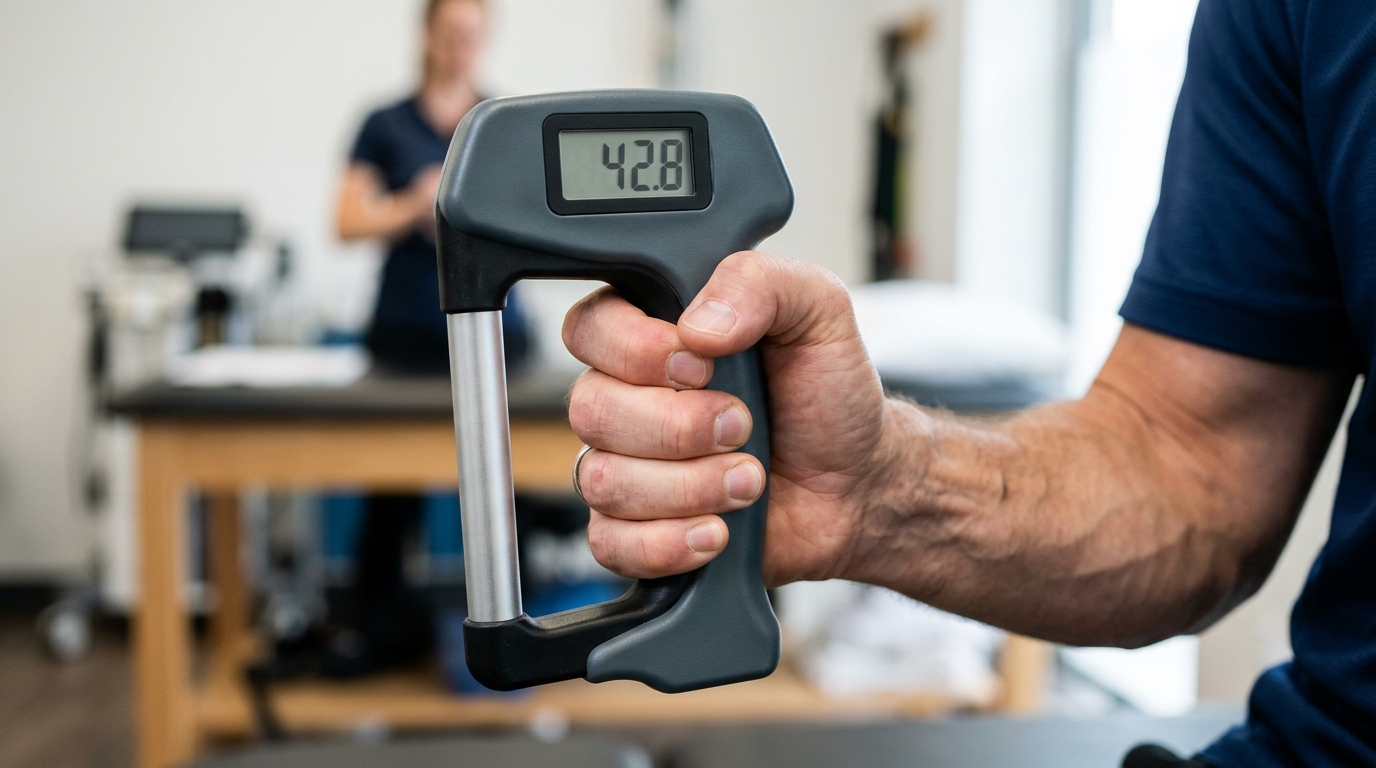
Digital handgrip dynamometers demonstrate high test-retest reliability but show systematic measurement differences that limit their interchangeability during musculoskeletal evaluations, according to an assessment of three commercial devices published in BMC Sports Science, Medicine and Rehabilitation. While handgrip strength is a widely applied indicator of upper extremity function and a critical field-based tool in sports medicine for injury screening, rehabilitation monitoring, and return-to-sport decisions, comparative data regarding device precision and agreement have remained limited.
To evaluate these properties, researchers tested three digital instruments: GripAble, K-Force Grip, and the JTech Commander Echo Grip. The investigation recruited twenty-five healthy adult participants, consisting of 15 females and 10 males with a mean age of 36.2 ± 11.8 years and no history of upper extremity injury. Each participant completed two identical testing sessions separated by an interval of 7 to 18 days.
The evaluation calculated intraclass correlation coefficients, standard error of measurement, and minimal detectable change at the 95% confidence level to assess reliability and precision. All three digital dynamometers demonstrated excellent test-retest reliability across sessions, with intraclass correlation coefficients ranging from 0.88 to 0.95. Among the tested instruments, K-Force recorded the lowest standard error of measurement values at 1.36 to 1.63 kg, alongside the lowest minimal detectable change thresholds, reflecting greater measurement precision and sensitivity to change.
Inter-device agreement among the three systems was rated as good, producing intraclass correlation coefficients between 0.851 and 0.873, yet repeated-measures analyses and Bland-Altman limits of agreement revealed substantial discrepancies. GripAble consistently yielded substantially lower absolute force measurements than JTech and K-Force, displaying an estimated bias of approximately 26.37% to 30.47% along with wide limits of agreement and evidence of both fixed and proportional bias. Conversely, JTech and K-Force exhibited narrower limits of agreement and minimal bias, indicating closer relative alignment, though the magnitude of these limits remains clinically non-negligible without predefined acceptance criteria.
Because systematic variations in absolute force values restrict interchangeability between different devices, the study authors recommend that clinicians and researchers employ the same dynamometer consistently across longitudinal assessments. The trial established device-specific minimal detectable change values ranging between 3.77 and 5.87 kg as benchmarks for identifying true measurement changes in healthy individuals. Because the study was conducted exclusively in healthy adults, further investigations are required to establish device performance and applicability in athletic and clinical populations.
Subject of Research: Reliability and interchangeability of digital handgrip dynamometers in healthy adults
Article Title: Digital handgrip assessment in musculoskeletal health: reliability, measurement precision, interchangeability, and clinical implications for rehabilitation and sports medicine
Article References: Akgün, İ., Ergen, H. İ., Torres-Pardo, A., Pancar, Z., & McGee, C. (2026). Digital handgrip assessment in musculoskeletal health: reliability, measurement precision, interchangeability, and clinical implications for rehabilitation and sports medicine. BMC Sports Science, Medicine and Rehabilitation. https://doi.org/10.1186/s13102-026-02225-3
Image Credits: AI Generated
DOI: 10.1186/s13102-026-02225-3
Keywords: handgrip strength, digital dynamometers, measurement precision, test-retest reliability, sports medicine, rehabilitation, interchangeability, musculoskeletal health, Digital, handgrip, assessment, musculoskeletal
News Source: Ophelia Keating. (November 7, 2026). Digital Handgrip Dynamometers Show High Reliability but Limited Interchangeability in Adult Testing. Scienmag.