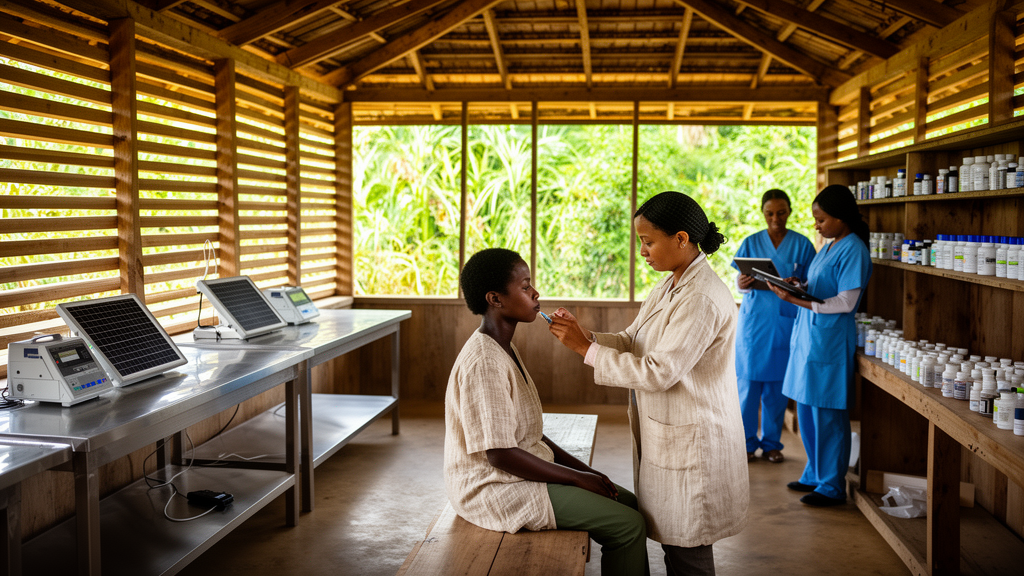
A comparative health systems analysis of Brazil, Rwanda, and China demonstrates that developing countries achieve universal health coverage not by replicating pure historical models from high-income nations, but through an adaptive process termed institutional assembly under constraints. Classical frameworks such as the tax-financed Beveridge model in the United Kingdom or the employment-linked Bismarck social insurance system in Germany and France rely fundamentally on mature administrative reach, formal employment structures, and broad domestic tax bases. Because developing economies face constrained fiscal resources, extensive informal labour markets, and fragmented administrative systems, the direct transplantation of these historical architectures proves largely unfeasible. Instead, the researchers show that these three nations have constructed functional universal health coverage pathways by selectively adapting elements from classical designs, integrating local historical legacies, and innovating pragmatic institutional mechanisms calibrated to their specific political and economic limitations.
To evaluate the long-term trajectories of these varied institutional structures, the study tracked progress using the World Health Organization Universal Health Coverage Service Coverage Index from 2000 to 2021 across Brazil, Rwanda, China, and regional benchmarks. This composite metric evaluates the coverage of essential health interventions across fourteen tracer indicators, encompassing reproductive, maternal, and child health, infectious diseases, non-communicable illnesses, and fundamental service capacity. Brazil consistently maintained the highest baseline among the three, rising from an index score of 68 in 2000 to a peak of 82 between 2015 and 2017 before settling at 80 in 2021, tracking just above the Americas regional average of 80. China exhibited the steepest upward trajectory over the two-decade span, surging from an initial index score of 47 in 2000 to 81 by 2021. This substantial increase elevated China far above the broader Asian regional average and brought its service coverage level on par with Brazil and the Americas benchmark. Rwanda demonstrated steady structural progress from an initial score of 19 in 2000 to 48 in 2017 and 49 in 2021, mirroring and slightly exceeding the African regional average, which climbed from 27 to 47 over the same observation window.
The institutional architecture established in Brazil relies predominantly on Beveridge-style mechanisms, establishing universal healthcare as a constitutional right through public financing and direct service provision. Prior to the late 1980s, Brazil’s healthcare arrangements primarily served formally employed individuals through selective private-sector contracts, leaving the majority of the population dependent on unstable philanthropic and municipal services. The creation of the Unified Health System, known as Sistema Único de Saúde or SUS, under the 1988 Constitution fundamentally transformed healthcare into an entitlement of citizenship and an explicit responsibility of the state, guaranteeing comprehensive care free of charge at the point of delivery across all administrative tiers. Operating through a decentralised governance structure shared across federal, state, and municipal authorities, SUS successfully expanded primary care networks and medical consultations, contributing to verifiable reductions in avoidable hospital admissions. However, public investment in SUS remains significantly lower than public expenditure levels seen across OECD nations and comparable middle-income peers, imposing severe operational constraints on the system’s overall capacity.
Because public financing remains constrained despite universal legal entitlements, Brazil has evolved a dualised system where a substantial commercial private sector operates alongside the public network. Consequently, financial risk protection remains an acute vulnerability for Brazilian households, with private out-of-pocket spending remaining notably elevated. Out-of-pocket expenses are driven heavily by retail pharmaceutical purchases from private suppliers, placing a disproportionate financial burden on poorer households. Quality of care within the public sector also faces scrutiny due to documented rates of preventable adverse events and adverse drug reactions. These persistent disparities contribute to depressed public confidence: a 2023 global survey indicated that only 43 percent of Brazilians trusted their national health system to provide optimal care, contrasting with an international average of 51 percent.
Rwanda adopted an alternative configuration of institutional assembly, responding to severe structural bottlenecks following the 1994 genocide, when the health sector was heavily underfunded, fractured, and dependent on direct out-of-pocket payments and volatile external donations. Facing low general tax revenues and an economy dominated by informal employment, Rwandan policymakers could not establish either a standard payroll-based social insurance system or a fully tax-funded public apparatus. The government instead formulated a subsidised Community-Based Health Insurance model, termed Mutuelles de Santé, which became mandatory in 2006 and covers more than 90 percent of the national population. While departing from Beveridge-style general taxation by utilising community-level pooling mechanisms and individual contributions, the system maintains strong centralised state stewardship over enrolment rules, premium schedules, and service standards. To protect equity, premiums were stratified by household wealth categories beginning in 2010, providing subsidised rates or full exemptions for poorer citizens, while insurance administration was centralised in 2015 to improve financial sustainability and risk pooling.
Rwanda’s hybrid insurance design generated substantial improvements in population health metrics and financial protection, alongside notable socioeconomic benefits. By expanding coverage across low-income and agrarian populations, the community-based framework significantly curtailed household out-of-pocket expenditures and lowered rates of catastrophic health spending. Increased healthcare utilisation directly supported major declines in infant mortality and extended national life expectancy, achievements formally commended by UNICEF as among the most significant in recent global health history. Insured households also experienced broader welfare improvements, such as enhanced educational participation among school-age children. In parallel, public trust reached remarkable heights, with international surveys recording the highest citizen confidence in local health facilities worldwide. By 2022, Rwanda allocated 7.9 percent of its gross domestic product to healthcare, translating to 76.80 US dollars per capita and substantially outpacing regional neighbours such as Tanzania, Uganda, and Ethiopia, which recorded expenditure levels between 2.9 and 4.4 percent of GDP.
Despite these achievements, Rwanda’s healthcare model remains vulnerable to external financing shocks and changing disease burdens. A significant share of national health expenditure continues to rely on external donor funding, meaning that unexpected reductions or delays in international assistance place immediate budgetary pressure on domestic revenues to sustain subsidised coverage.
China approached universal health coverage through a decentralised, multi-tiered insurance structure coordinated under strong central planning guidance. Following market reforms in the late twentieth century, historical urban collective insurance and rural cooperative medical systems disintegrated, leaving the vast majority of the population without health protection by the late 1990s.
Through phased municipal rollouts and matching state financial subsidies, social health insurance coverage in China expanded from below 30 percent in 2003 to more than 95 percent of the national population by 2011, establishing near-universal population enrolment. To reduce institutional fragmentation between rural and urban jurisdictions, national authorities initiated reforms in 2016 to merge the rural cooperative scheme and urban resident insurance into a unified basic insurance platform for all non-working residents. These tangible improvements in accessibility and financial risk mitigation also fostered rising levels of self-reported public satisfaction and perceived healthcare fairness among Chinese citizens over recent decades.
Nevertheless, the structural mechanism enabling China’s rapid expansion generated enduring institutional challenges, particularly regarding system integration and delivery efficiency. While expanded insurance coverage significantly narrowed health disparities across administrative boundaries, it has not automatically guaranteed equitable access to high-quality clinical care, leaving noticeable gaps in care continuity between distinct socioeconomic groups and geographical regions.
Synthesising the trajectories of Brazil, Rwanda, and China underscores that achieving universal health coverage in developing economies requires navigating what health economists describe as the health system trilemma: the structural trade-off among maximizing health outcomes, protecting household wealth, and ensuring equitable social access. Progress across one dimension inevitably introduces systemic pressures across another, compelling governments to balance cost containment against quality improvements. Ultimately, the concept of institutional assembly under constraints shifts international health policy from rigid classifications toward adaptive system building, emphasizing that long-term universal coverage depends on aligning insurance designs with prevailing labour structures, public revenues, and local governance realities.
Subject of Research: Comparative analysis of institutional pathways to universal health coverage in developing nations
Article Title: Institutional assembly under constraints: pathways to universal health coverage in Brazil, Rwanda, and China
Article References: Lin, M., Yang, H., & Yi, J. (2026). Institutional assembly under constraints: pathways to universal health coverage in Brazil, Rwanda, and China. Health Economics, Policy and Law, 1-10. https://doi.org/10.1017/s1744133126100607
Image Credits: AI Generated
DOI: 10.1017/s1744133126100607
Keywords: universal health coverage, health economics, health policy, Brazil, Rwanda, China, institutional assembly, health insurance reform, financial risk protection, community-based health insurance, Beveridge model, Bismarck model, public health financing, health equity, decentralised administration, health systems
News Source: Phoebe Ingram. (November 23, 2026). Developing Nations Build Distinct Pathways to Universal Healthcare Under Resource Constraints. Scienmag.