DETROIT – A research project led by Lobelia Samavati, M.D., professor of internal medicine and molecular medicine and genetics at the Wayne State University School of Medicine, and supported by the National Institutes of Health (NIH), has developed a tool to rapidly and inexpensively diagnose sarcoidosis, a chronic inflammatory disease marked by the growth of tiny lumps called granulomas in the lungs and other organs. The tool, which uses a simple blood test, could allow for selective use of more invasive diagnostic tests often used to identify the disease. The findings were published in the American Journal of Respiratory and Critical Care Medicine.
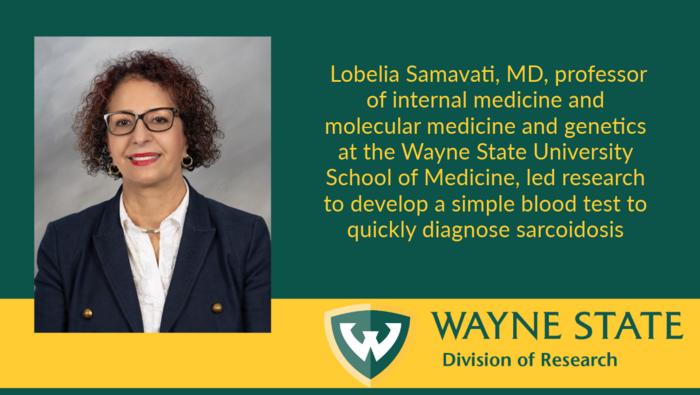
Credit: Wayne State University
DETROIT – A research project led by Lobelia Samavati, M.D., professor of internal medicine and molecular medicine and genetics at the Wayne State University School of Medicine, and supported by the National Institutes of Health (NIH), has developed a tool to rapidly and inexpensively diagnose sarcoidosis, a chronic inflammatory disease marked by the growth of tiny lumps called granulomas in the lungs and other organs. The tool, which uses a simple blood test, could allow for selective use of more invasive diagnostic tests often used to identify the disease. The findings were published in the American Journal of Respiratory and Critical Care Medicine.
“Currently, diagnosing sarcoidosis isn’t a straightforward process and requires tissue removal and testing with additional screenings to rule out other diseases, such as tuberculosis or lung cancer,” said James Kiley, Ph.D., director of the NIH’s Division of Lung Diseases at the National Heart, Lung, and Blood Institute (NHLBI). “Using a blood test will help diagnose faster, particularly in those organs that are more challenging to biopsy and with less harm to the patient.”
Though the exact cause of sarcoidosis is unknown, researchers suspect it is an immune disorder triggered by a group of specific antigens, which are generally foreign substances that incite an immune response in the body. In the United States, an estimated 8-11 people per 100,000 are affected by sarcoidosis each year, according to previous research.
To identify antigens and determine which might be linked to sarcoidosis, scientists collected lung fluid samples and blood cells from patients with pulmonary sarcoidosis, then extracted the genetic material. Using a combination of molecular techniques, the researchers homed in on two newly described disease-specific antigen biomarkers that only bind to the antibodies of sarcoidosis positive patients.
They next designed a highly specific blood test, which only requires a small amount of blood, to determine if they could accurately detect sarcoidosis. To verify the test, researchers compared blood samples from 386 people, which included patients with sarcoidosis, patients with tuberculosis, patients with lung cancer and healthy individuals. The researchers confirmed that their test was able to differentiate patients who had sarcoidosis from those with other respiratory diseases.
“More testing needs to be completed before this screening method is ready for clinical use, but it’s possible that could be a reality within a few years,” said Samavati.
“Dr. Samavati’s important work is an excellent example of how scientific research can have promising results that may lead to addressing major health challenges,” said Ezemenari M. Obasi, Ph.D., vice president for research at Wayne State University. “I look forward to the potential impact this research will have on the lives of those inflicted with sarcoidosis.”
Study: Peng C, Talreja J, Steinbauer B, et al. (2024) Discovery of two novel immunoepitopes and development of peptide-based sarcoidosis immunoassay. Am J Respir Crit Care Med. www.atsjournals.org/doi/abs/10.1164/rccm.202306-1054OC external link
This work was supported by NHLBI grants R01HL113508 and R21HL148089.
###
About Wayne State University
Wayne State University is one of the nation’s pre-eminent public research universities in an urban setting. Through its multidisciplinary approach to research and education, and its ongoing collaboration with government, industry and other institutions, the university seeks to enhance economic growth and improve the quality of life in the city of Detroit, state of Michigan and throughout the world. For more information about research at Wayne State University, visit research.wayne.edu.
About the National Heart, Lung, and Blood Institute (NHLBI): NHLBI is the global leader in conducting and supporting research in heart, lung, and blood diseases and sleep disorders that advances scientific knowledge, improves public health, and saves lives. For more information, visit www.nhlbi.nih.gov.
About the National Institutes of Health (NIH): NIH, the nation’s medical research agency, includes 27 Institutes and Centers and is a component of the U.S. Department of Health and Human Services. NIH is the primary federal agency conducting and supporting basic, clinical, and translational medical research, and is investigating the causes, treatments, and cures for both common and rare diseases. For more information about NIH and its programs, visit www.nih.gov.
NIH…Turning Discovery Into Health
Journal
American Journal of Respiratory and Critical Care Medicine
DOI
10.1164/rccm.202306-1054OC
Method of Research
Experimental study
Subject of Research
People
Article Title
Discovery of Two Novel Immunoepitopes and Development of Peptide-based Sarcoidosis Immunoassay
Article Publication Date
22-Feb-2024
COI Statement
None of the authors of this manuscript had any financial relationship with a commercial company. Wayne State University has filed for comprehensive world-wide patent protection related to this technology through the United States Patent and Trademark Office (USPTO). Patent No. WO2016141347A2.