

• HOME
  • NEWS
  • EXPLORE
    • CAREER
      • Companies
      • Jobs
    • EVENTS
    • iGEM
      • News
      • Team
    • PHOTOS
    • VIDEO
    • WIKI
  • BLOG
  • COMMUNITY
    • FACEBOOK
    • INSTAGRAM
    • TWITTER
Wednesday, April 1, 2026
BIOENGINEER.ORG
No Result
View All Result
  • Login
  • HOME
  • NEWS
  • EXPLORE
    • CAREER
      • Companies
      • Jobs
        • Lecturer
        • PhD Studentship
        • Postdoc
        • Research Assistant
    • EVENTS
    • iGEM
      • News
      • Team
    • PHOTOS
    • VIDEO
    • WIKI
  • BLOG
  • COMMUNITY
    • FACEBOOK
    • INSTAGRAM
    • TWITTER
  • HOME
  • NEWS
  • EXPLORE
    • CAREER
      • Companies
      • Jobs
        • Lecturer
        • PhD Studentship
        • Postdoc
        • Research Assistant
    • EVENTS
    • iGEM
      • News
      • Team
    • PHOTOS
    • VIDEO
    • WIKI
  • BLOG
  • COMMUNITY
    • FACEBOOK
    • INSTAGRAM
    • TWITTER
No Result
View All Result
Bioengineer.org
No Result
View All Result
Home NEWS Science News Health

Detailed structure of the sweat gland revealed

Bioengineer by Bioengineer
July 10, 2017
in Health
Reading Time: 2 mins read
0
Share on FacebookShare on TwitterShare on LinkedinShare on RedditShare on Telegram
IMAGE

Credit: Osaka University

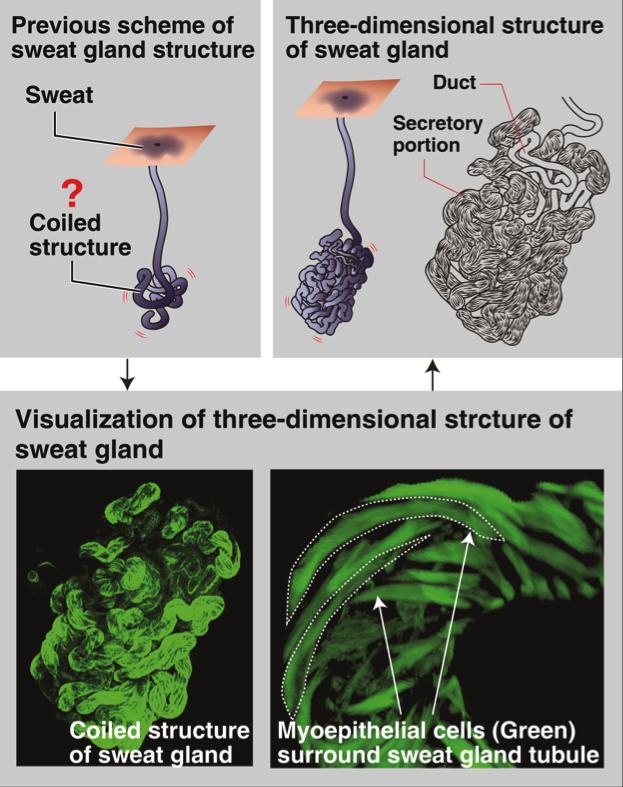
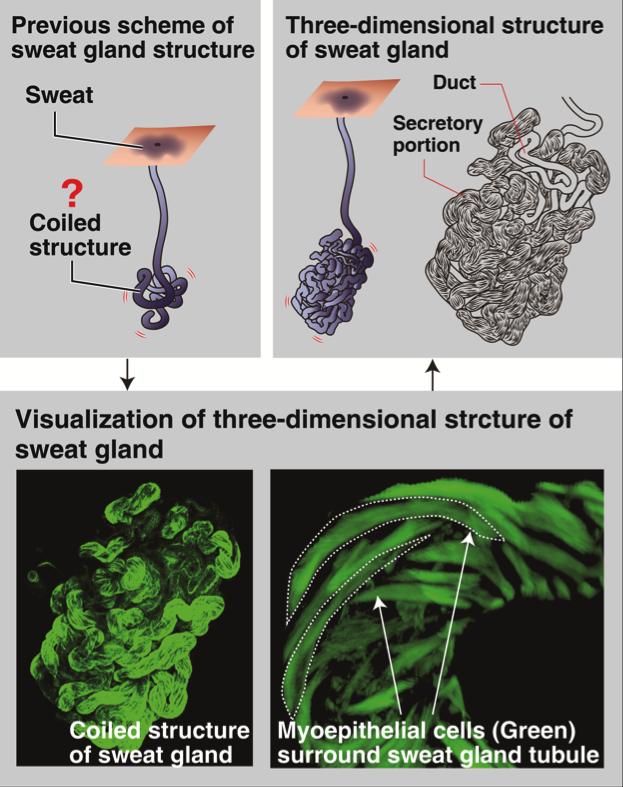
Osaka, Japan – The basic structure of human sweat glands consists of a coiled secretory region deep in the skin and then a tube or duct that conveys the sweat to a pore at the skin surface. However, it has been difficult to obtain more detailed structural insights due to technical limitations and the structural complexity of these glands.

In a major breakthrough that boosts our understanding of how we sweat, a team at Osaka University has applied a recently developed technique called whole-mount immunostaining to study sweat glands, revealing their structure down to the single-cell level and thus shedding light on the functions of their different components. The obtained findings should lead to treatments for disorders of the perspiratory system.

Conventional approaches for studying structural features of tissues involve cutting blocks of tissue into thin sections, and then viewing these sections after applying certain stains or dyes to resolve the features. Although these sections can then be reconstructed in a series to approximate the 3D arrangement of the tissue, this has a drawback in that the sectioning and preparation procedures can disrupt minute structural features. As reported in the journal PLOS One, the Osaka University team has now overcome these issues by applying whole-mount immunostaining to sweat glands after removing adjacent connective tissue in the skin, enabling anatomic features to be observed in a completely intact state.

"Whole-mount immunostaining allows us to view the sweat gland structures seamlessly, without interruptions for sectioning, which is very important given that part of the gland has tubes that are entangled with each other in a very complicated way," Kiyotoshi Sekiguchi says. "We revealed the different cross-sectional shapes of these tubes and the cells that they're made of."

The team's findings reveal the importance of cells called myoepithelial cells working in unison to induce contraction of the secretory part of sweat glands to convey sweat to the exterior. The results also show how nerves and blood vessels interact with the various components of sweat glands, providing hints about how regulation of sweating could go awry.

"This knowledge about sweat gland structure and function could have many clinical applications, and even lead to strategies for treating heatstroke," Ryuichiro Kurata adds. "Because of the high-resolution findings that our approach provides, we can even determine the density of nerve fibers in sweat glands, helping to diagnose specific sweating-related disorders and to select appropriate treatments."

###

Media Contact

Saori Obayashi
[email protected]
81-661-055-886
@osaka_univ_e

http://www.osaka-u.ac.jp/en

Original Source

http://journals.plos.org/plosone/article?id=10.1371/journal.pone.0178709 http://dx.doi.org/10.1371/journal.pone.0178709

Share12Tweet8Share2ShareShareShare2

Related Posts

Frailty, Malnutrition Link Falls to Daily Functioning

April 1, 2026

Dactylides D, E: Novel 22-Membered Polyol Macrolides

April 1, 2026

Cutting-Edge “Smart” Drugs Revolutionize Cancer Treatment

April 1, 2026

Brain Metastases Show Unique Macrophage Spatial Patterns

April 1, 2026
Please login to join discussion

POPULAR NEWS

  • blank

    Revolutionary AI Model Enhances Precision in Detecting Food Contamination

    96 shares
    Share 38 Tweet 24
  • Imagine a Social Media Feed That Challenges Your Views Instead of Reinforcing Them

    1006 shares
    Share 398 Tweet 249
  • Promising Outcomes from First Clinical Trials of Gene Regulation in Epilepsy

    51 shares
    Share 20 Tweet 13
  • Popular Anti-Aging Compound Linked to Damage in Corpus Callosum, Study Finds

    43 shares
    Share 17 Tweet 11

About

We bring you the latest biotechnology news from best research centers and universities around the world. Check our website.

Follow us

Recent News

FGFR2b Links to Biomarkers, Tumor Diversity, Survival

Frailty, Malnutrition Link Falls to Daily Functioning

Dactylides D, E: Novel 22-Membered Polyol Macrolides

Subscribe to Blog via Email

Enter your email address to subscribe to this blog and receive notifications of new posts by email.

Join 78 other subscribers
  • Contact Us

Bioengineer.org © Copyright 2023 All Rights Reserved.

Welcome Back!

Login to your account below

Forgotten Password?

Retrieve your password

Please enter your username or email address to reset your password.

Log In
No Result
View All Result
  • Homepages
    • Home Page 1
    • Home Page 2
  • News
  • National
  • Business
  • Health
  • Lifestyle
  • Science

Bioengineer.org © Copyright 2023 All Rights Reserved.
