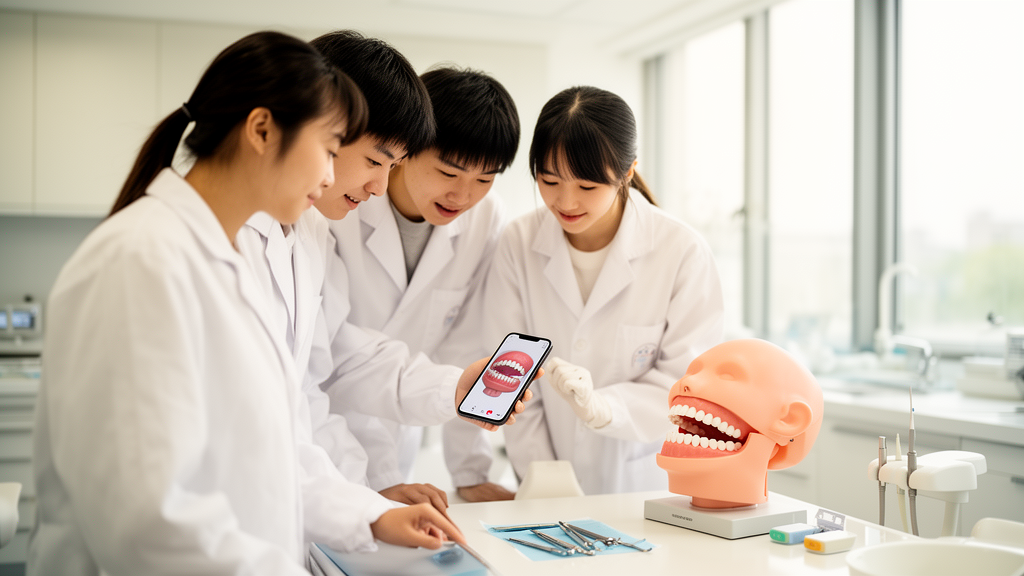
Most dental students at a Chinese university are already using mobile medical learning apps and artificial intelligence tools in their daily studies, and they generally view these technologies positively, according to a survey-based study published in BMC Medical Education.
Researchers at Chongqing Medical University distributed an anonymous, self-administered online questionnaire to dental students across different educational levels. The survey collected demographic information and asked about the use of mobile applications and AI technologies during studies, as well as perceptions and attitudes toward these tools. Attitudinal items were rated on a five-point Likert scale ranging from strongly disagree to strongly agree.
The study received 249 valid responses. Respondents had a median age of 23 years, and 62.7 percent were female. Of these, 229 students, or 92 percent, reported using mobile medical learning apps in their daily study, and more than half, 51.5 percent, used these apps at least once a week.
AI use was even more widespread among app users. Of the 229 students who used mobile medical learning apps, 221, or 96.5 percent, also used AI technologies through some of these apps and websites, and 51.1 percent reported using AI at least once a week.
The three most common reasons for using these apps were improving learning efficiency, assisting with exam preparation, and obtaining the latest medical information, the survey found.
Overall, students perceived the impact of these apps and AI technologies on their studies as positive. When asked about AI in medicine specifically, students rated it as fairly reliable, with a mean score of 3.50 plus or minus 0.73, and technically competent, with a mean of 3.53 plus or minus 0.74, and expressed moderate faith in it, with a mean of 3.44 plus or minus 0.79. Perceived trustworthiness was rated less highly than these other dimensions.
The authors conclude that most dental students used both mobile applications and AI technologies in their studies and generally reported satisfaction with these tools. Students also held an open and positive attitude toward the application of AI in medical education and believed that AI-based tools could enhance their learning engagement and performance.
However, the study carries an important caveat: these perceived benefits have not yet been verified against objective learning outcomes. The survey captures students’ self-reported perceptions and attitudes at a single institution, not measured effects on grades, clinical skills, or knowledge retention.
The authors suggest that future research should balance technological innovation with established pedagogical practices to ensure that AI truly serves educational quality and student development. The findings offer a snapshot of how the next generation of dental professionals in China is integrating digital tools into medical education, while highlighting the need for further evidence on whether these tools deliver measurable learning gains.
Subject of Research: Dental students' use of mobile medical learning apps and AI technologies and their perceptions and attitudes toward AI in medical education
Article Title: A survey-based study on dental students’ perceptions and attitudes toward AI and mobile medical learning apps in Chongqing, China
Article References: Li, S., Zeng, J., Liu, Y., Yu, C., Zhang, C., & Yao, Y. (2026). A survey-based study on dental students’ perceptions and attitudes toward AI and mobile medical learning apps in Chongqing, China. BMC Medical Education. https://doi.org/10.1186/s12909-026-10709-6
Image Credits: AI Generated
DOI: 10.1186/s12909-026-10709-6
Keywords: artificial intelligence, medical education, dental students, mobile learning apps, survey, Chongqing Medical University, China, student attitudes, digital learning, questionnaire study, survey-based, dental
News Source: Courtney Benton. (October 27, 2026). Dental students in China embrace AI and mobile learning apps, survey finds. Scienmag.