In a groundbreaking advance poised to reshape the future of renewable energy, scientists from Qingdao University, Beihang University, and the Chinese Academy of Sciences have unveiled an innovative membrane design featuring ultrahigh-density one-dimensional ionic wire arrays. This cutting-edge development promises to significantly enhance osmotic energy conversion—a process that harvests power from the salinity gradient between seawater and freshwater—by overcoming long-standing challenges that have historically stymied membrane performance.
For decades, the quest to tap into osmotic, or “blue,” energy has been hindered by the trade-offs inherent in ion-exchange membranes. Traditional membranes inevitably struggle to balance two crucial but often conflicting parameters: ion selectivity and ionic conductivity. High selectivity ensures only the target ions travel through the membrane to generate power, whereas high conductivity promotes rapid ion transport to maximize current. Achieving both simultaneously has eluded researchers due to physical and chemical limitations in membrane architecture.
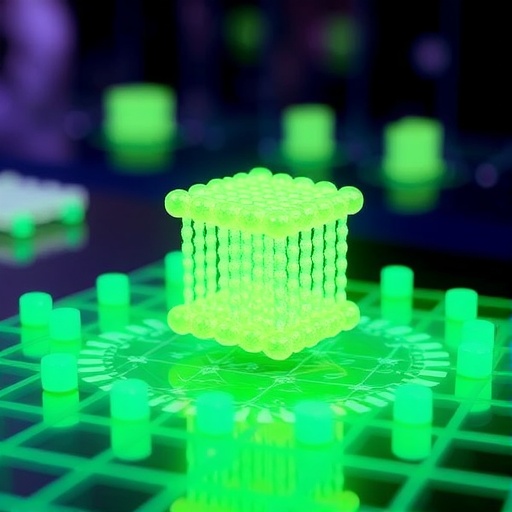
The team’s novel approach leverages the self-assembly of a carefully engineered homopolymer that spontaneously forms one-dimensional ionic wire arrays at an unprecedented density, reaching approximately 10^12 channels per square centimeter. These ionic wires act as meticulously organized nanoscale pathways that channel ions with remarkable efficiency. Such a dense and ordered structure dramatically increases ion flux under salinity gradients, pushing membrane performance to new heights.
What differentiates this membrane from conventional designs is its molecular architecture. By integrating hydrophilic imidazole groups as part of the polymer repeat units, the researchers create ionic cores that facilitate selective anion transport. Surrounding these cores are protective hydrophobic alkyl chains, forming a core-shell structure that both stabilizes the ionic wires and prevents swelling—a notorious issue that undermines membrane integrity and throughput. This anti-swelling property allows the membrane to maintain its structural and functional characteristics even after prolonged exposure to aqueous environments.
The membrane’s ultrahigh ion-exchange capacity, measured around 2.69 meq g⁻¹, is paired with minimal volumetric swelling under 10%, a significant improvement over existing materials. This balance between ion storage capacity and mechanical stability ensures long-term operational reliability, which is essential for practical energy harvesting applications in environments such as estuaries and desalination plants.
Advanced characterization techniques like Wide-Angle X-ray Diffraction (WAXD) and Atomic Force Microscopy (AFM) verified the formation of hexagonally packed ionic wire arrays within the membrane matrix. These analyses confirm that the nanoscale arrangement is indeed highly ordered, setting a new standard for the controlled self-assembly of functional polymers for energy applications.
Electrical measurements further underscore the membrane’s outstanding properties. The system exhibits near-ideal anion selectivity, with a chloride-to-potassium ion selectivity ratio close to 0.99. This near-perfect discrimination allows only charge-compensated ions to pass through efficiently, maximizing the conversion of osmotic potential into usable electrical energy.
Power output tests under artificial salinity gradients ranging from 50- to 500-fold concentration differences demonstrate power densities from 17.0 to 40.5 watts per square meter. Remarkably, when tested with actual seawater and river water, the membrane still delivers a solid 16.6 W m⁻², illustrating its real-world applicability beyond laboratory conditions.
One of the most exciting facets of this design is its long-term stability and recyclability. The membrane maintains over 90% of its initial power density after many hours and multiple cycles of use, addressing a vital requirement for commercial viability where durability under operational stresses is essential.
Additionally, the incorporation of imidazolium groups imbues the membrane with potent antibacterial properties. This dual-purpose functionality directly addresses biofouling — a major issue in marine and riverine environments that leads to performance degradation and frequent costly cleaning or replacement of membranes. This makes the membrane not just efficient but also practical and sustainable for long-term deployment.
This breakthrough offers profound implications for the design of next-generation membranes, showcasing how molecular self-assembly can be precisely tuned to devise nanoarchitectures that overcome fundamental performance limits. It paves the way for extending similar strategies to other membrane-based energy harvesting and separation technologies, such as fuel cells, water purification systems, and selective ion separation platforms.
As global energy demands grow and the transition to clean, sustainable sources accelerates, the ability to efficiently convert osmotic energy from ubiquitous salinity gradients represents a potentially transformative green energy pathway. The high-density 1D ionic wire membrane sets a new benchmark, promising to bridge the gap between laboratory innovation and scalable energy solutions that could help diversify the renewable energy portfolio worldwide.
The multidisciplinary effort exemplifies how advances in polymer chemistry, nanostructure engineering, and electrochemistry converge to tackle grand energy challenges. Continued research will likely explore optimization of channel chemistry and further molecular tailoring to harness even greater efficiencies, holding great promise for future commercial applications.
Subject of Research: High-density ionic wire arrays for osmotic energy conversion
Article Title: High‑Density 1D Ionic Wire Arrays for Osmotic Energy Conversion
News Publication Date: 1-Jan-2026
Web References:
http://dx.doi.org/10.1007/s40820-025-01976-x
Image Credits: Jinlin Hao, Cuncai Lin, Min Zhao, Yilin Wang, Xingteng Ma, Lilong Gao, Xin Sui, Longcheng Gao, Kunyan Sui, Lei Jiang.
Keywords
Energy, Ion-exchange Membranes, Osmotic Energy, Renewable Energy, Nanotechnology, Polymer Science, Ionic Conductivity, Antibacterial Membranes, Membrane Stability, Blue Energy, Nanostructured Materials, Molecular Self-Assembly
Tags: blue energy harvesting advancementsdense ionic wire arraysion-exchange membrane challengesionic conductivity and selectivity balancemembrane architecture breakthroughsnanoscale ion transport efficiencyosmotic energy conversion technologyQingdao University research contributionsrenewable energy innovationssalinity gradient power generationself-assembly of homopolymersultrahigh-density membrane design