• HOME
  • NEWS
  • EXPLORE
    • CAREER
      • Companies
      • Jobs
    • EVENTS
    • iGEM
      • News
      • Team
    • PHOTOS
    • VIDEO
    • WIKI
  • BLOG
  • COMMUNITY
    • FACEBOOK
    • INSTAGRAM
    • TWITTER
Sunday, November 22, 2026
BIOENGINEER.ORG
No Result
View All Result
  • Login
  • HOME
  • NEWS
  • EXPLORE
    • CAREER
      • Companies
      • Jobs
        • Lecturer
        • PhD Studentship
        • Postdoc
        • Research Assistant
    • EVENTS
    • iGEM
      • News
      • Team
    • PHOTOS
    • VIDEO
    • WIKI
  • BLOG
  • COMMUNITY
    • FACEBOOK
    • INSTAGRAM
    • TWITTER
No Result
View All Result
Bioengineer.org
No Result
View All Result
Home NEWS Science News Technology

Degree Proportional Selection Underperforms Uniform Choice Across Empirical Network Datasets

by
November 21, 2026
in Technology
Reading Time: 2 mins read
0
Degree Proportional Selection Underperforms Uniform Choice Across Empirical Network Datasets

Degree Proportional Selection Underperforms Uniform Choice Across Empirical Network Datasets

Share on FacebookShare on TwitterShare on LinkedinShare on RedditShare on Telegram

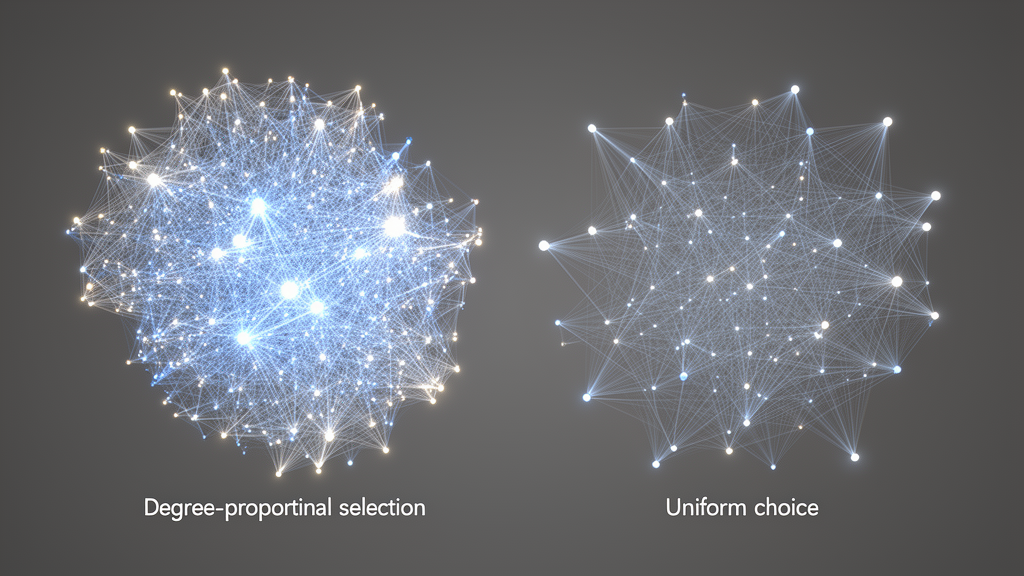
Growing-network models that incorporate triadic closure and preferential attachment serve as controlled mechanism endpoints rather than universal empirical laws, according to an analysis of synthetic and empirical systems published in Applied Network Science. Researchers Sergei Sidorov, Timofei Emelianov, and Sergei Mironov evaluated how distinct neighbor-selection rules govern network evolution, finding that exact degree-proportional attachment consistently performs worse than uniform selection when tested against empirical network data.

Triadic closure represents a fundamental mechanism driving the high clustering observed across social, technological, and biological networks. While the established Holme–Kim model couples triadic closure with preferential attachment, it assumes a uniform selection rule when choosing neighbors during triad formation. To assess this assumption, the authors compared four distinct growing-network models that independently vary the mechanisms governing initial attachment and subsequent triad formation between uniform and preferential selection rules.

Using mean-field and master-equation calculations alongside finite-size numerical simulations, the investigators derived conditional predictions for degree growth and degree distributions. The selection rules strongly altered degree dynamics, clustering, hub formation, and network robustness across the four frameworks. In simulated networks, Model 1 exhibited degree-growth slopes close to one-half, whereas Model 2 displayed decreasing slopes across finite observation windows. Furthermore, incorporating preferential choice into triad formation generated significantly stronger hubs in Models 3 and 4.

The study also identified critical limitations in analytical approximations of network behavior. Closure diagnostics revealed that several fitted parameters remained unstable or failed to reach their proposed saturation regimes during finite-size implementations. In addition, duplicate target attempts remained frequent for high-degree hubs. Because of these finite-size effects and diagnostic instabilities, the authors cautioned that the corresponding asymptotic tail exponents represent theoretical predictions of the mathematical approximations rather than established properties of the implemented finite networks.

To test these theoretical models against real-world systems, the team conducted temporal analyses on four empirical networks: DBLP, CollegeMsg, MathOverflow, and Email-EU. The empirical data revealed positive but sublinear degree bias in DBLP, CollegeMsg, and MathOverflow, while the Email-EU network behaved close to uniform choice. Crucially, exact degree-proportional selection underperformed uniform choice on held-out data across all four empirical datasets, demonstrating that idealized selection rules function as controlled baseline mechanism endpoints rather than universal empirical laws.

Subject of Research: Selection mechanisms and degree dynamics in triadic closure network models

Article Title: Selection mechanisms in triadic closure networks: systematic analysis of uniform and preferential rules

Article References: Sidorov, S., Emelianov, T., & Mironov, S. (2026). Selection mechanisms in triadic closure networks: systematic analysis of uniform and preferential rules. Applied Network Science. https://doi.org/10.1007/s41109-026-00847-7

Image Credits: AI Generated

DOI: 10.1007/s41109-026-00847-7

Keywords: triadic closure, preferential attachment, Holme-Kim model, network clustering, growing networks, degree dynamics, hub formation, network robustness, mean-field calculations, master-equation calculations, degree distribution, sublinear degree bias, DBLP network, CollegeMsg network, MathOverflow network, Email-EU network, finite-size networks, uniform selection

News Source: Denise Maddox. (November 21, 2026). Degree Proportional Selection Underperforms Uniform Choice Across Empirical Network Datasets. Scienmag.

Tags: CollegeMsg networkDBLP networkdegree distributiondegree dynamicsEmail-EU networkfinite-size networksgrowing networksHolme-Kim modelhub formationmaster-equation calculationsMathOverflow networkmean-field calculationsnetwork clusteringnetwork robustnesspreferential attachmentsublinear degree biastriadic closureuniform selection
Share12Tweet7Share2ShareShareShare1

Related Posts

Satellite Greenness Links to City Nitrogen Dioxide Weaken Sharply Under Spatial Validation

Satellite Greenness Links to City Nitrogen Dioxide Weaken Sharply Under Spatial Validation

November 22, 2026
Regional Climate Simulations Reveal Non-Uniform Future Shifts in Canadian Maximum Precipitation

Regional Climate Simulations Reveal Non-Uniform Future Shifts in Canadian Maximum Precipitation

November 22, 2026

Truncated Pyramid Voids Preserve Flexural Strength in Concrete Slabs Under One-Way Bending

November 22, 2026

Microcurrent Signals Precede Failure in Loaded Composite Coal-Rock Structures

November 22, 2026

POPULAR NEWS

  • Regional Climate Simulations Reveal Non-Uniform Future Shifts in Canadian Maximum Precipitation

    Regional Climate Simulations Reveal Non-Uniform Future Shifts in Canadian Maximum Precipitation

    29 shares
    Share 12 Tweet 7
  • Single-Cell Sequencing Uncovers How STAP2 Drives Diabetic Retinal Vascular Dysfunction

    29 shares
    Share 12 Tweet 7
  • Heterozygous BRCA1 Mutations Disrupt Ovarian Blood Vessel Formation Before Cancer Develops

    29 shares
    Share 12 Tweet 7
  • Portable Microfluidic Platform Quantifies Post-Transplant Viral Infections at Point of Care

    29 shares
    Share 12 Tweet 7

About

We bring you the latest biotechnology news from best research centers and universities around the world. Check our website.

Follow us

Recent News

Satellite Greenness Links to City Nitrogen Dioxide Weaken Sharply Under Spatial Validation

Japanese Neonatal Care Shows Higher Survival for Infants Under 24 Weeks

Regional Climate Simulations Reveal Non-Uniform Future Shifts in Canadian Maximum Precipitation

Subscribe to Blog via Email

Enter your email address to subscribe to this blog and receive notifications of new posts by email.

Join 89 other subscribers
  • Contact Us

Bioengineer.org © Copyright 2023 All Rights Reserved.

Welcome Back!

Login to your account below

Forgotten Password?

Retrieve your password

Please enter your username or email address to reset your password.

Log In
No Result
View All Result
  • Homepages
    • Home Page 1
    • Home Page 2
  • News
  • National
  • Business
  • Health
  • Lifestyle
  • Science

Bioengineer.org © Copyright 2023 All Rights Reserved.