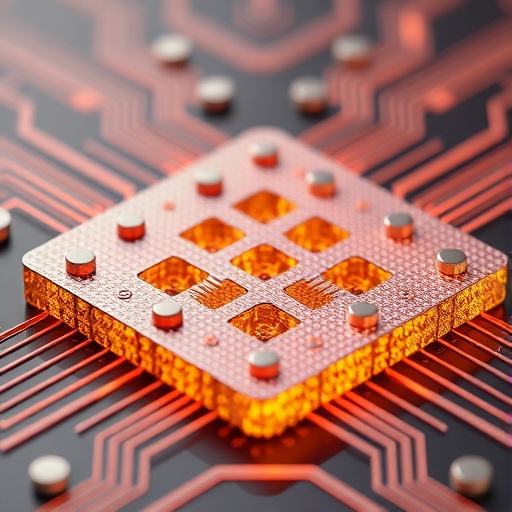
In a remarkable leap forward for flexible electronics and human-machine interfaces, researchers Li, Zhang, Yu, and their collaborators have unveiled an innovative class of deformation-adaptive pressure sensors. These sensors, articulated through a multi-level discrete sensing array architecture, promise to redefine how flexible devices interact with their environments and users. Detailed in the esteemed journal npj Flexible Electronics, their 2026 publication charts a pioneering course in morphing electronics—systems capable of dynamically adapting their shape and function in response to mechanical stimuli—ushering in new possibilities for wearable technology, robotics, and beyond.
At the heart of this breakthrough lies an ingenious design that transcends traditional pressure sensor paradigms, which typically suffer from limited sensitivity and spatial resolution when subjected to complex, non-uniform deformations. By integrating multi-level discrete sensing arrays, these sensors spatially and functionally separate detection elements, enabling unprecedented precision in capturing subtle pressure changes across flexible substrates. This architecture not only facilitates a high-fidelity response under deformation but also ensures adaptability to various bending, twisting, and stretching modes that flexible electronics commonly undergo.
Underlying the sensor’s performance is a sophisticated mechanism that mimics the hierarchical sensory structures found in biological systems. The discrete array configuration allows each sensing node to operate semi-independently, thus localizing pressure detection and mitigating noise interference caused by mechanical strain. Such biomimetic engineering leverages the benefits of compartmentalization, whereby deformation-induced signals are distinctly parsed, leading to an overall enhancement in sensor accuracy and robustness.
Methodologically, the team harnessed advanced materials engineering techniques, incorporating ultrathin, stretchable conductive films paired with innovative microfabrication processes. The resultant arrays are embedded within elastomeric matrices, which confer mechanical compliance without sacrificing electrical integrity. This synergy between material science and device engineering overcomes the perennial challenge of maintaining sensor performance amidst continuous and dynamic deformation cycles, a notorious limitation in flexible sensor development.
The sensors exhibit remarkable sensitivity ranges, detecting pressure variations as minute as a few pascals while maintaining operational stability over extensive strain regimes. This robustness is indicative of meticulous calibrations and rigorous testing protocols that the researchers employed, involving cyclic deformation experiments that mimic real-world applications such as skin-like interfaces and adaptable robotic grippers.
Beyond experimental accomplishments, the research delineates comprehensive models that describe the electromechanical response of the sensor arrays. These theoretical frameworks elucidate the relationship between mechanical deformation modes and resultant electrical output signals, providing predictive capability critical for optimizing sensor configurations for specific applications. Such modeling advances the practical utility of these sensors by enabling tailored designs based on intended operational contexts.
Perhaps most compelling is the potential application spectrum foreseen by the researchers. In human-machine interaction scenarios, these sensors could vastly improve prosthetic limb control and tactile feedback systems, allowing devices to accurately sense contact forces and adapt accordingly. Moreover, in wearable health monitoring, the sensors can track subtle physiological signals, such as pulse and muscle contractions, with enhanced spatial resolution, enabling more precise biometric analyses.
The morphing electronics concept intrinsic to this work pushes the boundary of traditional rigid electronics, proposing devices that are inherently dynamic and responsive. This capability to morph, or physically conform and react to external stimuli, is particularly beneficial for soft robotics, where integrating such pressure sensors could yield machines capable of delicate manipulations and nuanced environmental interactions previously unattainable.
Furthermore, the research addresses critical challenges related to sensor fabrication scalability and integration with existing electronic platforms. The fabrication strategy highlights compatibility with scalable manufacturing processes, suggesting that these advanced sensors could feasibly transition from laboratory prototypes to commercial products. Additionally, their incorporation into diverse circuitry frameworks underscores their versatility across different device architectures.
In terms of interdisciplinary impact, the sensor technology bridges materials science, electrical engineering, and biomechanics, fostering innovation at their intersections. This convergence is vital for advancing next-generation flexible electronics, where seamless integration of sensor functionality with adaptive structural elements dictates the performance ceiling.
The team’s approach foregrounds sustainability considerations by employing environmentally benign materials and processes, aligning with growing imperatives toward green electronics manufacturing. The durability and reusability of the sensors further amplify their appeal for wide-scale deployment, reducing electronic waste and enhancing lifecycle performance.
Intriguingly, this advancement also opens avenues for exploring tactile internet and augmented reality applications, where high-fidelity pressure sensing is paramount for real-time immersive experiences. Integrating these sensors could enable devices capable of perceiving and reacting to human touch with unprecedented accuracy and responsiveness, revolutionizing virtual interactions.
The study’s comprehensive experimental data, coupled with in-depth theoretical insights, provide a valuable resource for the scientific community aiming to push the envelope of flexible sensor technology. It lays a robust foundation for future explorations into multi-sensory array integration and novel material composites, potentially catalyzing breakthroughs in smart textiles, interactive surfaces, and bio-integrated electronics.
In sum, the deployment of multi-level discrete sensing arrays within deformation-adaptive pressure sensors marks a transformative milestone. By harmonizing material innovation, architectural ingenuity, and application versatility, this technology holds enormous promise to sculpt the future landscape of flexible electronics and human-machine symbiosis, heralding devices that are more sensitive, adaptive, and intimately responsive to the demands of the dynamic world they inhabit.
Subject of Research: Deformation-adaptive pressure sensors utilizing multi-level discrete sensing arrays for flexible and morphing electronic applications, particularly focusing on human-machine interaction.
Article Title: Deformation-adaptive pressure sensors based on multi-level discrete sensing arrays for morphing electronics and human–machine interaction.
Article References:
Li, C., Zhang, J., Yu, H. et al. Deformation-adaptive pressure sensors based on multi-level discrete sensing arrays for morphing electronics and human–machine interaction. npj Flex Electron (2026). https://doi.org/10.1038/s41528-025-00522-4
Image Credits: AI Generated