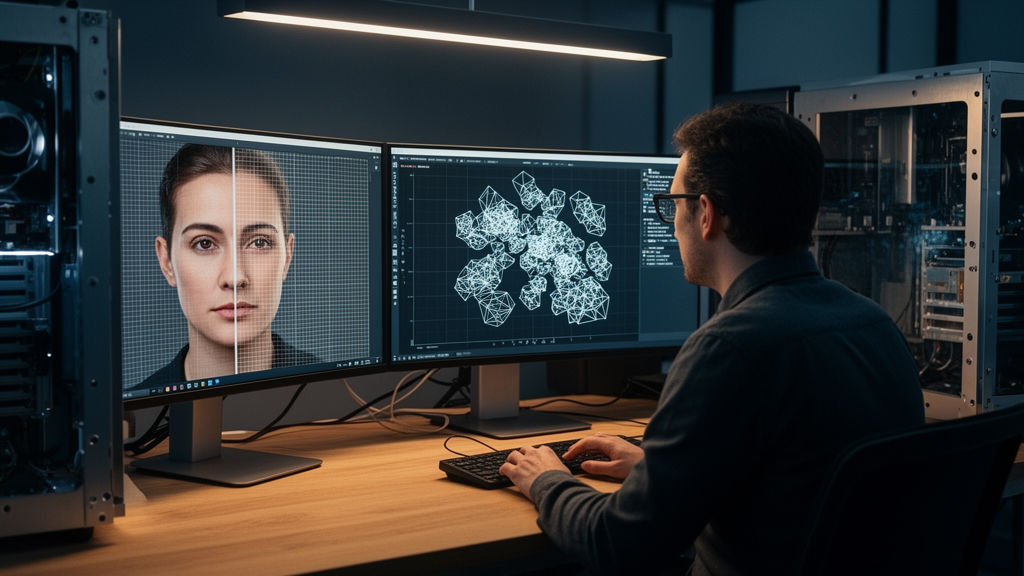
Researchers Tianli Guo and Yunqi Tang have presented a deepfake face image source tracing framework that achieved an overall tracing accuracy of 0.9911 through the analysis of discriminative latent features. Published in the International Journal of Legal Medicine, the study directly addresses a notable shortcoming in contemporary multimedia forensics, where conventional research remains largely focused on binary authenticity classification. While binary tools can determine whether a given face image is authentic or synthetic, that binary output fails to satisfy practical judicial tracing demands. In forensic identification, identifying the specific deepfake generation method responsible for an image is critical for extending the evidentiary value of digital evidence in legal and investigative contexts. To bridge this gap, the authors developed a fine-grained prototype designed to trace forged face images back to their underlying generation mechanisms.
To establish and evaluate the source tracing system, the authors assembled an extensive experimental dataset spanning 31 distinct categories and 620,000 images representing mainstream facial forgery mechanisms. This collection comprised one real-face class alongside 30 separate deepfake classes. To extract discriminative latent features from this varied imagery, the researchers designed a multi-classification neural network based on the EfficientNet-B4 architecture.
The proposed framework converts the latent feature representations into 31-dimensional confidence vectors corresponding to the classification categories. To establish structured reference points for attribution, the researchers carried out hierarchical clustering on these latent feature-derived confidence vectors. This clustering analysis identified 10 optimal clusters across the feature space. The team then designated the geometric cluster centers as tracing anchors.
In experimental evaluations, the multi-classification model combining the base EfficientNet-B4 network with hard-class weighting achieved an accuracy of 0.9568. Performance across individual categories was consistently high, with nearly all classes attaining Top-3 accuracy above 0.97. Furthermore, all 30 deepfake forgery classes demonstrated homologous consistency rates exceeding 0.95, contributing to the framework’s overall tracing accuracy of 0.9911. Beyond testing on known manipulation classes, the investigators evaluated the framework’s behavior against previously unencountered manipulation techniques using the Roop face-swap tool. That validation confirmed the preliminary feasibility of the tracing framework when confronted with one type of unseen forgery.
The authors concluded that the framework successfully upgrades digital face forensics from simple binary authenticity discrimination to a fine-grained source-tracing prototype, establishing technical foundations for future applications in digital forensic identification and criminal investigation. Nevertheless, the study highlighted clear operational boundaries prior to practical forensic deployment. The current implementation remains an experimental prototype, and the authors explicitly identified two priorities for future research: expanding the category dataset to encompass a wider spectrum of emerging manipulation techniques and optimizing the model’s adaptability under variable, real-world forensic conditions before active deployment can be realized.
Subject of Research: Forensic source tracing of deepfake face images via latent feature analysis
Article Title: Deepfake face image source tracing via latent feature analysis
Article References: Guo, T., & Tang, Y. (2026). Deepfake face image source tracing via latent feature analysis. International Journal of Legal Medicine. https://doi.org/10.1007/s00414-026-04060-0
Image Credits: AI Generated
DOI: 10.1007/s00414-026-04060-0
Keywords: deepfakes, forensic identification, image forensics, latent feature analysis, source tracing, EfficientNet-B4, digital evidence, facial manipulation, Deepfake, face, image, source
News Source: Ophelia Keating. (November 11, 2026). Deepfake Image Tracing Framework Achieves High Accuracy Through Latent Feature Analysis. Scienmag.