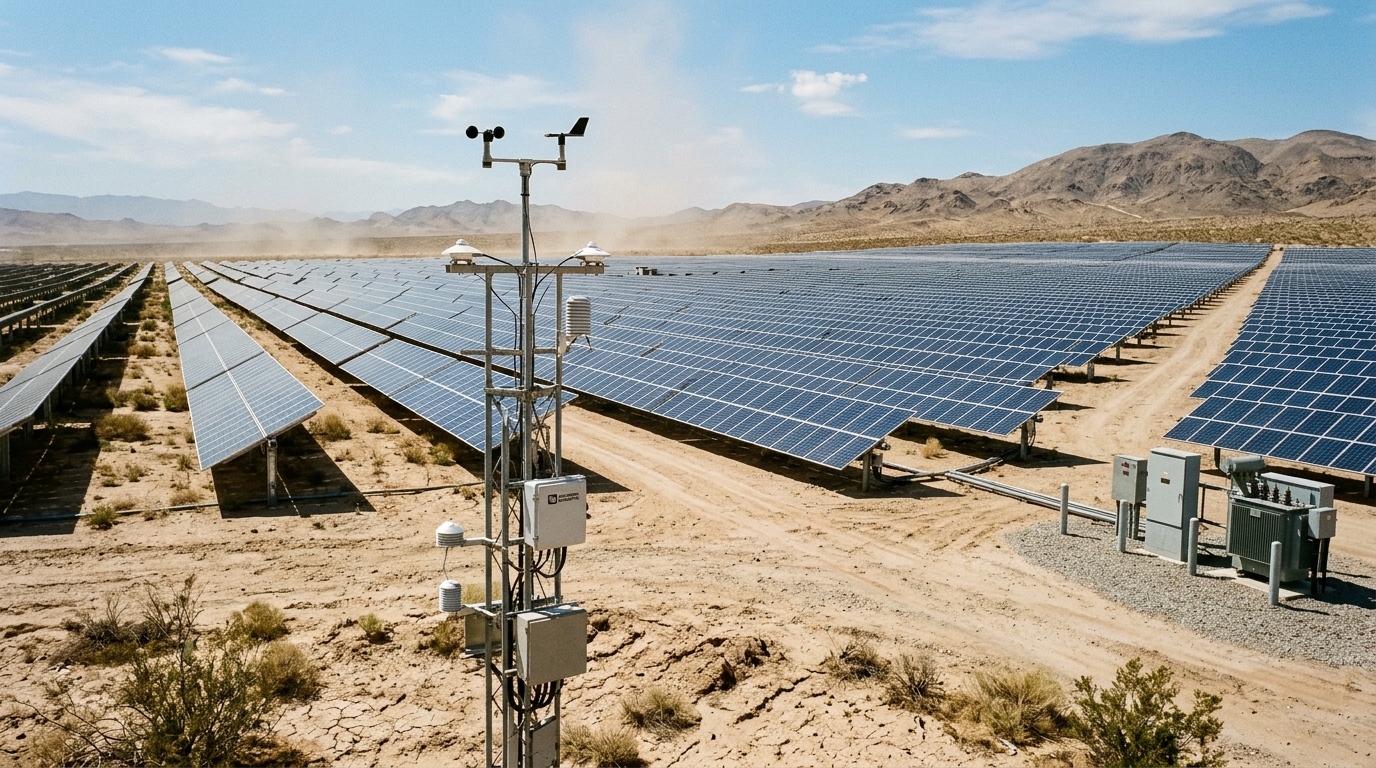
A comprehensive cross-location evaluation of deep learning architectures across solar photovoltaic installations in Oman has uncovered a fundamental trade-off between localized prediction accuracy and multi-site generalisation. Researchers evaluating Long Short-Term Memory networks and Temporal Fusion Transformers across ten school-based solar arrays discovered that single-site recurrent models achieve impressive accuracy when evaluated on climatically similar test locations, reaching a best root mean square error of 43.0 kilowatts and a coefficient of determination of 0.989. However, these recurrent networks degraded substantially when transferred across divergent climates or when tasked with processing multi-site data. Conversely, attention-based Temporal Fusion Transformers trained on pooled regional data demonstrated superior cross-location resilience, outperforming recurrent networks by up to 57.0 percent in root mean square error at climatically challenging desert sites. The comparative study provides empirical benchmarks for month-ahead and year-ahead photovoltaic power forecasting, establishing operational guidance for grid investment and capacity planning across high-irradiance arid environments.
Accurate long-term solar forecasting spanning month-ahead and year-ahead planning horizons represents an essential operational requirement for modern electrical grid balancing, capacity adequacy evaluations, and renewable infrastructure investment. The Sultanate of Oman occupies an exceptionally favorable geographic position for photovoltaic generation, receiving daily average horizontal solar irradiance between 5.5 and 6.0 kilowatt-hours per square meter alongside more than 3,000 annual hours of sunshine. Under the national development roadmap Oman Vision 2040, government planners target generating 30 percent of total domestic electricity from renewable resources by 2030. Despite this immense natural resource potential, renewable sources including solar and wind generation accounted for only approximately 4 percent of total national electricity production in 2023. Bridging this substantial deployment gap requires dependable predictive tools capable of anticipating seasonal generation dynamics, yet machine learning research has historically concentrated on short-term horizons spanning minutes to days rather than multi-month infrastructure horizons.
Traditional time-series methods such as autoregressive integrated moving average formulations frequently struggle with nonlinear meteorological dependencies and suffer acute accuracy degradation over extended forecast horizons. Over the preceding decade, Long Short-Term Memory networks emerged as the primary deep learning baseline for solar time-series forecasting due to their sequential modeling capabilities. Nevertheless, recurrent networks function as opaque black-box systems lacking native mechanisms to process static site metadata or provide transparent feature attribution. To resolve these operational shortcomings, researchers increasingly look to the Temporal Fusion Transformer, an advanced deep learning architecture that integrates recurrent encoder-decoder layers with interpretable multi-head attention mechanisms, gated residual networks, and variable selection networks. While the transformer architecture has demonstrated skill in short-term European and North American solar forecasting, it had never been systematically benchmarked against tuned recurrent baselines across geographically diverse sites in an underrepresented arid territory.
To establish a rigorous multi-climate benchmark, the investigation gathered three continuous years of high-resolution sensor telemetry collected between 1 January 2020 and 9 November 2022 from ten grid-tied school photovoltaic systems across Oman. Each standardized solar installation features two inverters rated at approximately 65 kilowatts each for an aggregate site capacity of roughly 130 kilowatts, paired with co-located meteorological sensors recording plane-of-array irradiance, global horizontal irradiance, ambient temperature, relative humidity, atmospheric pressure, and wind dynamics. The monitored arrays span seven of Oman’s eleven governorates, capturing diverse climatic regimes including the coastal plains of Al Batinah, inland desert highland plateaus in Al Dakhiliyah, hyper-arid desert terrain in Al Wusta, and humid coastal monsoon zones across southern Dhofar. Ambient conditions during the logging campaign exhibited extreme environmental variability, with recorded temperatures ranging from 9.4 to 48.1 degrees Celsius, relative humidity fluctuating between 1.9 and 99.0 percent, and surface wind speeds reaching 15.95 meters per second.
Raw five-minute telemetry underwent a disciplined five-stage preprocessing protocol to prevent data leakage and preserve physical fidelity. Technicians first eliminated nighttime sensor noise and calibration drift by resetting negative power and irradiance values to zero, followed by summing the discrete outputs of both on-site inverters into a single composite power metric representing total instantaneous generation. Data streams were subsequently aggregated to hourly averages for weather inputs and hourly sums for power output in month-ahead experiments, whereas year-ahead transformer evaluations utilized daily resampling. Missing observations, which ranged from 0.52 percent at Barka to 23.32 percent at Al-Kamil, were resolved through sequential forward-filling and backward-filling. Two problematic installations were excluded from primary modeling: Nizwa, which exhibited an anomalous peak capacity of only 26.5 kilowatts, and Al-Kamil, owing to extensive data gaps. The remaining eight locations yielded individual datasets alongside a merged all-locations dataset incorporating discrete site identification codes.
Feature selection combined Pearson correlation analysis with physical principles of photovoltaic semiconductor behavior in hot, dusty climates. Global horizontal irradiance demonstrated the strongest linear correlation with power output at 0.87, followed by ambient temperature at 0.34 and relative humidity at negative 0.31. Although wind speed registered a lower correlation of 0.18, investigators retained it because airflow provides convective cooling that mitigates thermal panel efficiency losses while simultaneously modulating particulate soiling rates in desert environments. Plane-of-array irradiance was omitted because its absolute correlation of 1.0 with global horizontal irradiance introduced complete multicollinearity without offering unique predictive information. The recurrent model was tuned using three-fold temporal cross-validation on the held-out Nizwa installation, yielding an architecture with 64 hidden units, a 0.1 dropout regularisation rate, and a 168-hour look-back window for 730-hour month-ahead forecasting, trained across three independent random seeds.
The study implemented a demanding cross-location evaluation protocol encompassing 35 distinct transfer experiments, training models on specific individual sites or the merged dataset before evaluating them across entirely unseen geographical stations. For recurrent models, incorporating location identity produced a median root mean square error deterioration of 187 percent across evaluation pairs, culminating in an extreme error escalation exceeding 195,000 percent when a model trained on Al-Kihil encountered unseen test telemetry from Ibri. Because standard recurrent layers lack dedicated mechanisms for invariant metadata, they treat static site identifiers as dynamic sequential inputs, destabilising learned relationships between meteorological features and electrical generation. Conversely, the Temporal Fusion Transformer successfully ingested static covariates through specialized encoder pathways that preserved regional context without corrupting time-series processing.
In month-ahead forecast comparisons spanning 730 future hours, single-site recurrent models demonstrated remarkable localized skill, maintaining strong cross-location generalisation across closely matched climates. Recurrent networks trained on data from Ibra achieved excellent accuracy when transferred to Barka and Duqum, yielding root mean square errors of 30.2 kilowatts and 31.6 kilowatts alongside coefficients of determination exceeding 0.99. In contrast, single-site transformers struggled severely when trained on modest data volumes, frequently exhibiting errors 35 to 70 percent higher than corresponding recurrent models; the transformer trained on the limited 14,621 samples from Al-Kihil failed to converge productively, producing negative coefficients of determination and errors surpassing 396 kilowatts. However, this competitive dynamic reversed entirely when architectures ingested the merged all-locations dataset. Pooled multi-site transformer training outperformed pooled recurrent networks by 57.0 percent at Duqum, 45.3 percent at Murbat, 36.2 percent at Ibra, and 27.2 percent at Yunqul.
Evaluating extended year-ahead horizons spanning 8,670 hours revealed counterintuitive structural behavior across model families. While individual-site recurrent models exhibited expected accuracy declines over annual horizons, the multi-site recurrent model unexpectedly achieved lower prediction errors at year-ahead horizons than at month-ahead horizons across seven of the eight test locations. At Duqum, root mean square error dropped from 163.01 kilowatts in the month-ahead task to 74.19 kilowatts in year-ahead forecasting, while the coefficient of determination climbed from 90.9 percent to 94.7 percent. Researchers attributed this unexpected horizon resilience to daily temporal aggregation, which smoothed high-frequency diurnal volatility and allowed the recurrent network to learn stable seasonal cycles pooled across the sultanate. Conversely, daily-resampled transformers failed entirely at the year-ahead task, yielding negative coefficients of determination due to acute sample scarcity, as each station provided at most 1,036 daily training instances.
Beyond predictive accuracy, the transformer architecture provided essential diagnostic transparency through its integrated variable selection networks and temporal self-attention maps. Examining a high-performing multi-site month-ahead transformer revealed that the model assigned 17 percent of encoder importance to ambient temperature, 14 percent to relative humidity, 13 percent to the operating hour, and 12 percent to historical power, while relying on static normalisation scale and center parameters for 95 percent of static covariate weighting. Temporal attention layers exhibited pronounced 24-hour cyclical periodicity, confirming that the network relied on physical diurnal solar cycles. In contrast, examining the failed Al-Kihil single-site transformer revealed severe architectural pathology: the model over-indexed on temporal indicators while assigning only 7 percent importance to global irradiance and 11 percent to power output, while its temporal attention maps displayed irregular, unphysical spikes 25, 50, and 70 hours prior to prediction.
These experimental outcomes translate into concrete deployment principles for electrical utilities and solar plant operators navigating renewable grid integration. Where historical monitoring records remain confined to a single operational site with twelve or more months of verified data, standalone recurrent networks trained without location identifiers provide the lowest absolute error and highest computational efficiency. However, when grid operators seek to integrate new solar installations lacking extensive local history, or require a unified regional forecasting model across distributed assets, the multi-site Temporal Fusion Transformer offers superior resilience against severe out-of-distribution transfer failures.
The authors emphasized several experimental boundaries that outline productive trajectories for ongoing renewable energy research. Severe hardware constraints on an NVIDIA A100 graphics processing unit prevented exhaustive hyperparameter tuning or multi-seed statistical significance testing for the computationally demanding transformer, meaning default software parameters were compared against a rigorously tuned recurrent architecture. Future research will explore transfer learning from pre-trained foundation models to overcome data scarcity at daily temporal resolutions, evaluate multi-year datasets capable of capturing broader interannual climatic cycles, and investigate hybrid architectures that combine the lean parameter efficiency of recurrent networks with the auditable diagnostic interpretability of self-attention mechanisms.
Subject of Research: Deep learning models for long-term solar photovoltaic power forecasting in arid climates
Article Title: A cross-location evaluation of temporal fusion transformers and LSTM for long-term solar PV forecasting in arid environments
Article References: Zidoum, H., & Ibrahim, H. (2026). A cross-location evaluation of temporal fusion transformers and LSTM for long-term solar PV forecasting in arid environments. Energy Informatics, 9(1), Article 73. https://doi.org/10.1186/s42162-026-00672-3
Image Credits: AI Generated
DOI: 10.1186/s42162-026-00672-3
Keywords: solar forecasting, photovoltaic power, temporal fusion transformers, LSTM networks, renewable energy, arid climates, Oman Vision 2040, grid integration, cross-location, evaluation, temporal, fusion
News Source: Blake Davidson. (November 7, 2026). Deep Learning Models Reveal Accuracy Tradeoffs in Arid Solar Grid Forecasting. Scienmag.