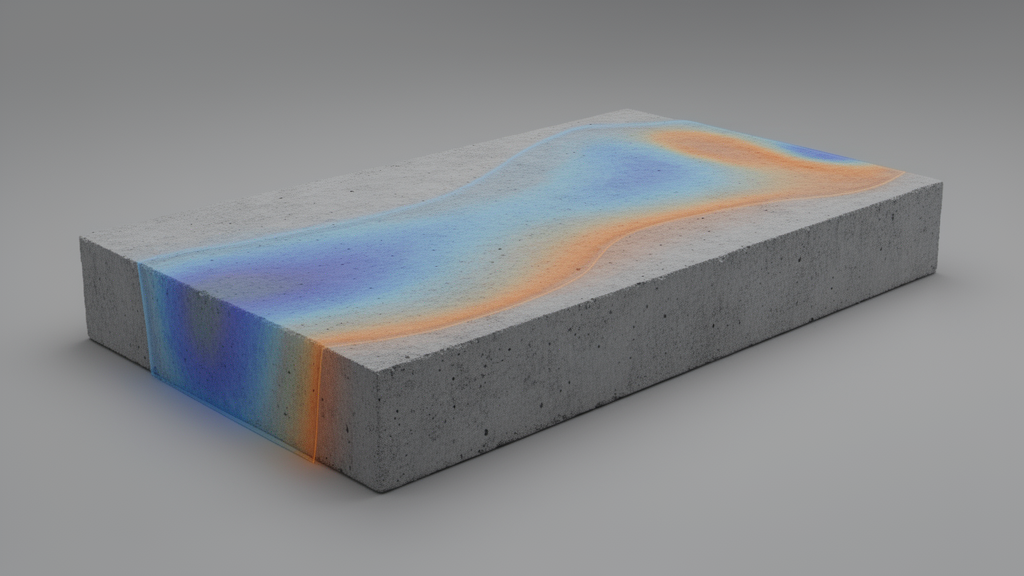
A research team has developed an advanced artificial intelligence framework combining three-dimensional convolutional neural networks and generative adversarial networks to predict shrinkage-induced stresses and displacements in monolithic reinforced concrete slabs on ground bases. Published in AI in Civil Engineering, the study reveals that deep neural networks trained on standardized voxel representations can determine complex stress–strain distributions in seconds, providing a rapid alternative to time-consuming finite element methods. Monolithic slabs form the foundation of high-load industrial floors, bridge decks, and airfield runways, yet assessing early stress development during concrete hardening remains an ongoing engineering challenge. Traditional analytical equations struggle to account for the simultaneous restraints imposed by reinforcing steel and underlying ground contact. By converting complex slab geometries into uniform three-dimensional voxel arrays, the researchers demonstrated that an improved generative adversarial network and a 3D U-Net can reliably capture forced deformations and pre-operational tensile stresses across diverse slab geometries.
The expanding reliance on monolithic concrete in large-scale civil engineering projects underscores the necessity of precise stress evaluation during the initial curing phase. Throughout the hardening process, Portland cement concrete undergoes significant volume reduction through drying and chemical shrinkage. Because the concrete slab is physically restrained by friction against the base and bonded internal reinforcement, this contracting motion induces internal tensile stresses across the plane of the structure. Given the low tensile capacity of young concrete, these restrained forces routinely generate microcracking prior to the commissioning of the facility and before any external live service loads are applied. Even narrow pre-operational cracks compromise structural integrity, elevate structural deformability, and drastically decrease the design service life of floors, pavements, and foundations. Predicting initial shrinkage-induced stresses is therefore a crucial engineering prerequisite for controlling cracking and ensuring long-term infrastructural durability.
Current regulatory building codes provide minimal analytical methodology for assessing shrinkage stresses or determining joint placement. In the Republic of Belarus, the primary building code CH 5.09.01-2020 specifies only slab thickness and concrete compressive strength class during floor design. Similarly, within the European Union, standard EN 1992-1-1:2023 Eurocode 2 lacks calculation procedures that account for concrete shrinkage, thermal variations, and contact interactions with the underlying soil or aggregate base. Consequently, expansion joint spacing in ground slabs is established constructively through rule-of-thumb conventions rather than mechanical calculation. Research indicates that seamless monolithic slabs exhibit superior functional performance compared to jointed counterparts, yet the absence of accurate calculation methods often causes excessive material consumption during construction. Furthermore, existing building codes provide no systematic methodology to forecast optimal expansion joint positions based on the full stress–strain state of the structural element.
Classical analytical formulations and conventional numerical simulation suites face severe obstacles when analyzing practical slab configurations. Earlier analytical models, such as formulations by Zhang and Li in 2001 and the bilinear approximations within the 2010 Fib Model Code, relied on generalized shear parameters that failed to represent realistic concrete-on-concrete friction. While refined three-linear shear diagrams developed by Zheltkovich and Tur enabled analytical solutions for simple strip slabs, extending these closed-form solutions to slabs with complex geometries or technological openings is virtually impossible. Practical construction regularly demands openings for industrial machinery, plumbing, or power equipment, creating asymmetric stress distributions. In popular finite element packages like ABAQUS, ANSYS, and SAP2000, configuring non-linear contact shear behavior based on empirical shear curves remains unsupported. Crucially, locating zero shear points, where displacements vanish and tensile stresses reach peak values, becomes prohibitively labor-intensive when openings are irregular or offset from the slab center.
To circumvent these computational bottlenecks, the authors developed a soft computing strategy utilizing a standardized voxel-based data representation. Rather than manipulating complex, unstructured meshes typical of finite element software, the researchers transformed three-dimensional slab models into regular arrays of 64 by 64 by 4 voxels, evaluating 16,384 discrete spatial elements. This volumetric approach establishes a structured binary logic indicating the presence or absence of slab material, which dramatically simplifies geometric operations when modeling irregular slabs containing holes. Furthermore, the voxel grid standardizes varying mesh densities into a unified data structure, reducing model elements from 18,483 in fine-mesh numerical setups to 16,384 voxels. For every occupied voxel, a 15-dimensional vector of input features encompasses concrete and rebar physical properties, geometric identifiers, and boundary conditions. Each voxel corresponds to two calculated target values: shrinkage-induced principal tensile stress and in-plane displacement.
The experimental training dataset was compiled through numerical modeling in ABAQUS, comprising 95 distinct reinforced concrete slab configurations. The finite element setup simulated an upper structural slab separated by 10 centimeters from a fully fixed lower foundation slab. Foundation soil interaction was established using connector springs providing three translational degrees of freedom while restricting all three rotational degrees of freedom. Slabs experienced gravitational acceleration of 9.8 meters per second squared alongside thermal cooling to minus 16.3 degrees Celsius, simulating a concrete shrinkage strain of 0.000163. Concrete was modeled with eight-node thermally coupled brick elements, while steel rebars were represented by two-node linear truss elements. Across the dataset, 12 mechanical parameters were systematically varied, including concrete elastic modulus, compressive strength, Poisson ratio, and thermal expansion, alongside reinforcement diameters, ratios, and layout patterns involving single and double reinforcement layers.
For structural prediction, the researchers constructed a three-dimensional convolutional neural network utilizing the U-Net architecture. Operating on the voxel grid, the network’s contracting encoder applies 4 by 4 by 4 cubic filters with a stride of two along the horizontal axes while leaving the vertical dimension unreduced to conserve computing resources. One voxel of zero-padding preserved boundary dimensions, expanding the input to 66 by 66 by 4 before convolution. The encoder utilized LeakyReLU activations with a slope of 0.2 to avoid dying gradients, whereas the decoding pathway incorporated rectified linear units, batch normalization, and dropout to stabilize feature reconstruction. Direct skip connections concatenated encoder feature maps with upsampled decoder layers, preserving spatial resolution throughout the network. The final output layer omitted activation functions to permit unbounded regression outputs across 116,898 trainable parameters optimized using the Adam stochastic gradient algorithm.
Alongside the U-Net architecture, the study implemented two generative models: a Deep Convolutional Generative Adversarial Network and a modified architecture termed I-GAN. Operating under a minimax zero-sum game, the generator synthesizes stress and displacement fields while the discriminator distinguishes synthetic outputs from numerical training samples. To surpass standard DCGAN capabilities, the I-GAN architecture increased maximum filter depth from 64 to 256 channels and applied targeted random normal weight initialization. Furthermore, the I-GAN discriminator incorporated a 3D Global Average Pooling layer followed by a 50 percent dropout layer to stabilize adversarial training. The generator loss function combined binary cross-entropy adversarial loss with an L1 mean absolute error content loss weighted by a multiplier of 100. This formulation ensured that the generated mechanical patterns satisfied overall distribution realism while strictly adhering to local stress and displacement measurements.
Computational evaluations highlighted dramatic differences in execution speeds between deep learning inference and traditional numerical modeling. ABAQUS simulations run on an Intel Core i7-8750H processor required 1 to 1.5 minutes per slab calculation, with overall modeling and mesh configuration averaging 15 to 20 minutes per geometry. In contrast, once trained, each neural network produced complete stress and displacement predictions for test slabs in mere seconds. Training was executed on an AMD Ryzen 5-5600H central processor without graphical acceleration. The 3D-CNN-U-Net completed 500 training epochs in 3 minutes and 53 seconds, while DCGAN required 22 minutes and 23 seconds for 30,000 epochs. The parameterized I-GAN converged after 70 epochs in 29 minutes and 41 seconds. Future implementation of graphics processing units is projected to reduce these training durations by an order of magnitude.
Statistical performance metrics verified the superior predictive precision of the improved generative architecture across test samples. For principal tensile stresses, DCGAN registered a determination coefficient of 0.545 and a correlation coefficient of 0.596. The 3D-CNN-U-Net achieved higher accuracy, yielding a determination coefficient of 0.566 and a correlation of 0.697, with paired t-tests confirming its statistical advantage over DCGAN. The I-GAN model achieved the strongest stress prediction performance, delivering a determination coefficient of 0.616 and a correlation coefficient of 0.7795, confirmed statistically superior to both U-Net and DCGAN. Regarding in-plane displacements, U-Net recorded a determination coefficient of 0.716 and a correlation of 0.864, whereas I-GAN attained a determination coefficient of 0.8988 and a correlation coefficient of 0.9662. Overall analysis of variance confirmed statistically significant divergence among models, yielding an F-statistic of 4,185.3595 for stress predictions and 5,672.8707 for displacement predictions.
Detailed residual analysis demonstrated that I-GAN achieved remarkable accuracy in standard pre-operational ranges, particularly between 0 and 1 megapascal for stresses and 0 to 8 millimeters for displacements. However, predictive uncertainty increased for stresses above 1 megapascal and displacements exceeding 8 millimeters. The authors attributed this variation to localized stress concentrations near technological openings and slab end zones, caused by thermal expansion differences and complex concrete-rebar bonding interactions. By predicting stress concentrations around asymmetrical openings in seconds, the voxel-based deep learning framework provides engineers with an effective computational tool for identifying optimal expansion joint locations. Future work will expand training datasets and refine voxel resolution to 32 by 32 by 4 voxels, further reducing computational data volume while advancing automated structural design for complex monolithic slabs in civil engineering practice.
Subject of Research: Deep learning prediction of shrinkage stresses and displacements in monolithic reinforced concrete slabs on a base
Article Title: 3D-DCGAN and 3D-CNN-U-Net for predicting shrinkage stresses and displacements in monolithic reinforced concrete slabs on a base
Article References: Zheltkovich, A. E., He, Y., Marmysh, D. E., Ren, Y., Molosh, V. V., Mou, N., Huang, Z., Guo, X., Statkevich, P. I., & Parchotz, K. G. (2025). 3D-DCGAN and 3D-CNN-U-Net for predicting shrinkage stresses and displacements in monolithic reinforced concrete slabs on a base. AI in Civil Engineering, 4(1), Article 27. https://doi.org/10.1007/s43503-025-00078-2
Image Credits: AI Generated
DOI: 10.1007/s43503-025-00078-2
Keywords: civil engineering, deep learning, reinforced concrete, shrinkage stress, finite element method, voxel modeling, generative adversarial networks, structural engineering, D-DCGAN, D-CNN-U-Net, predicting, shrinkage
News Source: Blake Davidson. (November 8, 2026). Deep Learning Models Predict Shrinkage Stresses in Monolithic Concrete Slabs. Scienmag.