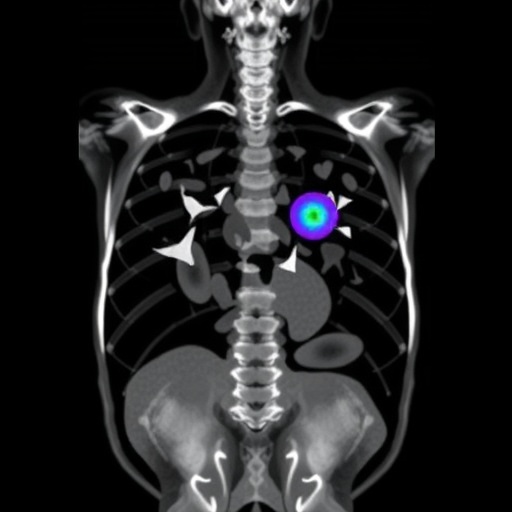
In a groundbreaking advancement set to revolutionize thoracic radiotherapy, researchers have unveiled the results of a prospective multicenter trial that harnesses the power of deep learning auto-segmentation to accurately identify organs at risk (OARs). This ambitious study, spearheaded by Niu, Guan, Zhang, and their colleagues, offers a beacon of hope for oncologists striving to enhance precision in radiation treatment while minimizing collateral damage to healthy tissues. Published recently in Nature Communications, the findings epitomize the remarkable intersection of artificial intelligence and medical imaging, marking a turning point in cancer care technology.
The treatment of thoracic cancers, such as lung and esophageal malignancies, typically involves complex radiotherapy regimens that require meticulous planning to protect vital organs like the heart, lungs, esophagus, and spinal cord. Traditionally, this planning demands labor-intensive manual segmentation of these organs from imaging scans, a process susceptible to variability and errors due to human factors and anatomical complexities. By introducing an automated deep learning framework, the research team has addressed these challenges, striving not only for accuracy and efficiency but also for consistency across diverse clinical settings.
Central to this study is the deployment of convolutional neural networks (CNNs), a subset of deep learning algorithms renowned for their prowess in image analysis. The research utilized a vast dataset, collated from multiple medical centers worldwide, ensuring the system was trained on diverse anatomical variations and imaging conditions. This multicentric approach mitigated the risks of model overfitting and enhanced the generalizability of the auto-segmentation tool, positioning it as a universally applicable aid in thoracic radiotherapy.
The trial meticulously assessed the performance of the auto-segmentation system against gold-standard manual delineations conducted by expert radiologists. Metrics such as Dice similarity coefficient, Hausdorff distance, and volumetric overlap demonstrated striking concordance, with the AI-driven method not only matching but, in some instances, surpassing human accuracy. Importantly, the model showcased a consistent ability to segment critical structures with high fidelity, a feat crucial for safeguarding patients from radiation-induced toxicities.
Beyond mere accuracy, the time-efficiency delivered by this deep learning application represents a substantial clinical benefit. Traditional manual segmentation can consume several hours per patient, delaying treatment initiation and inflating healthcare costs. In contrast, the AI system completes segmentation within minutes, enabling rapid treatment planning and fostering more streamlined workflows. This temporal advantage could have profound implications for institutions managing high patient volumes or those with limited specialist availability.
The implications of this research extend into the realm of personalized medicine, as the precise delineation of organs at risk facilitates more tailored radiation dosing. By accurately sparing healthy tissues, clinicians can escalate tumor doses safely, thereby potentially enhancing therapeutic outcomes. Moreover, the uniformity introduced by automated segmentation diminishes inter- and intra-observer variability, cultivating greater trust in treatment consistency and reproducibility.
Another notable aspect of this investigation is its robust validation framework. The researchers incorporated diverse imaging modalities, including computed tomography (CT) and magnetic resonance imaging (MRI), to test the resilience of their model under varying conditions. The system’s adeptness at maintaining segmentation performance across these modalities signifies its versatility, allowing integration into heterogeneous clinical environments without compromising accuracy.
Integration of deep learning tools within existing clinical workflows often encounters resistance due to technological barriers and concerns over interpretability. To circumvent these issues, the team developed an intuitive user interface that facilitates clinician oversight and manual adjustments when necessary. This hybrid approach preserves clinical control while leveraging AI efficiency, addressing the critical need for human-in-the-loop systems in sensitive medical applications.
Importantly, the trial also addressed ethical and regulatory considerations intrinsic to deploying AI in healthcare. The multicenter design enabled compliance with diverse institutional policies and data privacy regulations, setting a precedent for future large-scale AI studies. This cautious approach augurs well for the eventual clinical translation of deep learning segmentation tools, potentially expediting regulatory approvals and fostering clinician acceptance.
Delving into the technical architecture, the model employed a U-Net-based network, a widely adopted design in biomedical image segmentation renowned for its capability to capture intricate spatial features. Training involved extensive data augmentation and cross-validation techniques to bolster robustness. Furthermore, transfer learning strategies were utilized, enabling the system to adapt to new datasets more swiftly, reducing the need for exhaustive retraining when deployed in new clinical sites.
The study also sheds light on the scalability of AI-driven auto-segmentation beyond thoracic radiotherapy. Given the universal challenge of organ delineation in radiotherapy for various cancers, this framework could be extended to head and neck, pelvic, or abdominal malignancies. The prospect of a modular, adaptable AI segmentation toolkit paves the way toward more automated, efficient oncologic care across multiple anatomical domains.
While the technical achievements are impressive, the researchers acknowledge that continued efforts are needed to refine the model’s performance further, especially in segmenting complex or rare anatomical variants. Future research directions point toward incorporating multi-modal imaging data, such as positron emission tomography (PET) fusion, and developing uncertainty quantification methods to highlight cases requiring expert review.
In summary, this landmark prospective multicenter trial validates the transformative potential of deep learning auto-segmentation as a reliable, rapid, and scalable solution for organ at risk delineation in thoracic radiotherapy. By bridging cutting-edge AI with real-world clinical practice, Niu and colleagues have charted a course toward more precise, efficient, and patient-centered cancer treatment paradigms. The clinical oncology community awaits the widespread adoption of these innovations, which promise to redefine standards of care and improve the lives of countless patients worldwide.
The implications of this research resonate beyond thoracic cancers, heralding a future where artificial intelligence seamlessly complements human expertise, catalyzing a new era of precision medicine. As deep learning continues to evolve and integrate with medical imaging, the vision of fully automated, intelligent radiotherapy planning systems inches closer to reality, offering hope for improved outcomes and reduced side effects for cancer patients everywhere.
With rigorous validation, thoughtful clinical deployment strategies, and an unwavering commitment to patient safety, deep learning auto-segmentation stands poised to become an indispensable tool in the radiation oncologist’s arsenal. This evolution epitomizes the fusion of technology and medicine, demonstrating how interdisciplinary collaboration can yield breakthroughs that fundamentally enhance healthcare delivery.
Ultimately, the success of this endeavor underscores the critical role of artificial intelligence in healthcare innovation. As more robust, generalizable models emerge and regulatory frameworks adapt, clinical institutions worldwide will increasingly harness AI to improve treatment accuracy, reduce workload burdens, and empower clinicians. The work by Niu, Guan, Zhang, and their team exemplifies this paradigm shift, pointing the way toward a smarter, more effective future in cancer therapy.
Subject of Research: Deep learning-based auto-segmentation for organs at risk in thoracic radiotherapy.
Article Title: A prospective multicenter trial of deep learning auto-segmentation for organs at risk in thoracic radiotherapy.
Article References:
Niu, G., Guan, Y., Zhang, Y. et al. A prospective multicenter trial of deep learning auto-segmentation for organs at risk in thoracic radiotherapy. Nat Commun (2026). https://doi.org/10.1038/s41467-026-70863-9
Image Credits: AI Generated
Tags: AI in cancer treatmentartificial intelligence in oncologyautomated organ delineation in radiotherapyconvolutional neural networks for medical imagingdeep learning auto-segmentation in radiotherapydeep learning for thoracic imaginglung and esophageal cancer treatmentminimizing radiation damage to healthy tissuesmulticenter clinical trial in radiotherapyorgans at risk segmentationprecision radiation therapy techniquesthoracic cancer radiotherapy planning