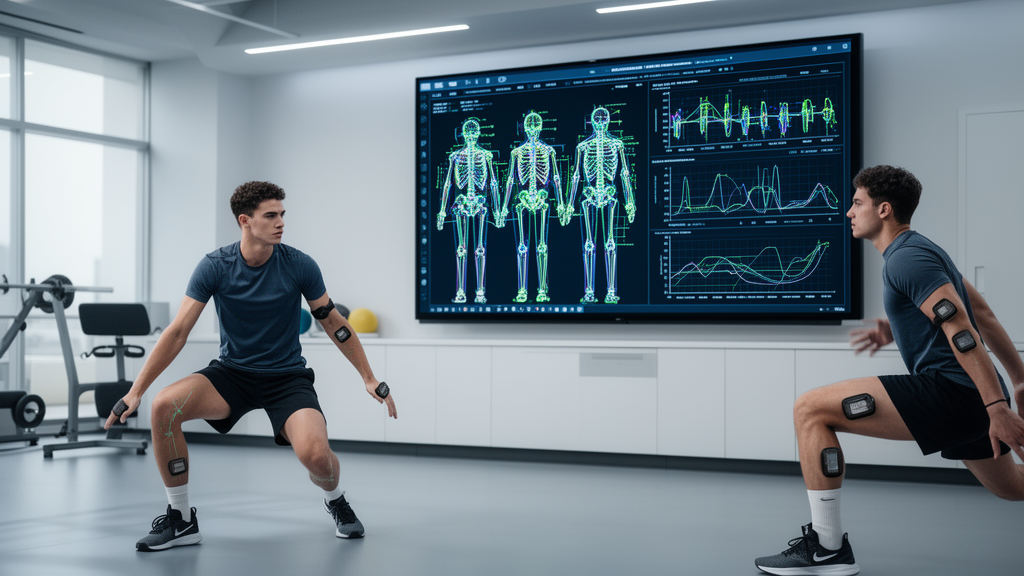
A computational framework combining wearable Internet of Things sensing hardware with a specialized hybrid neural network architecture has demonstrated high accuracy in tracking student exercise patterns, assessing physical conditioning, and providing automated instructional feedback within undergraduate physical education classes. The investigation evaluated an analytical pipeline designated as the Scalable Elephant Clan optimized Global-Context Residual Recurrent Neural Network, which processes multimodal movement streams and physiological metrics collected during collegiate training sessions. In benchmark testing using five-fold cross-validation across thousands of recorded activity sequences, the computational system achieved an average activity recognition accuracy of 96.00 percent alongside a precision of 96.20 percent, a recall of 95.72 percent, and an F1-score of 95.96 percent. Evaluated across specialized instructional assessment categories, the architecture attained 98.73 percent accuracy in motor skill assessment, 91 percent in fitness learning progress analysis, 95.1 percent in physical fitness quantification, 97.3 percent in student engagement detection, 92.8 percent in student satisfaction estimation, and 97 percent in overall instructional delivery efficiency.
Traditional instructional models in higher education physical education have long relied upon direct visual observation, oral correction, and generalized group drills conducted by a single instructor across large student cohorts. Under conventional classroom conditions, educators frequently track attendance, motor execution, and physical progress through manual recordkeeping, regular physical testing, and unassisted subjective grading. Furthermore, conventional observational techniques cannot quantitatively track dynamic physiological variables such as instantaneous heart rate variations, biomechanical movement intensities, or physiological exhaustion states during training. This lack of objective telemetry creates an instructional environment focused on rigid, standardized curricula rather than adaptive training tailored to the physiological limits and developmental trajectories of individual students.
The experimental validation was conducted using the publicly available Smart Classroom PE Dataset sourced from Kaggle, encompassing between 10,000 and 15,000 operational data instances collected from student cohorts participating in structured exercise routines. The data structure integrates multidimensional time-series measurements, capturing both kinematic motion data and vital physiological indicators.
To ensure data fidelity prior to neural feature extraction, the researchers implemented a preprocessing pipeline centered on a fourth-order Butterworth low-pass filter configured with an empirical cutoff frequency of 0.5 Hertz. Because the benchmark dataset provides pre-extracted kinematics rather than raw uncalibrated inertial streams, this low-pass filtering stage was applied selectively to the continuous physiological data streams, including heart rate, blood oxygenation, skin temperature, and step-count progressions. Applying zero-phase digital filtering preserved meaningful physiological fluctuations while eliminating phase distortion across the time series. This maximally flat passband attenuation eliminated transient electrical noise and mechanical disturbances without dampening genuine biological trends, after which the filtered signals were normalized into uniform numeric arrays suitable for network ingestion.
The feature extraction stage of the pipeline relies on a multi-stage convolutional neural network configured to isolate hierarchical spatial patterns from student movement records and body posture configurations. Rather than utilizing handcrafted kinematic heuristics, the convolutional architecture automatically derives discriminative spatial representations, including joint articulation angles, motion intensity vectors, and spatial body alignments. The network processes the preprocessed sensory arrays through convolutional layers utilizing receptive field filters of three-by-three and five-by-five dimensions with unit stride and unit padding to maintain spatial resolution throughout the feature hierarchy. Nonlinear rectified linear unit activation functions introduce computational flexibility to accommodate diverse anatomical variations and complex exercise postures. To compress intermediate representations and minimize the computational burden of processing high-dimensional movement matrices, two-by-two max-pooling operations with a stride of two downsample feature maps, producing robust spatial descriptors that feed directly into downstream recurrent layers.
To capture time-dependent correlations and long-range sequential dynamics in student exercise routines, the pipeline couples the convolutional frontend to a Global-Context Residual Recurrent Neural Network. The GC-RRNN resolves this limitation by formulating hidden state transitions through residual mappings that learn differences between consecutive time steps rather than relearning entire temporal representations from scratch.
Optimizing deep network hyperparameters and isolating the most informative kinematic features from high-dimensional IoT data presents significant mathematical difficulty, frequently trapping conventional gradient descent algorithms in local minima. To address this computational bottleneck, the study incorporated the Scalable Elephant Clan metaheuristic optimization algorithm, a swarm intelligence method inspired by the cooperative social behaviors of natural elephant herds. In the SEC formulation, candidate solutions represent individual elephants organized into hierarchical clan structures governed by a matriarch update strategy, autonomous local position adjustments, and male herd exploration vectors. The optimization balances global exploration with local exploitation through Euclidean-distance-based clan segregation, adaptive scaling factors that decrease over thirty successive iterations, and simplex-based replacement operators that substitute poorly performing solutions with newly generated candidates.
System performance was rigorously quantified using a five-fold cross-validation strategy maintaining strict subject-wise partitioning between training folds and evaluation folds to prevent identity leakage across experimental splits. During offline training, the SEC-GC-RRNN demonstrated rapid numerical convergence, attaining 99 percent training accuracy and 96 percent validation accuracy by the fiftieth epoch with minimal loss divergence between curves, confirming stable generalization without empirical overfitting. Systematic one-at-a-time sensitivity analyses confirmed that the optimized hyperparameter configurations occupied broad, flat regions of the parameter surface, with small variations in learning rate or hidden layer dimensions causing only modest degradations in classification accuracy. Paired t-tests conducted against comparative model baselines demonstrated that the performance improvements achieved by the bio-inspired recurrent architecture were statistically significant, yielding p-values below 0.01 across all tested cross-validation folds.
The system was evaluated on its capacity to categorize five distinct collegiate physical education exercises: running, lunges, push-ups, squats, and jumping jacks. In biometric scatter analyses, running was characterized by elevated heart rates spanning 150 to 180 beats per minute paired with high step counts between 800 and 1,000 increments, whereas stationary push-ups registered moderate cardiovascular responses of 90 to 120 beats per minute with limited step accumulation. Although exercises such as lunges and squats exhibited heavily overlapping physiological distributions in unrefined sensor logs, the SEC-GC-RRNN successfully mapped these movements into discrete kernel density estimation peaks, distinguishing squat intervals between 100 and 150 beats per minute from lunge sequences between 100 and 140 beats per minute. Parallel coordinate analyses verified that tracking cumulative step volumes, cardiovascular intensities, and workout durations enabled the system to establish distinct multi-feature signatures for each exercise modality, resolving confusion between structurally similar kinetic movements.
When benchmarked against established neural architectures evaluated on identical data splits, the SEC-GC-RRNN outperformed alternative fusion models and baseline deep learning techniques. In comparative classification testing, the proposed model achieved 98.73 percent accuracy, exceeding RNN-fusion at 93.21 percent, GRU-fusion at 95.60 percent, LSTM-fusion at 96.09 percent, Transformer-fusion at 97.24 percent, and hierarchical Transformer-fusion at 98.15 percent. When compared against the CogVLM2-Video computer vision model, the proposed IoT-driven network delivered an inference latency of 22 milliseconds versus 25 milliseconds, alongside higher annotation consistency at 96 percent, superior recall at 92 percent, precision of 95 percent, and an F1-score of 93.03 percent. Ablation experiments verified the complementary contribution of each architectural module: removing SEC optimization, GC-RRNN recurrence, or CNN preprocessing produced step-wise performance reductions, demonstrating that baseline model accuracy of 88.40 percent rose to the final 98.73 percent mark only when all computational components operated cohesively.
Beyond basic activity categorization, the researchers evaluated the architecture across automated training efficiency and fatigue tracking metrics compared against a standard residual recurrent baseline. The SEC-GC-RRNN achieved substantial gains in correct posture ratio assessment, reaching 91 percent compared to 88 percent for the baseline, repetition accuracy estimation at 85 percent versus 82 percent, energy expenditure optimization tracking at 78 percent versus 75 percent, workout completion time evaluation at 72 percent versus 70 percent, and feedback response time at 82 percent versus 80 percent. In fatigue monitoring tasks, the system outperformed the baseline in detecting abrupt heart rate spikes at 83 percent versus 80 percent, identifying movement velocity drops at 81 percent versus 78 percent, assessing sweat rates at 85 percent versus 82 percent, formulating valid recovery recommendations at 78 percent versus 75 percent, and delivering timely exhaustion alerts at 89 percent versus 87 percent.
Despite these favorable simulation results, the authors explicitly detailed several technical constraints that currently limit real-world deployment across general educational environments. The empirical evaluation relied upon offline simulations using an existing public Kaggle dataset collected from a relatively small cohort of collegiate participants, meaning the observed classification accuracy may not generalize directly to diverse demographic groups, varied age brackets, or institutions with distinct athletic facilities. Furthermore, the offline experimental setup did not evaluate real-time hardware performance under conditions of network packet loss, intermittent wireless connectivity, or sensor calibration drift. The practical deployment of smart physical education systems remains constrained by hardware acquisition expenses, student data privacy considerations, and the logistical challenge of maintaining wearable sensors across large student bodies.
Subject of Research: Deep learning and Internet of Things framework for college physical education instruction and activity recognition
Article Title: Innovation of smart classroom teaching methods for college physical education supported by deep learning and the Internet of Things
Article References: Liu, Z. (2026). Innovation of smart classroom teaching methods for college physical education supported by deep learning and the Internet of Things. Discover Artificial Intelligence, 6(1), Article 1951. https://doi.org/10.1007/s44163-026-02119-w
Image Credits: AI Generated
DOI: 10.1007/s44163-026-02119-w
Keywords: deep learning, Internet of Things, physical education, activity recognition, convolutional neural networks, recurrent neural networks, Scalable Elephant Clan optimization, smart classroom, Butterworth low-pass filter, motor skills evaluation, wearable sensors, exercise tracking, adaptive feedback, fatigue detection, cross-validation, biometric monitoring
News Source: Blake Davidson. (November 26, 2026). Deep Learning and IoT Architecture Enhances College Physical Education Performance Tracking. Scienmag.