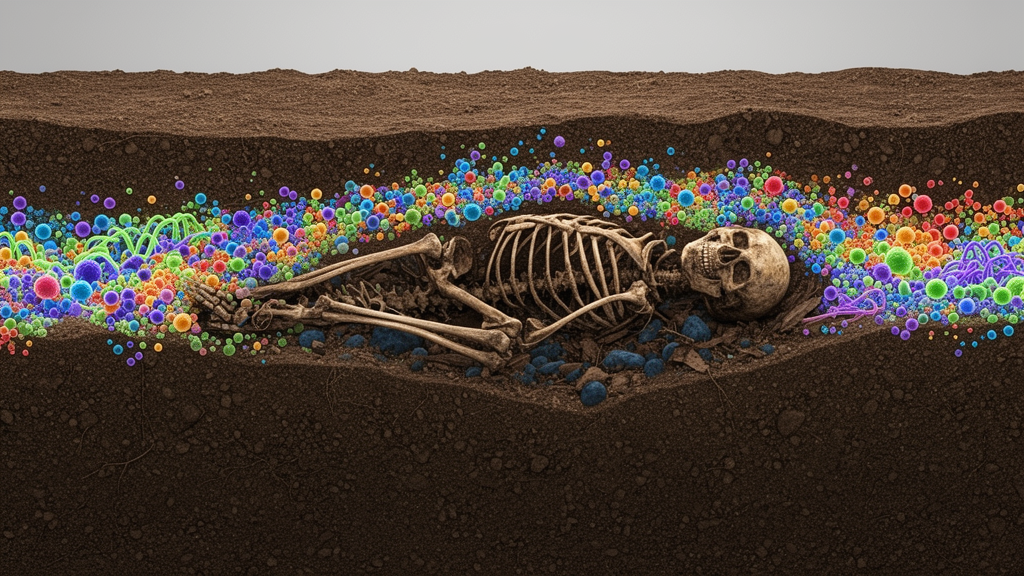
Postmortem microbial community succession in decaying carcasses differs substantially between deep burial and indoor conditions, severely limiting the cross-environment transferability of forensic models designed to estimate postmortem interval. While shallow burial succession broadly resembles surface decomposition in open air, deep burial exerts distinct and influential effects on postmortem microbial dynamics. To evaluate whether a unified postmortem interval model could function reliably across diverse terrestrial environments, researchers compared decomposition trajectories between deeply buried rat carcasses and carcasses kept under constant indoor temperature and humidity.
The researchers utilized 16S rRNA sequencing to track bacterial community succession across multiple internal anatomical sites as well as surrounding grave soil. Specifically, the team examined successional dynamics within initially sterile internal tissues, including the heart and skeletal muscle, alongside bacteria-rich environments represented by the cecum and adjacent soil. By tracking microbial changes across these distinct anatomical and environmental niches over time, the authors evaluated how separate bacterial communities evolve under contrasting decomposition settings.
Experimental observations revealed clear contrasts in diversity trajectories between sterile and bacteria-rich tissues during decomposition. Initially sterile organs, including the heart and skeletal muscle, exhibited similar diversity profiles that remained largely homogeneous across most decomposition time points.
Co-occurrence network analysis uncovered distinct structural patterns among microbial communities across the different sampled tissues. In initially sterile organs, microbial assemblages formed highly modular networks during early postmortem stages, which later reorganized as decomposition progressed. In contrast, cecal microbial communities maintained stable network architectures throughout decomposition, centered predominantly on taxa from Firmicutes and Bacteroidetes. Meanwhile, grave soil networks transitioned from assemblages dominated by the ambient surrounding environment to networks directly associated with active carcass decomposition.
Cross-environment prediction tests revealed that postmortem interval models failed to transfer accurately between environments, as buried carcass succession diverged significantly from exposed conditions. Models calibrated on heart and skeletal muscle performed poorly in cross-environment estimations, while cecal samples generalized best, although their predictive accuracy remained limited.
Subject of Research: Forensic postmortem interval estimation using carcass microbial community succession
Article Title: A comparative study on microbial community succession of carcasses in two environments
Article References: Zhao, G., Li, X., Dong, C., Dou, S., Liang, Y., Zhang, Y., Liu, R., Zhou, Z., Yu, H., Li, S., Fu, L., & Cong, B. (2026). A comparative study on microbial community succession of carcasses in two environments. BMC Microbiology. https://doi.org/10.1186/s12866-026-05936-2
Image Credits: AI Generated
DOI: 10.1186/s12866-026-05936-2
Keywords: postmortem interval, microbial succession, deep burial, forensic microbiology, 16S rRNA sequencing, carcass decomposition, cecum microbiome, grave soil, Firmicutes, Bacteroidetes, alpha diversity, co-occurrence network, rat carcasses, heart microbiome, muscle microbiome, cross-environment prediction, indoor decomposition, decomposition ecology
News Source: Morgan Morrow. (November 23, 2026). Deep Burial Changes Carcass Microbial Succession and Limits Forensic Interval Models. Scienmag.