• HOME
  • NEWS
  • EXPLORE
    • CAREER
      • Companies
      • Jobs
    • EVENTS
    • iGEM
      • News
      • Team
    • PHOTOS
    • VIDEO
    • WIKI
  • BLOG
  • COMMUNITY
    • FACEBOOK
    • INSTAGRAM
    • TWITTER
Saturday, February 7, 2026
BIOENGINEER.ORG
No Result
View All Result
  • Login
  • HOME
  • NEWS
  • EXPLORE
    • CAREER
      • Companies
      • Jobs
        • Lecturer
        • PhD Studentship
        • Postdoc
        • Research Assistant
    • EVENTS
    • iGEM
      • News
      • Team
    • PHOTOS
    • VIDEO
    • WIKI
  • BLOG
  • COMMUNITY
    • FACEBOOK
    • INSTAGRAM
    • TWITTER
  • HOME
  • NEWS
  • EXPLORE
    • CAREER
      • Companies
      • Jobs
        • Lecturer
        • PhD Studentship
        • Postdoc
        • Research Assistant
    • EVENTS
    • iGEM
      • News
      • Team
    • PHOTOS
    • VIDEO
    • WIKI
  • BLOG
  • COMMUNITY
    • FACEBOOK
    • INSTAGRAM
    • TWITTER
No Result
View All Result
Bioengineer.org
No Result
View All Result
Home NEWS Science News Biology

Decoding sugar molecules offers new key for combating muscular…

Bioengineer by Bioengineer
January 24, 2018
in Biology, Science News
Reading Time: 2 mins read
0
Share on FacebookShare on TwitterShare on LinkedinShare on RedditShare on Telegram
IMAGE

A group of Japanese scientists have succeeded in decoding a sugar molecule and clarifying a mechanism linked to muscular dystrophy. Their discovery has potential implications for muscular dystrophy treatment. The results of their research were published in the journal Cell Reports on February 25, 2016 EST.

Key research group members include Professor TODA Tatsushi, Associate Professor KANAGAWA Motoi, and Associate Professor KOBAYASHI Kazuhiro from the Kobe University Graduate School of Medicine; Doctor ENDO Tamao, Vice-director from the Tokyo Metropolitan Institute of Gerontology; and Doctor WADA Yoshinao, Director of the Osaka Medical Center and Research Institute for Maternal and Child Health.

Muscular dystrophy is an incurable genetic condition marked by progressive weakening of the muscles. The condition is caused by mutations in the genes responsible for muscle structure and functions. Previous research had revealed three major genes involved in a certain family of muscular dystrophies: fukutin, fukutin-related proteins (FKRP), and isoprenoid synthase domain-containing (ISPD). When these three genes do not function correctly, abnormalities occur in the sugar molecules that bind to the dystroglycan protein on the surface of muscle cells. However, until now the exact composition of the sugar molecules and the role of these genes was unclear.

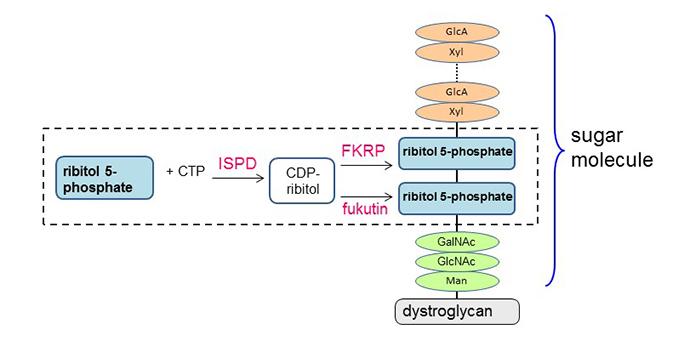
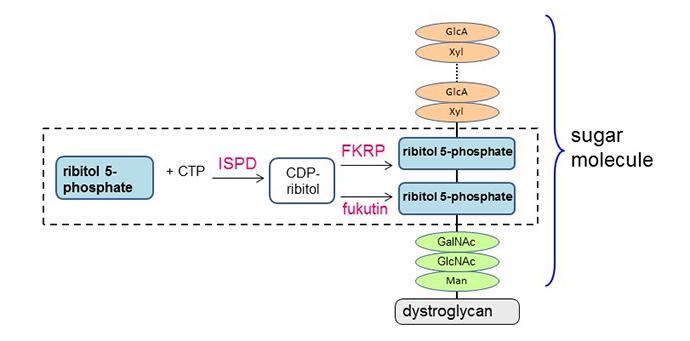
Professor Toda's research group succeeded in creating a sugar molecule in a cell culture. Using mass spectrometric analysis, they calculated the mass of each component in the sugar molecule and identified an unusual sugar unit called "ribitol 5-phosphate". The group went on to discover that three causative genes of muscular dystrophy (ISPD, fukutin, and FKRP) are all involved in creating this sugar unit. In a patient cell model with each of these three genes removed, ribitol 5-phosphate was also absent, proving that the abnormal synthesis of ribitol 5-phosphate is a cause of the condition. When CDP-ribitol, one of the ingredients for ribitol 5-phosphate, was added to the cell model, the abnormalities in the sugar molecule were resolved.

The sugar unit ribitol 5-phosphate was previously only confirmed in bacteria and some plants, so the researchers were surprised to discover that in mammals it functions as a component of sugar-protein interactions. They suggest that the sugar unit also has a key role in embryonic tissue development. Abnormalities in its combination with proteins could cause cancer metastasis and viral infection as well as muscular dystrophy.

"Sugar molecules play a key role in many biological processes, but their composition is difficult to determine and research on them is still limited", said Professor Toda. "The decoding of this sugar molecule has implications for the field of life sciences, as well as being a step further in the treatment of muscular dystrophy".

###

Media Contact

Eleanor Wyllie
[email protected]
81-788-035-282
@KobeU_PR

http://www.kobe-u.ac.jp/en/
Share12Tweet8Share2ShareShareShare2

Related Posts

Palmitoylation of Tfr1 Drives Platelet Ferroptosis and Exacerbates Liver Damage in Heat Stroke

February 7, 2026

Oxygen-Enhanced Dual-Section Microneedle Patch Improves Drug Delivery and Boosts Photodynamic and Anti-Inflammatory Treatment for Psoriasis

February 7, 2026

Scientists Identify SARS-CoV-2 PLpro and RIPK1 Inhibitors Showing Potent Synergistic Antiviral Effects in Mouse COVID-19 Model

February 7, 2026

Neg-Entropy: The Key Therapeutic Target for Chronic Diseases

February 7, 2026
Please login to join discussion

POPULAR NEWS

  • Robotic Ureteral Reconstruction: A Novel Approach

    Robotic Ureteral Reconstruction: A Novel Approach

    82 shares
    Share 33 Tweet 21
  • Digital Privacy: Health Data Control in Incarceration

    63 shares
    Share 25 Tweet 16
  • Study Reveals Lipid Accumulation in ME/CFS Cells

    57 shares
    Share 23 Tweet 14
  • Breakthrough in RNA Research Accelerates Medical Innovations Timeline

    53 shares
    Share 21 Tweet 13

About

We bring you the latest biotechnology news from best research centers and universities around the world. Check our website.

Follow us

Recent News

Palmitoylation of Tfr1 Drives Platelet Ferroptosis and Exacerbates Liver Damage in Heat Stroke

Oxygen-Enhanced Dual-Section Microneedle Patch Improves Drug Delivery and Boosts Photodynamic and Anti-Inflammatory Treatment for Psoriasis

Scientists Identify SARS-CoV-2 PLpro and RIPK1 Inhibitors Showing Potent Synergistic Antiviral Effects in Mouse COVID-19 Model

Subscribe to Blog via Email

Enter your email address to subscribe to this blog and receive notifications of new posts by email.

Join 73 other subscribers
  • Contact Us

Bioengineer.org © Copyright 2023 All Rights Reserved.

Welcome Back!

Login to your account below

Forgotten Password?

Retrieve your password

Please enter your username or email address to reset your password.

Log In
No Result
View All Result
  • Homepages
    • Home Page 1
    • Home Page 2
  • News
  • National
  • Business
  • Health
  • Lifestyle
  • Science

Bioengineer.org © Copyright 2023 All Rights Reserved.