

• HOME
  • NEWS
  • EXPLORE
    • CAREER
      • Companies
      • Jobs
    • EVENTS
    • iGEM
      • News
      • Team
    • PHOTOS
    • VIDEO
    • WIKI
  • BLOG
  • COMMUNITY
    • FACEBOOK
    • INSTAGRAM
    • TWITTER
Thursday, June 25, 2026
BIOENGINEER.ORG
No Result
View All Result
  • Login
  • HOME
  • NEWS
  • EXPLORE
    • CAREER
      • Companies
      • Jobs
        • Lecturer
        • PhD Studentship
        • Postdoc
        • Research Assistant
    • EVENTS
    • iGEM
      • News
      • Team
    • PHOTOS
    • VIDEO
    • WIKI
  • BLOG
  • COMMUNITY
    • FACEBOOK
    • INSTAGRAM
    • TWITTER
  • HOME
  • NEWS
  • EXPLORE
    • CAREER
      • Companies
      • Jobs
        • Lecturer
        • PhD Studentship
        • Postdoc
        • Research Assistant
    • EVENTS
    • iGEM
      • News
      • Team
    • PHOTOS
    • VIDEO
    • WIKI
  • BLOG
  • COMMUNITY
    • FACEBOOK
    • INSTAGRAM
    • TWITTER
No Result
View All Result
Bioengineer.org
No Result
View All Result
Home Headlines

Deciphering an embryo-protecting protein

Bioengineer.org by Bioengineer.org
January 31, 2018
in Headlines, Health, Science News
Reading Time: 2 mins read
0
Share on FacebookShare on TwitterShare on LinkedinShare on RedditShare on Telegram
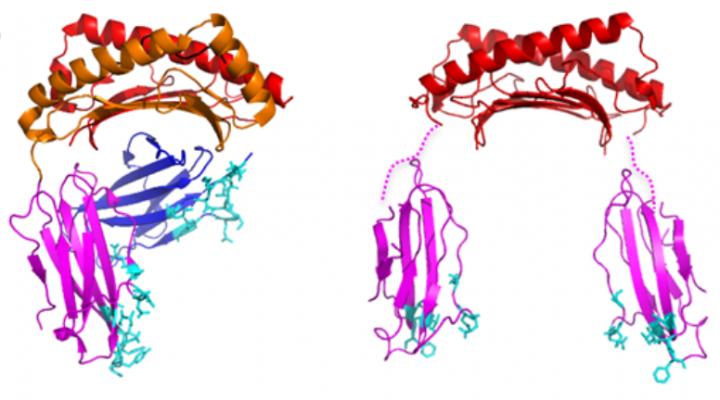
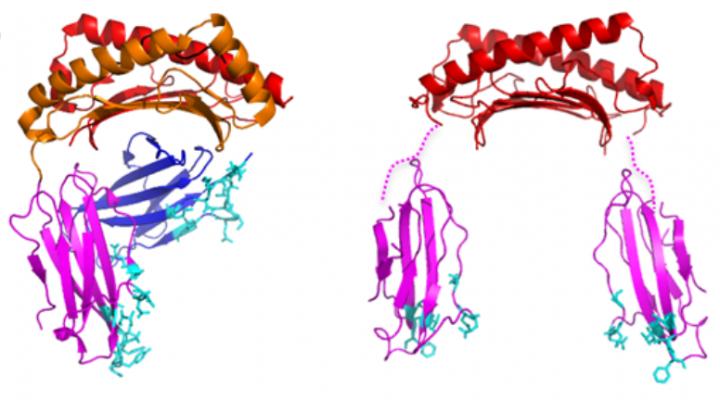
IMAGE

Credit: Kuroki K. et al., The Journal of Immunology, March 27, 2017

Revelations about a protein expressed in fetal cells could provide novel insights into its function and future immunosuppressive therapies.

Researchers at Hokkaido University together with colleagues in Japan have uncovered the structure of a protein that protects embryos from being attacked by their mothers' immune system. Further understanding of this protein could give rise to immunosuppressive therapies.

Trophoblasts are cells found in the outer layer of the developing embryo that form part of the placenta. They express a type of protein called human leukocyte antigens-G (HLA-G) which interacts with receptors on the maternal cells to suppress immune responses to the embryo during pregnancy.

The structures of HLA-G1, the major form of HLA-G, are well understood. Interestingly, individuals whose cells lack HLA-G1 could be born and healthy. Researchers believe this is because they can express another form, HLA-G2, which should compensate for the loss of the former's function. But the structure of HLA-G2 has been largely unknown.

In a study published in the Journal of Immunology, the team investigated the structure of HLA-G2 by a single particle electron microscopy.

Surprisingly, the structure of HLA-G2 was completely different from HLA-G1, but was similar to another class of human leukocyte antigens called HLA class II. This suggests that the HLA-G gene evolved from the same ancestral gene as HLA class II.

They also found that HLA-G2 make pairs called homodimers which strengthen the binding to the receptors. HLA-G1 is also known to form homodimers but in a different manner. Furthermore, their biochemical analysis revealed that HLA-G2 bound strongly to a leukocyte immunoglobulin-like receptor B2 (LILRB2), but not to LILRB1. By contrast, HLA-G1 binds strongly to both receptors.

Previous research by the Hokkaido University team showed that, in addition to its protective role during pregnancy, the HLA-G2 protein had an anti-inflammatory effect when injected into collagen-induced arthritis mice.

"A narrower target specificity of HLA-G2 could be advantageous in developing immunosuppressive drugs with less side-effects. We suggest further investigations to elucidate the structure of the HLA-receptor complex for a more precise understanding of this interaction," says Katumi Maenaka, the corresponding author at Hokkaido University.

###

Media Contact

Naoki Namba
81-117-068-034
@hokkaido_uni

https://www.global.hokudai.ac.jp/

Original Source

https://www.global.hokudai.ac.jp/blog/deciphering-an-embryo-protecting-protein/ http://dx.doi.org/10.4049/jimmunol.1601296


Share16Tweet8Share2ShareShareShare2

Related Posts

Tracking Lanthanide-Labeled Microplastics in Plants

June 25, 2026

POSTECH Researchers Slash Cost of Reconstituted Cell-Free Systems by 95%

June 25, 2026

AI and Physics Collaborate to Design Advanced Hydrogen Storage Materials

June 25, 2026

Natural Hallucinogens: Evolution’s Ecological Tools, Not Mere Chemical Byproducts

June 25, 2026
Please login to join discussion

POPULAR NEWS

  • Saying Goodbye to PGY-6: Pediatric Fellowship Realities

    103 shares
    Share 41 Tweet 26
  • Multi-Hospital Study Reveals Long Covid Burden Is Twice as High as Current Estimates

    92 shares
    Share 36 Tweet 23
  • Detection of EDCs in Breast Milk and Infant Urine Up to Six Months Highlights Early Exposure Risks

    77 shares
    Share 31 Tweet 19
  • New Drug Candidate Developed at McMaster Shows Potential for Treating Brain Cancer

    58 shares
    Share 23 Tweet 15

About

We bring you the latest biotechnology news from best research centers and universities around the world. Check our website.

Follow us

Recent News

Tracking Lanthanide-Labeled Microplastics in Plants

POSTECH Researchers Slash Cost of Reconstituted Cell-Free Systems by 95%

AI and Physics Collaborate to Design Advanced Hydrogen Storage Materials

Subscribe to Blog via Email

Enter your email address to subscribe to this blog and receive notifications of new posts by email.

Join 82 other subscribers
  • Contact Us

Bioengineer.org © Copyright 2023 All Rights Reserved.

Welcome Back!

Login to your account below

Forgotten Password?

Retrieve your password

Please enter your username or email address to reset your password.

Log In
No Result
View All Result
  • Homepages
    • Home Page 1
    • Home Page 2
  • News
  • National
  • Business
  • Health
  • Lifestyle
  • Science

Bioengineer.org © Copyright 2023 All Rights Reserved.