COVID-19 in animals? The question got lost in the shuffle during the ongoing global pandemic. Research on SARS-CoV-2 has primarily focused on its implications for humans, despite the virus most likely being a zoonosis, a disease transmitted from animals to humans. Overall, not even half of the known SARS-CoV-2 cases in animals were officially reported, and the value is significantly lower for fatalities. A recent study by the Complexity Science Hub (CSH) and Vetmeduni Vienna evidences this data gap in animal health data, particularly concerning as policies rely on official datasets.
Credit: © Complexity Science Hub and Vetmeduni
COVID-19 in animals? The question got lost in the shuffle during the ongoing global pandemic. Research on SARS-CoV-2 has primarily focused on its implications for humans, despite the virus most likely being a zoonosis, a disease transmitted from animals to humans. Overall, not even half of the known SARS-CoV-2 cases in animals were officially reported, and the value is significantly lower for fatalities. A recent study by the Complexity Science Hub (CSH) and Vetmeduni Vienna evidences this data gap in animal health data, particularly concerning as policies rely on official datasets.
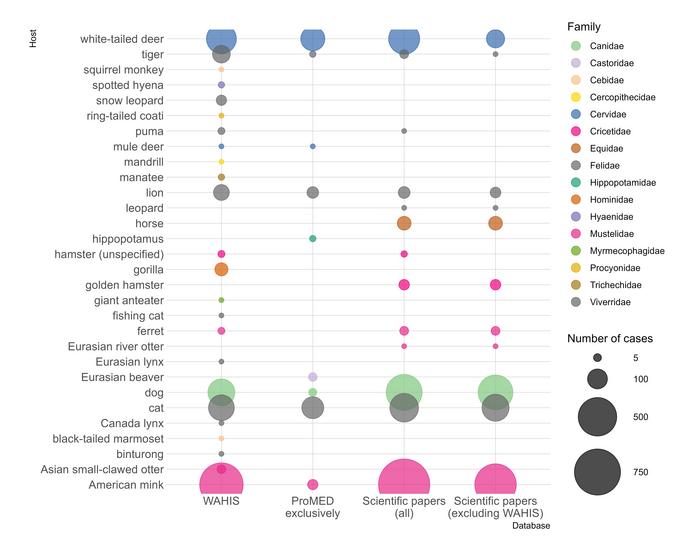
This study aimed to bridge the data gap in the number of SARS-CoV-2 cases and associated deaths in animals. Researchers compared official figures reported by the World Organisation for Animal Health (WOAH) through the World Animal Health Information System (WAHIS) with data from two other sources: ProMED-Mail and scientific publications.
AT LEAST TWO-THIRDS OF ANIMAL COVID DEATHS UNREPORTED
“At least 52.8% of SARS-CoV-2 cases in animals and 65.8% of deaths between February 2020 and August 2022 were not reported to WAHIS,” explains study lead author Amélie Desvars-Larrive, a researcher at CSH and Vetmeduni.
“This data gap in the official reporting of cases and deaths is a significant challenge, particularly as policymakers rely on official data. Data biases and skewed data can lead to suboptimal policymaking and inefficient allocation of resources,” emphasizes Desvars-Larrive.
Moreover, the researchers noted a “geographic gap.” While certain countries, mainly in the Global North, routinely share data on SARS-CoV-2 cases in animals, this is less common in the Global South, where resource availability may be a major barrier to effective data collection and dissemination.
These insights were based on combining information from three different sources, leading the research team to compile a comprehensive list of 35 animal species susceptible to SARS-CoV-2 under natural conditions during the first 2.5 years of the pandemic. “This represents a significant advancement over WOAH and FAO (UN Food and Agriculture Organization) numbers. Furthermore, we identified species underreported to WAHIS, whereas dogs and cats have received the most attention in research studies,” adds Desvars-Larrive.
ONE HEALTH: A VALUABLE APPROACH FOR PREVENTING EMERGING ZOONOSES
“As around 75% of emerging human diseases are of animal origin, and we should be prepared in the event of the next pandemic, this data gap is an important issue that needs to be addressed now,” says Desvars-Larrive.
This analysis provides valuable insights into the patterns of reporting animal infections with SARS-CoV-2, emphasizing the need to improve data exchange on SARS-CoV-2 events in animals. This is crucial for effective One Health monitoring, prevention, and control of emerging zoonotic diseases.
FAIR DATA IS PARAMOUNT
Ideally, this improvement should occur through equitable sharing of data and metadata based on the FAIR principles – Findable, Accessible, Interoperable, Reusable. According to researchers, timely, high-quality, and accurate data on cases in both humans and animals are essential for combating zoonotic pandemic threats. “As decisions and public health policies increasingly rely on data, it’s high time to close these data gaps,” urges Desvars-Larrive to policymakers.
_______________
ABOUT THE STUDY
The study “Data on SARS-CoV-2 events in animals: mind the gap!” has been published in One Health (doi: 10.1016/j.onehlt.2023.100653).
Journal
One Health
DOI
10.1016/j.onehlt.2023.100653
Method of Research
Data/statistical analysis
Subject of Research
Animals
Article Title
Data on SARS-CoV-2 events in animals: Mind the gap!
Article Publication Date
10-Nov-2023