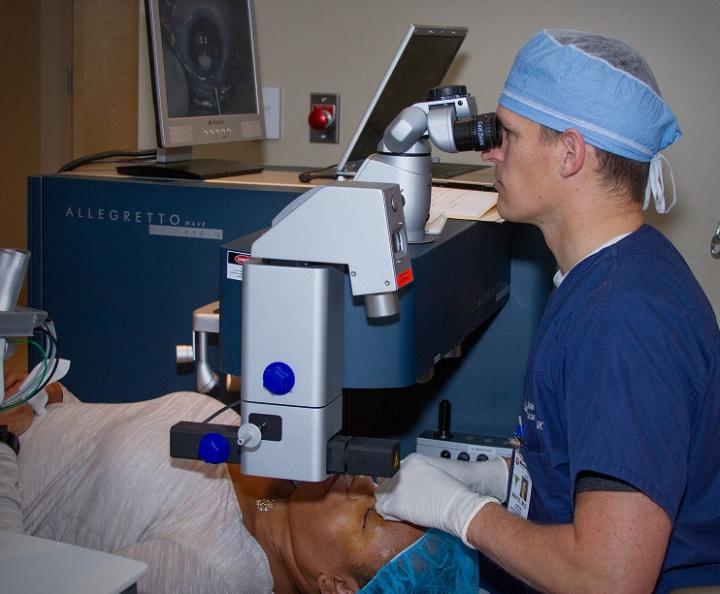
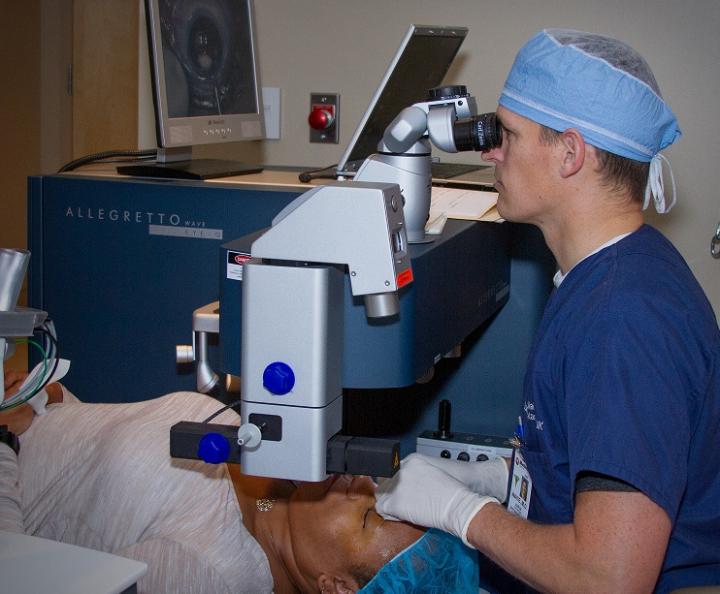
Credit: University of Tennessee Health Science Center
Memphis, Tenn. – Which causes fewer eye infections – contact lens wear or LASIK surgery? While traditionally contacts were thought to be safer than a surgical procedure, an analysis by ophthalmologists from the Hamilton Eye Institute at the University of Tennessee Health Science Center indicates otherwise.
A meta-data analysis comparing the incidence of microbial keratitis, an infection of the cornea caused by bacteria or a virus, for contact lens wearers versus post-LASIK (laser-assisted in situ keratomileusis) patients indicates that over time the infection rate for the contact lens wearers was higher than for those who had LASIK to correct their vision. An article on the findings was published in the Journal of Cataract & Refractive Surgery, a high-impact, peer-reviewed scientific journal.
"Microbial keratitis is a relatively rare complication associated with contact lens use and LASIK postoperatively," the article said. The authors were Jordan Masters, MD; Mehmet Kocak, PhD; and Aaron Waite, MD. "The risk for microbial keratitis was similar between patients using contact lenses at one year, compared with LASIK. Over time, the risk for microbial keratitis was higher for contact lens use than for LASIK, specifically with extended-wear lenses."
Literature in the PubMed database between December 2014 and July 2015 was analyzed. The results showed that after one year of daily soft-contact lens wear, there were fewer microbial keratitis cases than after LASIK, approximately two fewer cases per 10,000. If the surgery is assumed to have essentially a one-time risk for infection, after five years of extrapolation, contact lens wearers would show 11 more cases per 10,000 than those with surgery.
"Most contact lens wearers use them for decades, which means they have a much higher risk of corneal infection compared to the risk with LASIK," said Dr. Waite, director of the Cornea, Cataract, and Refractive Surgery Program at the Hamilton Eye Institute and associate professor in the Department of Ophthalmology at UT Health Science Center.
Microbial keratitis can be devastating, since it can lead to vision loss. It can also be expensive. Contact lens wear has been associated as a risk factor in the development of the condition. Factors, including hygiene, lens type, and history of use, contribute to the risk. According to the analysis, the approximately 38 million contact lens wearers in the United States accounted for an estimated 1 million clinical visits related to microbial keratitis at a cost of about $174.9 million in 2010.
"We did this analysis to directly compare the rate for corneal infections between contact lens use and LASIK," Dr. Waite said. "Contact lenses carry a real risk of infection. In our experience with contact lens infections, some patients have lost vision and have needed a corneal transplant, or even lost the eye. There are cases where LASIK could have prevented this vision loss. LASIK does carry a rare risk of infection, however, it is a one-time risk compared to a continuous risk for infection in contact lens users. We wanted to compare the rates to get hard numbers."
This is believed to be the first meta-analysis comparing the rates of microbial keratitis in contact lens wearers to those who have had LASIK surgery. "It is difficult to compare complications from contact lens use to LASIK, because the complication rate of both is so rare, but our analysis definitely shows that the infection rate is higher with contact lens use comparted to LASIK," Dr. Waite said.
More studies are needed to focus on other complications, such as vision loss and dry eye, to further explore the safety and risk of complications.
###
As Tennessee's only public, statewide, academic health system, the mission of the University of Tennessee Health Science Center (UTHSC) is to bring the benefits of the health sciences to the achievement and maintenance of human health, with a focus on the citizens of Tennessee and the region, by pursuing an integrated program of education, research, clinical care, and public service. Offering a broad range of postgraduate and selected baccalaureate training opportunities, the main UTHSC campus is located in Memphis and includes six colleges: Dentistry, Graduate Health Sciences, Health Professions, Medicine, Nursing and Pharmacy. UTHSC also educates and trains cohorts of medicine, pharmacy and/or health professions students — in addition to medical residents and fellows — at its major sites in Knoxville, Chattanooga and Nashville. Founded in 1911, during its more than 100 years, UT Health Science Center has educated and trained more than 57,000 health care professionals in academic settings and health care facilities across the state. For more information, visit http://www.uthsc.edu. Follow us on Facebook: facebook.com/uthsc, on Twitter: twitter.com/uthsc and on Instagram: instagram.com/uthsc.
References:
Cope JR, Collier SA, Srinivasan K, et al. Contact Lens-Related Corneal Infections — United States, 2005-2015. MMWR Morb Mortal Wkly Rep 2016;65:817-820. DOI: http://dx.doi.org/10.15585/mmwr.mm6532a2
Media Contact
Peggy Reisser Winburne
[email protected]
901-448-4072
http://www.uthsc.edu
Original Source
https://news.uthsc.edu/data-analysis-ophthalmologists-hamilton-eye-institute-ut-health-science-center-finds-lower-risk-infection-time-lasik-surgery-contacts/ http://dx.doi.org/10.1016/j.jcrs.2016.10.022