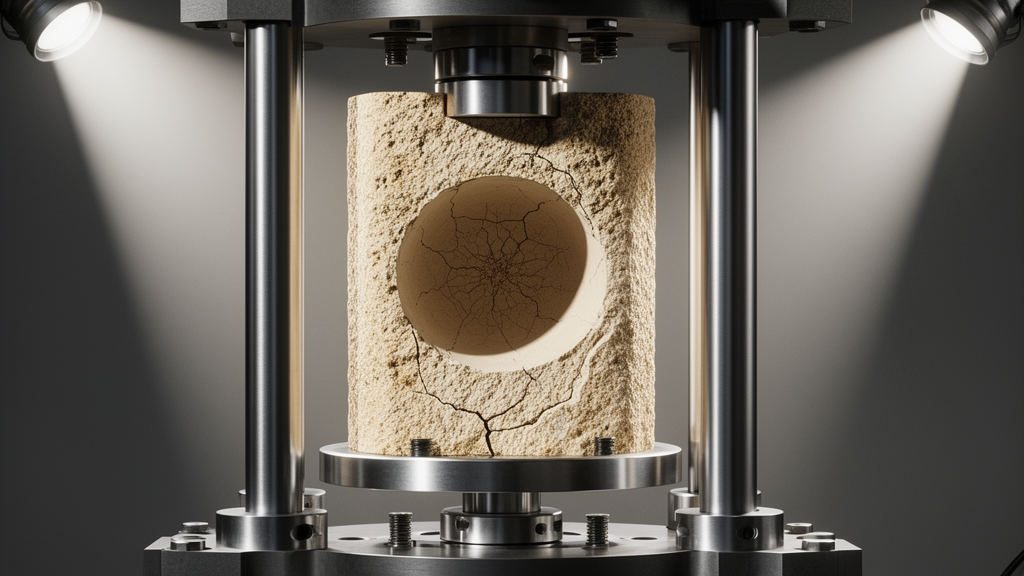
Cyclic triaxial loading significantly reduces the peak strength of hollow sandstone compared to conventional triaxial loading, driving progressive structural degradation through microcrack initiation, crack coalescence, and eventual shear failure. According to experimental and numerical investigations published in Geomechanics and Geophysics for Geo-Energy and Geo-Resources, hollow rock structures subjected to repeated loading cycles experience continuous internal damage accumulation that alters their macroscopic load-bearing capacity and deformation responses.
The study examines the damage evolution mechanisms governing hollow sandstone under complex stress states, which represent critical considerations for evaluating the structural integrity, safety, and long-term stability of deep underground engineering structures, including deep wells and deep tunnels.
To investigate these mechanical processes, researchers conducted triaxial cyclic loading experiments paired with X-ray micro-computed tomography (micro-CT) scanning on cylindrical hollow sandstone specimens. The physical test specimens were prepared with an inner diameter of 15 millimeters and subjected to testing under an internal pressure condition of 0 megapascals. The laboratory testing framework enabled direct observation and quantitative measurement of strength degradation, deformation characteristics, and internal structural damage under applied confinement.
To complement the laboratory experiments and analyze microscopic failure dynamics, the investigators established a numerical framework using the particle flow code (PFC). Within this discrete element modeling environment, the team developed a nonlinear parallel-bonded stress corrosion (N-PSC) model specifically formulated to capture cyclic damage behavior. The fundamental governing principle of the N-PSC model reproduces cyclic material degradation by nonlinearly modifying the bond diameter between constituent particles across repeated stress cycles.
The synthesized experimental and numerical observations revealed that hollow sandstone specimens exhibit three distinct stages of nonlinear damage development under triaxial cyclic loading: an initial damage stage, a stable damage stage, and an accelerated damage stage. Numerical specimens based on the N-PSC formulation accurately reflected the macroscopic mechanical properties of the hollow sandstone, successfully reproducing the experimental stress–strain curves, strength metrics, and deformation characteristics.
A combined analysis of experimental energy dissipation and simulated crack evolution clarified the internal damage accumulation mechanism under cyclic loading. Microcracks initiate once the applied cyclic stress exceeds the material’s crack damage threshold. These microcracks originate specifically at the inner hole wall of the hollow specimen and gradually propagate outward toward the external wall, rapidly multiplying and coalescing during the post-peak stage to generate an interconnected macroscopic fracture zone.
Under ongoing cyclic loading, the hollow sandstone specimens demonstrate overall shear failure accompanied by noticeable hole spalling along the interior void. In addition, when testing occurs under high confining pressure, stress concentrations at the specimen ends induce severe localized end damage and failure. The integrated experimental and numerical results provide a theoretical foundation explaining the progressive damage processes and crack evolution pathways governing hollow rock under cyclic triaxial conditions.
Subject of Research: Failure mechanical behavior and crack evolution in hollow sandstone under triaxial cyclic loading
Article Title: Experimental and numerical investigation on the failure mechanical behavior and crack evolution mechanism of hollow sandstone under triaxial cyclic loading
Article References: Yang, S.-Q., Cao, M.-H., Ranjith, P. G., Tian, W.-L., & Sun, B.-W. (2026). Experimental and numerical investigation on the failure mechanical behavior and crack evolution mechanism of hollow sandstone under triaxial cyclic loading. Geomechanics and Geophysics for Geo-Energy and Geo-Resources, 12(1), Article 145. https://doi.org/10.1007/s40948-026-01206-7
Image Credits: AI Generated
DOI: 10.1007/s40948-026-01206-7
Keywords: hollow sandstone, triaxial cyclic loading, crack evolution mechanism, damage evolution, peak strength, X-ray micro-CT scanning, particle flow code, N-PSC model, stress corrosion, bond diameter, shear failure, hole spalling, crack damage threshold, deep tunnels, deep wells, confining pressure, energy analysis, stress-strain curves
News Source: Denise Maddox. (November 11, 2026). Cyclic Loading Lowers Hollow Sandstone Strength Through Progressive Inner Wall Cracking. Scienmag.