


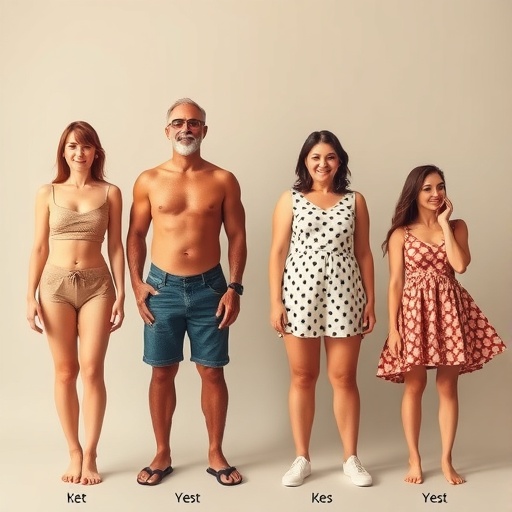
In a groundbreaking study, researchers have explored the cross-cultural preferences for body ratios, specifically focusing on women’s waist-to-hip ratio and men’s shoulder-to-hip ratio. This investigation traverses four countries—Iran, Norway, Poland, and Russia—bringing forth a diverse array of perspectives on physical attractiveness. The study, authored by Pazhoohi, Afhami, Chegeni, and their colleagues, employs rigorous scientific methods to assess how these body metrics are perceived across different cultures and what influences these preferences.
Body shape has long been a topic of interest in the fields of psychology, anthropology, and evolutionary biology. It is commonly believed that certain body ratios signal health, fertility, and fitness, which could explain why these traits are universally sought-after amongst partners. The researchers utilized survey methods to gather data, allowing participants from various cultural backgrounds to express their preferences regarding body ratios. Such investigations are vital not only for understanding human attraction but also for examining cultural attitudes towards body image.
The waist-to-hip ratio (WHR) is a classic determinant in assessing female attractiveness. Evolutionary theories often suggest that a lower waist-to-hip ratio is linked to higher fertility rates in women. In contrast, men’s shoulder-to-hip ratio (SHR) is frequently associated with perceived strength and masculinity, traits which may appeal to women looking for a partner capable of providing security. This study aims to dissect these long-standing assumptions and observe whether cultural context alters these perceptions.
One striking aspect of the research is the diversity in preferences highlighted by the cross-cultural approach. Participants from Iran exhibited a notable preference for lower waist-to-hip ratios, aligning with traditional views prevalent in many non-Western societies, where fertility signals play a pivotal role. Norwegian participants, on the other hand, indicated a broader range of acceptable body types, suggesting that modern, Western ideals may encourage more varied standards of beauty.
The Polish sample presented results that indicated a blend of both traditional and modern influences, illustrating the complexity of cultural evolution in aesthetic preferences. Participants revealed a tendency toward appreciating certain body types more than others, highlighting how intra-cultural differences might even emerge within a unified national identity. Meanwhile, the Russian perspectives underscored a preference for pronounced shoulder ratios in men, indicating a strong idealization of physical strength and dominance.
The research employed a robust statistical framework to analyze the preferences ascribed by different cultural groups. Factor analysis was utilized to measure the impacts of individual variables, such as age, gender, and regional backgrounds, on the preferences expressed by respondents. The findings were meticulously compiled to reflect variations and commonalities across the four countries surveyed, revealing a fascinating tapestry of human attraction that is as integral to our social fabric as it is elusive in its complexities.
Another important revelation from the study is the burgeoning recognition of how societal changes—such as increased globalization, media exposure, and shifting gender norms—are influencing preferences. Younger generations displayed a pivotal shift towards a more inclusive view of body types, suggesting that as cultural interactions increase, the rigidity of beauty standards may soften. This aligns with ongoing dialogues regarding body positivity, challenging conventional norms and urging a collective acknowledgment of diverse forms of attractiveness.
As the authors of the study illustrated through their findings, beauty is not merely skin deep; it is a complex interplay of cultural rituals, social influences, and individual preferences. The implications of such research extend beyond academia; they resonate with the modern individual effectively navigating a digitally interconnected world where images and ideals travel without borders. In a society that increasingly values diversity, the research prompts a critical re-evaluation of how we perceive ourselves and one another.
The study further emphasizes the roles that interpersonal relationships and expectations play in shaping individual preferences. Family, friends, and community standards can have compelling influences, directing the lens through which personal beauty is defined. Realizing that these factors vary starkly across cultures is crucial for fostering understanding and appreciation of diversity in body types as manifested in different societies.
Notably, the research sheds light on the ongoing struggle against unrealistic beauty standards perpetuated through media. As images of ideal bodies inundate social networks, the pressure to conform can mount, affecting self-esteem and body image perceptions. By exposing the real, statistically supported preferences that diverge from the mainstream, this study challenges the myths surrounding attractiveness and promotes a more inclusive understanding of beauty.
At this juncture in human history, where issues of body image and self-acceptance are more pressing than ever, findings like those presented in this research serve as a beacon of hope. They remind us that while culturally ingrained preferences can shape our perceptions, there is immense value in recognizing and embracing the diversity of human bodies. With an increasing number of voices advocating for body positivity, the tide is turning towards acceptance and celebration of all forms of beauty.
This pivotal study by Pazhoohi, Afhami, and Chegeni is fundamental in prompting deeper discussions on attractiveness, cultural standards, and the importance of diversity. It catalyzes conversations about moving beyond narrow definitions of beauty and embarking on journeys toward understanding and compassion. As societal values evolve, it is essential that we embrace the complexity of human beauty in all its forms, appreciating the rich variety of bodies that coexist in our global society.
The research highlights a remarkable journey of appreciation through cultural lenses, presenting a narrative that reminds us beauty is indeed pluralistic, fluid, and endlessly captivating in its diversity. Recognizing this breadth of human attractiveness invites us to engage in a more comprehensive dialogue about health, self-image, and ultimately, human connection, ensuring that future generations inherit a legacy of acceptance and resilience.
Lastly, as media platforms, educators, and influencers continue to play significant roles in shaping beauty standards, findings from this study should be leveraged to inform policy, design, and practice across various fields. This research holds potential applications from psychological well-being strategies to healthier living campaigns. By weaving this data into the fabric of societal discourse, we can foster environments where all body types are honored and where beauty is seen in its myriad forms, as a fundamental aspect of our shared humanity.
Subject of Research: Cross-cultural preferences for body ratios in men and women.
Article Title: Cross-Cultural Preferences for Women’s Waist to Hip Ratio and Men’s Shoulder to Hip Ratio: Data From Iran, Norway, Poland, and Russia.
Article References:
Pazhoohi, F., Afhami, R., Chegeni, R. et al. Cross-Cultural Preferences for Women’s Waist to Hip Ratio and Men’s Shoulder to Hip Ratio: Data From Iran, Norway, Poland, and Russia.
Adaptive Human Behavior and Physiology 10, 1–17 (2024). https://doi.org/10.1007/s40750-024-00232-7
Image Credits: AI Generated
DOI: 22 January 2024
Keywords: Body image, cultural preferences, attractiveness, waist-to-hip ratio, shoulder-to-hip ratio, diversity, cross-cultural studies, evolutionary psychology, beauty standards, body positivity, self-acceptance, globalization.
Tags: anthropology of physical attractivenessbody image perceptions in different countriescross-cultural body ratio preferencescultural attitudes towards body shapeevolutionary biology of body ratioshealth and fertility signals in attractioninternational study on body preferencesmen’s shoulder-to-hip ratiophysical attractiveness across culturespsychological perspectives on body metricssurvey methods in body image researchwomen’s waist-to-hip ratio



