A multi-year field investigation conducted within the protected forests of Tamaulipas, Mexico, has documented an unprecedented degree of spatial confinement and long-term site fidelity in an adult reptile, challenging longstanding ecological generalizations regarding the relationship between animal body size and spatial movement. Rather than maintaining the expansive activity areas typical of insectivorous lizards of comparable physical dimensions, this resident female exhibited a calculated minimum home-range proxy of merely 0.014 square meters. When evaluated through comparative Bayesian generalized linear models encompassing 100 diverse lizard species, the observed spatial usage of Xenosaurus platyceps fell more than two orders of magnitude below the theoretical baseline established by classical body-size allometry, providing quantitative evidence that tight microhabitat specialization and environmental buffering can fully decouple an organism’s movement ecology from size-dependent energetic expectations.
For decades, broad macroecological syntheses across squamate reptiles have treated adult body mass and snout–vent length as primary mathematical determinants of spatial demand, working from the thermodynamic principle that larger organisms carry elevated absolute energetic requirements and must necessarily scour wider geographical territories to secure sufficient metabolic resources. Classical ecological paradigms further posit that foraging modes predictably shift these boundaries, expecting active, wide-ranging foragers and large-bodied carnivores to command vast expanses of terrain, while smaller, sedentary ambush predators sustain proportionally narrower domains.
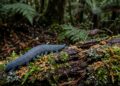
To rigorously examine how extreme microhabitat fidelity interacts with standard allometric predictions, the investigation focused on an isolated population of Xenosaurus platyceps situated within the rugged landscape of the El Cielo Biosphere Reserve in the municipality of Gómez Farías, Tamaulipas, Mexico. Field activities centered on a five-hectare designated monitoring plot established within the reserve’s dominant tropical sub-deciduous forest. The regional climate is characterized by warm subhumid atmospheric conditions, with long-term meteorological records documenting a mean annual temperature of 21 degrees Celsius alongside a mean annual precipitation total of 1,245 millimeters. Within this forested setting, the secretive lizards inhabit fractured rock outcrops and tree bark fissures, microhabitats that present physically complex three-dimensional substrates characterized by stable microclimates and narrow architectural openings that physically isolate the reptiles from the broader surrounding forest floor.
Field monitoring was executed across 24 discrete sampling expeditions undertaken between July 2000 and February 2004, spanning an observational timeline of roughly 3.5 years. Sampling surveys were carried out methodically during daytime intervals between 6:00 and 19:00 hours. The researchers marked each occupied refuge and captured resident lizards by hand from within their rock cavities, assigning permanent individual marks through precise toe-clipping schedules. Cloacal body temperature was measured using a digital thermometer sensitive to 0.1 degrees Celsius inserted directly into the lizard’s cloaca. Simultaneously, the investigators measured internal crevice air temperatures alongside ambient environmental air temperatures immediately adjacent to the opening, while cataloging physical crevice dimensions including interior width, opening height, horizontal depth, vertical distance from the ground surface, and entry angle.
Over the entire 43.5-month surveillance campaign, the investigators monitored 218 individual lizards across 314 distinct rock crevices, classifying the demographic sample into 136 mature adults and 82 juveniles based on an established adult snout–vent length threshold of 100 millimeters. Notably, zero individual lizards were ever observed fully outside a crevice at any point during the hundreds of field survey hours. Diurnal activities were strictly confined to the threshold of the refuge, where lizards were observed partially protruding their heads or anterior bodies with open eyes during daylight hours, but retracting entirely into the deepest interior spaces with closed eyes during darkness. A persistent subcohort of 23 lizards, representing approximately 10 percent of the monitored individuals and comprising 19 adults and 4 juveniles, maintained uninterrupted residence within their original crevices for a minimum duration of at least six months, averaging 565 consecutive days of documented site fidelity with an overall range extending from 188 to 1,305 days. Among these, the aforementioned 120-millimeter female in crevice 10 demonstrated continuous residency across the entire 43.5-month monitoring timeline, occasionally sharing the narrow cavity with two juveniles in January 2001 and with a mature adult male in February 2003.
To determine whether the minimal spatial footprints of Xenosaurus platyceps represented a statistical departure from squamate allometry, the authors assembled a comprehensive comparative morphological and spatial dataset comprising 100 lizard species sourced from established ecological literature. Species selections were curated to maximize taxonomic diversity, body-size ranges, trophic regimes, and predatory behaviors across the squamate phylogeny. Each comparative entry was categorized across standardized dietary modes—distinguishing carnivorous, herbivorous, and omnivorous feeding habits—as well as foraging strategies, separating active hunting, sit-and-wait ambush predation, and mixed tactics. The researchers fitted a hierarchical set of 10 Bayesian generalized linear mixed models using the MCMCglmm analytical package in R, evaluating competing hypotheses regarding how body size, diet, and foraging mode structure minimum home-range area. Log-transformed variables were evaluated under uninformative priors, and model selection was executed via the Deviance Information Criterion, treating values within five units as statistically competitive.
Model selection identified an additive model incorporating snout–vent length, diet, and foraging mode as the single best-fitting specification, achieving a Deviance Information Criterion value of 311.7. Across the multi-species dataset, minimum home range exhibited a significant positive relationship with body length, demonstrating that general squamate spatial demands scale upward predictably with physical size. However, when evaluating the empirical measurements of Xenosaurus platyceps against these statistical parameters, the divergence was striking. For a carnivorous, sit-and-wait ambush lizard exhibiting the mean snout–vent length of the site-faithful Xenosaurus cohort, the additive Bayesian models predicted expected minimum home ranges of 44.9 square meters and 21.9 square meters, respectively. In sharp contrast, the empirical mean internal crevice area measured for these individuals was only 0.061 square meters—an observed footprint 44.8 and 21.8 square meters smaller than model expectations. While sub-meter home ranges are routinely documented in small juvenile squamates or territorial marine iguanas during localized disputes, mature rock-dwelling relatives such as Laudakia tuberculata, which possesses a comparable adult snout–vent length of approximately 120 millimeters, maintain minimum home ranges of 45.7 square meters.
The study sought a mechanistic explanation for this acute spatial confinement by analyzing the thermal environment of the crevices. Cloacal body temperature recordings from site-faithful individuals averaged 21.8 degrees Celsius, while mean internal crevice temperatures and external forest ambient temperatures averaged 21.4 and 22.2 degrees Celsius, respectively. Bayesian model comparison revealed that an intercept-only null model treating all three temperature categories as statistically indistinguishable provided the best fit with a Deviance Information Criterion of minus 59.1, confirming that the lizards inhabit an exceptionally homogeneous thermal buffer. Furthermore, when evaluating competitive predictors of lizard body temperature, internal crevice temperature overwhelmingly outperformed external ambient temperature, body length, and body mass. The resulting regression between log-transformed body temperature and internal crevice temperature yielded a slope of 0.94 with a 95 percent credible interval spanning 0.82 to 1.04. In squamate ecophysiology, a regression slope approaching 1.0 combined with high correlation to substrate temperatures diagnoses complete thermoconformity and pronounced thigmothermy, demonstrating that Xenosaurus platyceps passively absorbs heat directly from its rocky shelter rather than undertaking exploratory locomotion to bask.
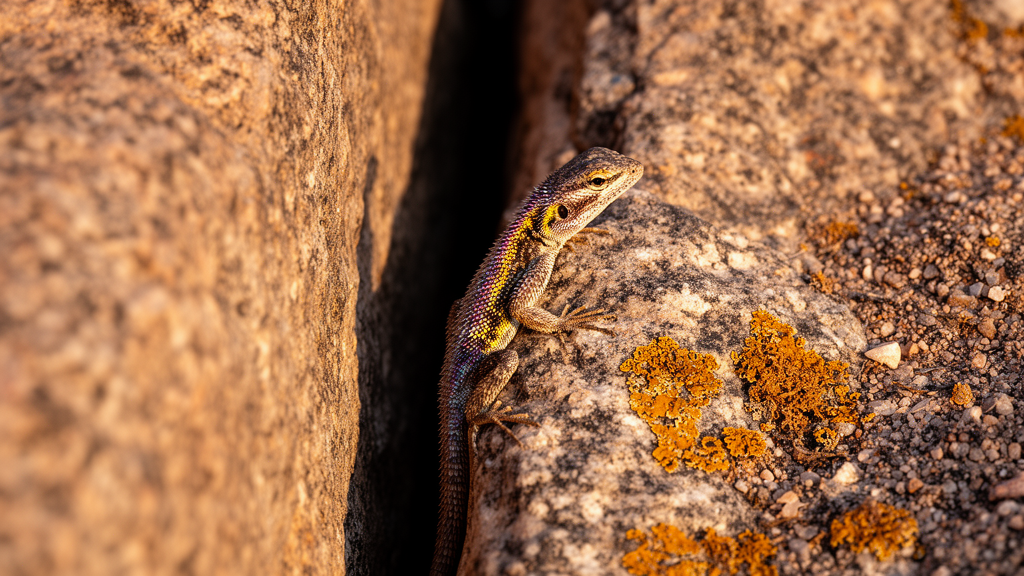
This reliance on passive thermal equilibrium is structurally supported by specialized morphological traits and highly localized foraging habits. Morphologically, Xenosaurus platyceps exhibits severe dorsoventral flattening, paired with laterally splayed limbs positioned perpendicularly against the body axis, facilitating secure anchoring within narrow structural margins. Behaviorally, the species operates as a sedentary ambush predator relying on chemical reception to detect prey passing within striking distance. Although diet consists predominantly of coleopteran beetles and orthopterans, individuals opportunistically consume large prey items, including small mammals, snakes, and other lizards. This feeding generalism, combined with field and captive observations showing that individuals establish latrines located an average of only 11 centimeters from the crevice entrance, demonstrates that essential physiological, nutritional, and metabolic activities are executed without requiring departure from the immediate shelter.
The authors contextualize their findings by addressing several methodological and ecological nuances, noting that crevice occupancy represented a spectrum across the broader population. While certain refuges sustained continuous multi-year fidelity, other monitored cavities exhibited turnover between different individuals, and comparative populations inhabiting cooler, climatically heterogeneous temperate zones demonstrate slightly attenuated site fidelity. The researchers also caution that comparative home-range syntheses across diverse species inevitably draw upon varied field tracking methodologies, and that using internal refuge area as an operational proxy for home range is a specialized approximation necessitated by the secretive habits of extreme crevice specialists. Nonetheless, the findings demonstrate that microhabitat coupling can fully override classical allometric laws, meaning that body size alone cannot reliably predict movement dynamics in habitat specialists.
Subject of Research: Spatial ecology, site fidelity, and thermal biology of the crevice specialist lizard Xenosaurus platyceps
Article Title: Extreme spatial confinement and high site fidelity in a crevice-dwelling lizard with a minimal home range
Article References: Rojas-González, R. I., & Diaz-Ortega, I. E. (2025). Extreme spatial confinement and high site fidelity in a crevice-dwelling lizard with a minimal home range. BMC Zoology, 11(1), Article 5. https://doi.org/10.1186/s40850-025-00253-z
Image Credits: AI Generated
DOI: 10.1186/s40850-025-00253-z
Keywords: Xenosaurus platyceps, home range allometry, site fidelity, crevice specialist, thermal ecology, thermoconformity, thigmothermy, Bayesian generalized linear models, El Cielo Biosphere Reserve, lizard behavioral ecology, Extreme, spatial
News Source: Drew Townsend. (November 10, 2026). Crevice-Dwelling Lizard Maintains Tiny Home Range Defying Classical Ecological Allometry. Scienmag.