• HOME
  • NEWS
  • EXPLORE
    • CAREER
      • Companies
      • Jobs
    • EVENTS
    • iGEM
      • News
      • Team
    • PHOTOS
    • VIDEO
    • WIKI
  • BLOG
  • COMMUNITY
    • FACEBOOK
    • INSTAGRAM
    • TWITTER
Friday, April 3, 2026
BIOENGINEER.ORG
No Result
View All Result
  • Login
  • HOME
  • NEWS
  • EXPLORE
    • CAREER
      • Companies
      • Jobs
        • Lecturer
        • PhD Studentship
        • Postdoc
        • Research Assistant
    • EVENTS
    • iGEM
      • News
      • Team
    • PHOTOS
    • VIDEO
    • WIKI
  • BLOG
  • COMMUNITY
    • FACEBOOK
    • INSTAGRAM
    • TWITTER
  • HOME
  • NEWS
  • EXPLORE
    • CAREER
      • Companies
      • Jobs
        • Lecturer
        • PhD Studentship
        • Postdoc
        • Research Assistant
    • EVENTS
    • iGEM
      • News
      • Team
    • PHOTOS
    • VIDEO
    • WIKI
  • BLOG
  • COMMUNITY
    • FACEBOOK
    • INSTAGRAM
    • TWITTER
No Result
View All Result
Bioengineer.org
No Result
View All Result
Home NEWS Science News Biology

Crepidula onyx resilient towards microplastic diet

Bioengineer by Bioengineer
March 5, 2018
in Biology
Reading Time: 2 mins read
0
Share on FacebookShare on TwitterShare on LinkedinShare on RedditShare on Telegram
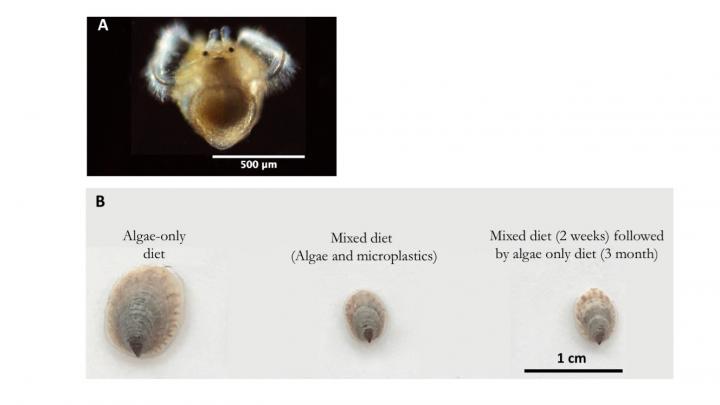
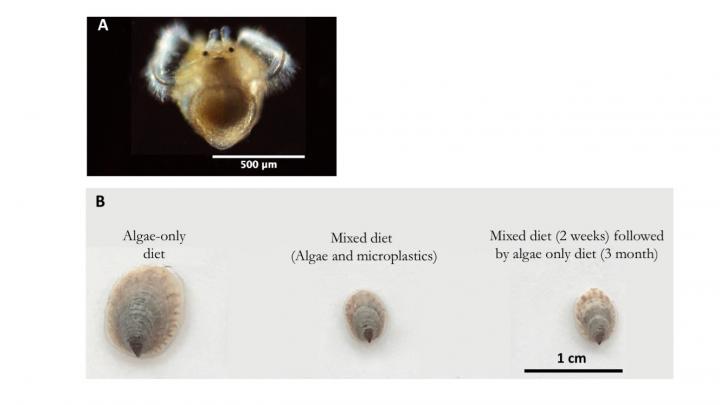
IMAGE

Credit: Chan Lab, Division of Life Science, HKUST

Coastal marine organisms are hit hard by pollution and global climate change stress. Perhaps a result of publication bias, studies often focus on species that are negatively impacted. However, to better understand how the ecological communities would response to these human-induced stress, it is equally important to study organisms that are seeming pollutant tolerant.

Invasive species are "expats" that have created successful populations in and in turn adversely affect the foreign habitat they colonize. The North American native slipper limpet, Crepdiula onyx, is one such species found in Asia. A group of scientists at the Chan Lab of the Division of Life Science, HKUST, uses this species as a model organism to test if these invaders are also "immune" to an emergent pollutant: microplastics. These

Their findings were published in the journal Environmental Pollution in Feb 2018 (doi: 10.1016/j.envpol.2017.10.095).

"Microplastics exposure could be detrimental to marine organisms especially under high concentrations," said Abby Lo Hau Kwan, PhD student at the Division of Life Science, HKUST, and co-author of the paper. "In our two-stage experiment, we first exposed Crepidula onyx to additions of algae-sized micro-polystyrene (micro-PS) beads at different concentrations, including ones that were comparable their algal diet. We then halted or continued after settlement and continued to measure the impact of microplastics in the snails."

The group found that at environmentally relevant concentration, larval and juvenile C. onyx were not affected at all. At higher concentrations, the micro-PS fed larvae consumed a similar amount of algae compared to those in control, but grew relatively slower, suggesting that ingestion and/or removal of microplastic was/were energetically costly.

"The larvae also settled earlier at a smaller size compared to the control, which could negatively affect post-settlement success," said Karen Chan, Assistant Professor at the Divison of Life Science, HKUST, and lead author and researcher of the Chan Lab. "As expected, juvenile C. onyx receiving continuous micro-PS addition had slower growth rates. Interestingly, individuals only exposed to micro-PS during their larval stage but not after settlement continued to have slower growth rates than others. This legacy effect would warrant further investigation and work."

"The problem is, C. onyx were unfazed by microplastics at environmental concentration, which would place them higher in the resilience pecking order compared to other species we have examined," noted Chan. "This may explains why C. onyx is so common in the sea waters in Hong Kong, despite its foreign origin. Further work on their coping mechanisms may help us understand how organisms will function in a changing world."

###

Media Contact

Johnny Tam
[email protected]
852-235-88556

http://www.ust.hk

Related Journal Article

http://dx.doi.org/10.1016/j.envpol.2017.10.095

Share12Tweet8Share2ShareShareShare2

Related Posts

Brain Power May Hold the Key to Predicting Cognitive Decline

Brain Power May Hold the Key to Predicting Cognitive Decline

April 2, 2026
Insights into CD4+ T-Cell Depletion and Pulmonary Infections in Critically Ill Immunocompromised Patients

Insights into CD4+ T-Cell Depletion and Pulmonary Infections in Critically Ill Immunocompromised Patients

April 2, 2026

Advanced Sensors Reduce Costs in Genetic Disorder Research

April 2, 2026

Advancing Blood Purification: Innovations Beyond Traditional Dialysis

April 2, 2026
Please login to join discussion

POPULAR NEWS

  • blank

    Revolutionary AI Model Enhances Precision in Detecting Food Contamination

    96 shares
    Share 38 Tweet 24
  • Imagine a Social Media Feed That Challenges Your Views Instead of Reinforcing Them

    1007 shares
    Share 398 Tweet 249
  • Promising Outcomes from First Clinical Trials of Gene Regulation in Epilepsy

    51 shares
    Share 20 Tweet 13
  • Popular Anti-Aging Compound Linked to Damage in Corpus Callosum, Study Finds

    44 shares
    Share 18 Tweet 11

About

We bring you the latest biotechnology news from best research centers and universities around the world. Check our website.

Follow us

Recent News

Revolutionary Magnetic Biochar Gel Tackles Arsenic and Antimony Pollution in Rice Cultivation

Engineered Biochar Harnesses Soil Chemistry to Degrade Antibiotic Pollution

Leading Cancer Scientist Thales “PapaG” Papagiannakopoulos Joins Salk Institute

Subscribe to Blog via Email

Success! An email was just sent to confirm your subscription. Please find the email now and click 'Confirm' to start subscribing.

Join 78 other subscribers
  • Contact Us

Bioengineer.org © Copyright 2023 All Rights Reserved.

Welcome Back!

Login to your account below

Forgotten Password?

Retrieve your password

Please enter your username or email address to reset your password.

Log In
No Result
View All Result
  • Homepages
    • Home Page 1
    • Home Page 2
  • News
  • National
  • Business
  • Health
  • Lifestyle
  • Science

Bioengineer.org © Copyright 2023 All Rights Reserved.