• HOME
  • NEWS
  • EXPLORE
    • CAREER
      • Companies
      • Jobs
    • EVENTS
    • iGEM
      • News
      • Team
    • PHOTOS
    • VIDEO
    • WIKI
  • BLOG
  • COMMUNITY
    • FACEBOOK
    • INSTAGRAM
    • TWITTER
Friday, December 19, 2025
BIOENGINEER.ORG
No Result
View All Result
  • Login
  • HOME
  • NEWS
  • EXPLORE
    • CAREER
      • Companies
      • Jobs
        • Lecturer
        • PhD Studentship
        • Postdoc
        • Research Assistant
    • EVENTS
    • iGEM
      • News
      • Team
    • PHOTOS
    • VIDEO
    • WIKI
  • BLOG
  • COMMUNITY
    • FACEBOOK
    • INSTAGRAM
    • TWITTER
  • HOME
  • NEWS
  • EXPLORE
    • CAREER
      • Companies
      • Jobs
        • Lecturer
        • PhD Studentship
        • Postdoc
        • Research Assistant
    • EVENTS
    • iGEM
      • News
      • Team
    • PHOTOS
    • VIDEO
    • WIKI
  • BLOG
  • COMMUNITY
    • FACEBOOK
    • INSTAGRAM
    • TWITTER
No Result
View All Result
Bioengineer.org
No Result
View All Result
Home NEWS Science News Chemistry

Creating blood vessels on demand

Bioengineer by Bioengineer
April 3, 2019
in Chemistry
Reading Time: 2 mins read
0
IMAGE
Share on FacebookShare on TwitterShare on LinkedinShare on RedditShare on Telegram

IMAGE

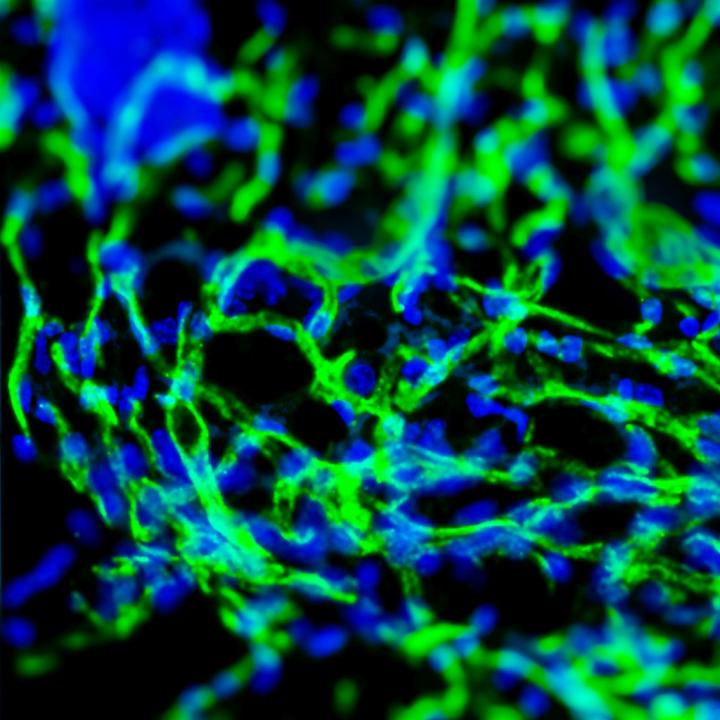
Credit: Photo: AG Shastri

When organs or tissues are damaged, new blood vessels must form as they play a vital role in bringing nutrients and eliminating waste. This is the only way for organs and tissues to resume their normal function. At present, the injection of growth factors or genetic material into the tissue site of interest can trigger angiogenesis, i.e. the growth of new blood vessels from pre-existing vessels. In a study published in the journal Advanced Materials, scientists from the Universities of Freiburg and Basel led by Prof. Dr. Prasad Shastri show that stable angiogenesis can be achieved by simple hydrogel injection. Due to its mechanical properties, this hydrogel resembles a blood clot.

The cells that organize into blood vessels need support from other cells for stability and blood flow regulation. The Freiburg researchers and the biomedical scientists Dr. Roberto Gianni-Barrera and Dr. Andrea Banfi from the University of Basel discovered a new population of cells of the immune system that circulate in the blood, the CD11b+ monocytes that produce the protein Piezo-1. This is one of the so-called mechanoreceptors that are necessary for the interaction of cells in the central nervous system, as Shastri found out in an earlier study. The scientists were also able to clarify the role of the cell population of CD11b+ monocytes in the stabilization of newly formed blood vessels. On the basis of these results, they have developed a hydrogel which, due to its mechanical properties, is able to stimulate the CD11b+ monocytes to form piezo-1 so that new blood vessels develop at the desired site.

“Our study represents a paradigm shift, as it shows for the first time that a mechanically defined microenvironment is capable of recruiting a specific population of mechanosensing cells that can aid in a regenerative process,” says Shastri. The results had an effect on the treatment of peripheral vascular diseases, explains co-author Dr. Melika Sarem. “The hydrogel is a simple means to induce new and healthy vascular systems in a target tissue,” adds Dr. Aurelien Forget, who co-led the study at the University of Freiburg.

###

Prasad Shastri is Professor of Biofunctional Macromolecular Chemistry at the Institute for Macromolecular Chemistry and Professor of Cell Signalling Environments in the Excellence Cluster BIOSS Centre for Biological Signalling Studies and at the University of Freiburg.

Media Contact
Dr. Prasad Shastri
[email protected]

Original Source

https://www.pr.uni-freiburg.de/pm-en/press-releases-2019/creating-blood-vessels-on-demand

Related Journal Article

http://dx.doi.org/10.1002/adma.201808050

Tags: BiochemistryBiologyMolecular Biology
Share12Tweet8Share2ShareShareShare2

Related Posts

Cutting Electrolyte Reduction Boosts High-Energy Battery Performance

Cutting Electrolyte Reduction Boosts High-Energy Battery Performance

December 19, 2025
Microenvironment Shapes Gold-Catalysed CO2 Electroreduction

Microenvironment Shapes Gold-Catalysed CO2 Electroreduction

December 11, 2025

Photoswitchable Olefins Enable Controlled Polymerization

December 11, 2025

Cation Hydration Entropy Controls Chloride Ion Diffusion

December 10, 2025
Please login to join discussion

POPULAR NEWS

  • Nurses’ Views on Online Learning: Effects on Performance

    Nurses’ Views on Online Learning: Effects on Performance

    70 shares
    Share 28 Tweet 18
  • NSF funds machine-learning research at UNO and UNL to study energy requirements of walking in older adults

    70 shares
    Share 28 Tweet 18
  • Unraveling Levofloxacin’s Impact on Brain Function

    53 shares
    Share 21 Tweet 13
  • MoCK2 Kinase Shapes Mitochondrial Dynamics in Rice Fungal Pathogen

    72 shares
    Share 29 Tweet 18

About

We bring you the latest biotechnology news from best research centers and universities around the world. Check our website.

Follow us

Recent News

Optimizing Polyhydroxybutyrate from Waste Oil: Economic Insights

Connecting Individual and Community Health Insights: A Study

RECQL4 Mutations Impact Helicase Function and Chemotherapy Response

Subscribe to Blog via Email

Enter your email address to subscribe to this blog and receive notifications of new posts by email.

Join 70 other subscribers
  • Contact Us

Bioengineer.org © Copyright 2023 All Rights Reserved.

Welcome Back!

Login to your account below

Forgotten Password?

Retrieve your password

Please enter your username or email address to reset your password.

Log In
No Result
View All Result
  • Homepages
    • Home Page 1
    • Home Page 2
  • News
  • National
  • Business
  • Health
  • Lifestyle
  • Science

Bioengineer.org © Copyright 2023 All Rights Reserved.