In the rapidly advancing field of nanotechnology, indium phosphide (InP) quantum dots (QDs) have garnered increasing attention as environmentally friendly substitutes for the conventional cadmium-based quantum dots, which pose significant toxicity concerns. InP QDs are particularly valued for their excellent optical properties, making them ideal candidates for applications in lighting, displays, and optoelectronic devices. Despite their promise, the development of high-quality blue-emitting InP QDs has faced persistent obstacles. These challenges stem primarily from surface defects inherent in small-sized InP cores and the lattice mismatch between the core and its protective shell, which detrimentally impact the emission efficiency and color purity.
Addressing these fundamental issues, a pioneering study has unveiled a novel approach involving chromium (Cr³⁺) doping of InP/ZnS core-shell quantum dots. Utilizing a precise hot injection synthesis method, the research team introduced Cr³⁺ ions at the critical interface between the InP core and the ZnS shell. This meticulous doping strategy was achieved using chromium acetylacetonate (Cr(acac)₃) as the chromium source and was complemented by advanced ligand engineering techniques and interface design optimizations to ensure an even distribution and stable incorporation of the Cr³⁺ ions.
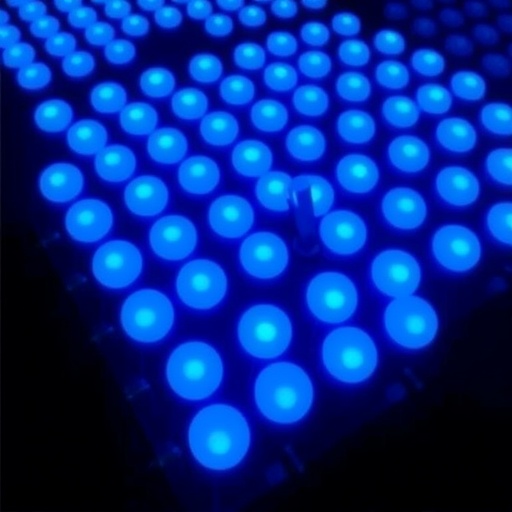
A notable consequence of embedding Cr³⁺ ions at the core-shell boundary is the effective passivation of surface defects on the InP cores. Passivation reduces non-radiative recombination pathways that typically quench photoluminescence, thereby enhancing the quantum yield of the quantum dots. In this work, the Cr³⁺-doped InP/ZnS QDs exhibited a remarkable pure blue emission at a wavelength of 471 nm, with a photoluminescence quantum yield (PLQY) reaching 52%. Not only does this represent a significant improvement in efficiency, but it also manifests in a narrow emission spectral width, with a full width at half maximum (FWHM) of just 46 nm—a critical parameter for achieving vivid and color-pure displays.
Beyond their enhanced photophysical properties, these quantum dots demonstrated an unprecedented magnetic characteristic. Traditionally, dilute magnetic semiconductors (DMSs) have struggled to maintain ferromagnetism at room temperature due to low Curie temperatures, limiting their practical applicability in spintronic devices. Remarkably, the Cr³⁺ doping enabled the InP QDs to exhibit robust room-temperature ferromagnetism, with the Curie temperature surpassing 350 K. This breakthrough owes itself to the formation of a Cr–P–Cr coordination bridge at the InP core surface, facilitating a ferromagnetic superexchange interaction among Cr³⁺ ions.
The synergy between the intrinsic strong local magnetic moments of the Cr³⁺ ions and the quantum confinement effects intrinsic to the nanoscale dimensions of the quantum dots contributes to the stabilization of magnetic ordering at elevated temperatures. The maximum coercivity value observed was an impressive 95.45 Oe, underlining the strength and stability of the ferromagnetic state in these quantum dots. This accomplishment resolves a critical bottleneck in DMS research, opening the door to room-temperature spintronic applications previously unattainable with conventional materials.
From a materials chemistry perspective, the integration of magnetic functionalities into optically active quantum dots represents a leap forward in multifunctional nanomaterial design. The Cr³⁺ doping strategy exemplifies how interface engineering and precise control over dopant placement can significantly influence both optical and magnetic properties without compromising either. This dual functionality is particularly attractive for the development of spin-optoelectronic devices that require simultaneous control over spin and photon dynamics at room temperature.
Researchers utilized advanced characterization techniques to confirm the successful incorporation of Cr³⁺ ions at the core-shell interface and to elucidate the electronic and magnetic interactions responsible for the observed properties. Spectroscopic analyses verified the suppression of surface trap states, while magnetic measurements confirmed the presence of long-range ferromagnetic order. These findings collectively demonstrate that the Cr–P–Cr bridging motif is pivotal in mediating the ferromagnetic superexchange mechanism, highlighting the importance of atomic-scale structural control.
The implications of this research extend well beyond the realm of quantum dot synthesis. By overcoming the longstanding trade-off between optical performance and magnetic behavior in III-V semiconductor nanomaterials, these Cr³⁺-doped InP QDs establish a new paradigm for multifunctional nanodevices. The approach offers a template for future investigations into other transition metal dopants and semiconductor hosts, potentially leading to a diverse library of materials with tunable opto-magnetic properties.
The publication of these findings in the esteemed journal Advanced Powder Materials solidifies the significance of the work within the scientific community. It not only pushes forward the frontier of quantum dot technology but also lays foundational knowledge that can invigorate research in spintronics, nano-optoelectronics, and environmentally benign luminescent materials. The possibility of integrating such materials into commercial devices promises enhanced performance coupled with greener technologies.
Looking ahead, this dual-functional platform invites exploration into device fabrication and integration strategies. Scaling synthesis while maintaining precise dopant control will be crucial for commercial viability. Additionally, exploring the dynamic interplay between optical emissions and magnetic responses under various external stimuli could unlock novel functionalities, such as magneto-optical modulation and spin-dependent light emission, enriching the toolkit available to future nanoengineers.
In conclusion, the groundbreaking work on Cr³⁺-doped InP quantum dots exemplifies how innovative material engineering can simultaneously satisfy stringent optical and magnetic criteria. By achieving pure blue emission and room-temperature ferromagnetism in a single, eco-friendly nanomaterial, this study marks a pivotal advance with far-reaching impacts on the design of next-generation spintronic and optoelectronic devices.
Subject of Research: Not applicable
Article Title: Dual-functional Cr3+-doped InP quantum dots with pure blue emission and room-temperature ferromagnetism
News Publication Date: 8-Jan-2026
Web References:
– https://doi.org/10.1016/j.apmate.2026.100393
– https://www.sciencedirect.com/journal/advanced-powder-materials
Image Credits: HIGHER EDUCATION PRESS
Keywords
Indium phosphide quantum dots, Cr³⁺ doping, room-temperature ferromagnetism, dilute magnetic semiconductors, blue-emitting quantum dots, core-shell interface, hot injection synthesis, photoluminescence quantum yield, spintronic materials, semiconductor nanocrystals, opto-magnetic properties, ligand engineering
Tags: advancedchromium acetylacetonate doping techniqueCr³⁺ doping in InP quantum dotsenvironmentally friendly cadmium-free quantum dotshot injection synthesis method for quantum dotsInP/ZnS core-shell nanostructureslattice mismatch mitigation in core-shell QDsligand engineering for quantum dot stabilityoptoelectronic applications of InP quantum dotspure blue emission quantum dotsroom-temperature ferromagnetism in quantum dotssurface defect passivation in quantum dots