• HOME
  • NEWS
  • EXPLORE
    • CAREER
      • Companies
      • Jobs
    • EVENTS
    • iGEM
      • News
      • Team
    • PHOTOS
    • VIDEO
    • WIKI
  • BLOG
  • COMMUNITY
    • FACEBOOK
    • INSTAGRAM
    • TWITTER
Saturday, April 11, 2026
BIOENGINEER.ORG
No Result
View All Result
  • Login
  • HOME
  • NEWS
  • EXPLORE
    • CAREER
      • Companies
      • Jobs
        • Lecturer
        • PhD Studentship
        • Postdoc
        • Research Assistant
    • EVENTS
    • iGEM
      • News
      • Team
    • PHOTOS
    • VIDEO
    • WIKI
  • BLOG
  • COMMUNITY
    • FACEBOOK
    • INSTAGRAM
    • TWITTER
  • HOME
  • NEWS
  • EXPLORE
    • CAREER
      • Companies
      • Jobs
        • Lecturer
        • PhD Studentship
        • Postdoc
        • Research Assistant
    • EVENTS
    • iGEM
      • News
      • Team
    • PHOTOS
    • VIDEO
    • WIKI
  • BLOG
  • COMMUNITY
    • FACEBOOK
    • INSTAGRAM
    • TWITTER
No Result
View All Result
Bioengineer.org
No Result
View All Result
Home NEWS Science News Biology

COVID-19 genetic risk variant protects against HIV

Bioengineer by Bioengineer
February 21, 2022
in Biology
Reading Time: 2 mins read
0
DNA analytics
Share on FacebookShare on TwitterShare on LinkedinShare on RedditShare on Telegram

Some people become seriously ill when infected with SARS-CoV-2 while others have only mild symptoms or no symptoms at all. In addition to risk factors such as advanced age and chronic diseases, like diabetes, our genetic heritage also contributes to our individual COVID-19 severity risk.
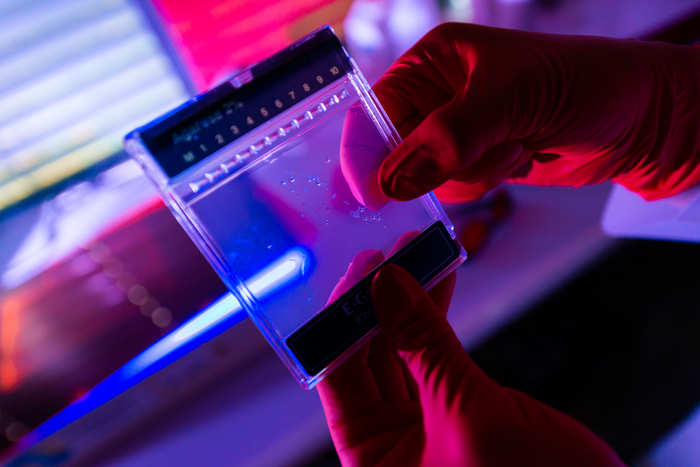
DNA analytics

Credit: Max Planck Institute for Evolutionary Anthropology

Some people become seriously ill when infected with SARS-CoV-2 while others have only mild symptoms or no symptoms at all. In addition to risk factors such as advanced age and chronic diseases, like diabetes, our genetic heritage also contributes to our individual COVID-19 severity risk.

In the autumn of 2020, Hugo Zeberg at Karolinska Institutet and MPI-EVA and Svante Pääbo at MPI-EVA showed that we inherited the major genetic risk factor for severe COVID-19 from Neandertals. In the spring of 2021, the same researcher duo studied this variant in ancient human DNA and observed that its frequency has increased significantly since the last ice age. In fact, it has become unexpectedly common for a genetic variant inherited from Neandertals. Hence, it may have had a favourable impact on its carriers in the past. “This major genetic risk factor for COVID-19 is so common that I started wondering whether it might actually be good for something, such as providing protection against another infectious disease”, says Hugo Zeberg, who is the sole author of the new study in PNAS.

The genetic risk factor is located in a region on chromosome 3 that consists of many genes. There are several genes in its vicinity that encode receptors in the immune system. One of these receptors – CCR5 – is used by the HIV virus to infect white blood cells. Zeberg found that people who carried the risk factor for COVID-19 had fewer CCR5 receptors. This led him to test whether they also had a lower risk of becoming infected with HIV. By analysing patient data from three major biobanks (FinnGen, UK Biobank and Michigan Genomic Initiative) he found that carriers of the risk variant for COVID-19 had a 27 percent lower risk of contracting HIV. “This shows how a genetic variant can be both good and bad news: Bad news if a person contracts COVID-19, good news because it offers protection against getting infected with HIV”, says Zeberg.

However, since HIV only arose during the 20th century, protection against this infectious disease cannot explain why the genetic risk variant for COVID-19 became so common among humans as early as 10,000 years ago. “Now we know that this risk variant for COVID-19 provides protection against HIV. But it was probably protection against yet another disease that increased its frequency after the last ice age”, Zeberg concludes.


Journal

Proceedings of the National Academy of Sciences

DOI

10.1073/pnas.2116435119

Article Title

The major genetic risk factor for severe COVID-19 is associated with protection against HIV

Article Publication Date

21-Feb-2022

Share12Tweet8Share2ShareShareShare2

Related Posts

Epigenetic Alterations at Birth Linked to Infant Microbiome and Neurodevelopment

Epigenetic Alterations at Birth Linked to Infant Microbiome and Neurodevelopment

April 10, 2026
Lung Cancer That Alters Its Identity Could Be Concealed in Plain Sight

Lung Cancer That Alters Its Identity Could Be Concealed in Plain Sight

April 10, 2026

Neuronal Motor Protein Composition Determines Cargo Specificity

April 10, 2026

How Your Housemates Might Be Altering Your Gut Microbiome

April 10, 2026

POPULAR NEWS

  • Boosting Breast Cancer Risk Prediction with Genetics

    47 shares
    Share 19 Tweet 12
  • Popular Anti-Aging Compound Linked to Damage in Corpus Callosum, Study Finds

    44 shares
    Share 18 Tweet 11
  • Scientists Investigate Possible Connection Between COVID-19 and Increased Lung Cancer Risk

    44 shares
    Share 18 Tweet 11
  • Imagine a Social Media Feed That Challenges Your Views Instead of Reinforcing Them

    1012 shares
    Share 400 Tweet 250

About

We bring you the latest biotechnology news from best research centers and universities around the world. Check our website.

Follow us

Recent News

Loneliness in Early Alzheimer’s: Key Risks Revealed

Sevoflurane Safeguards Heart via RMRP/miR-206 Pathway

E-selectin Microbubbles Boost Kidney Protection in Rats

Subscribe to Blog via Email

Enter your email address to subscribe to this blog and receive notifications of new posts by email.

Join 78 other subscribers
  • Contact Us

Bioengineer.org © Copyright 2023 All Rights Reserved.

Welcome Back!

Login to your account below

Forgotten Password?

Retrieve your password

Please enter your username or email address to reset your password.

Log In
No Result
View All Result
  • Homepages
    • Home Page 1
    • Home Page 2
  • News
  • National
  • Business
  • Health
  • Lifestyle
  • Science

Bioengineer.org © Copyright 2023 All Rights Reserved.