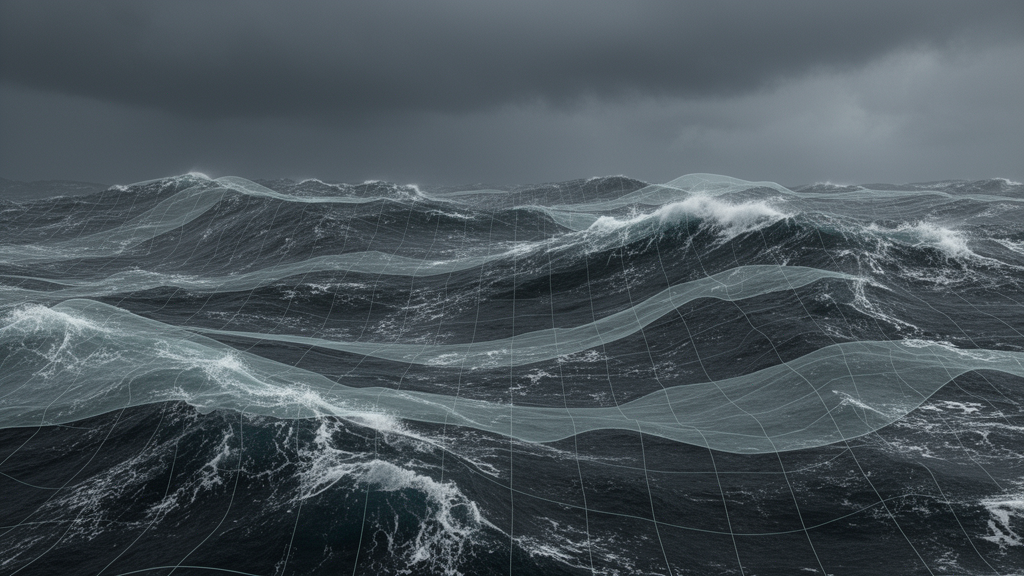
Researchers from the Technical University of Denmark have demonstrated that a high-resolution, multiscale modeling framework significantly improves the simulation of wind and wave interactions during severe North Sea storms. Published in Wind Energy Science, the study by Sima Hamzeloo and colleagues utilized the Coupled Ocean–Atmosphere–Wave–Sediment Transport (COAWST) system to link the Weather Research and Forecasting (WRF) model with the Simulating WAves Nearshore (SWAN) model. By integrating large-eddy simulation (LES) domains within mesoscale simulations, the team aimed to capture the complex physical processes occurring in the marine atmospheric boundary layer, a region where ocean waves modify atmospheric flow up to turbine hub height and above.
The primary objective of the research was to evaluate how explicitly representing wind-wave feedback affects the accuracy of mean wind profiles and turbulence structures. Previous multiscale studies often relied on one-way coupling or mesoscale resolutions that failed to fully account for the bidirectional interactions between the atmosphere and the ocean surface. This study addressed those gaps by implementing a two-way, online coupling strategy, allowing the wave model to dynamically influence the atmospheric boundary layer through the wave boundary layer model (WBLM). This approach provides a more realistic assessment of how wave-induced motions and momentum exchange alter the vertical wind profile during extreme weather events.
To validate the modeling framework, the researchers focused on a specific storm event that occurred on 5 December 2015, near the west coast of Jutland, Denmark. This day was selected because it coincided with the most intense wave event of the measurement period, with a significant wave height of 5.77 meters and an average wind speed ranging from 21.3 to 26.8 meters per second at various heights. The simulation was compared against real-world data from the Reducing the Uncertainty of Nearshore Experiment (RUNE) project, which collected detailed wind and wave measurements approximately 7 kilometers offshore using a directional wave buoy and a Doppler wind lidar.
The modeling configuration consisted of six nested domains, with the three outer domains operating in mesoscale mode at horizontal grid spacings of 9.9, 3.3, and 1.1 kilometers. The three inner domains utilized large-eddy simulation mode, with the coarsest LES domain (D04) featuring a 100-meter grid spacing. This resolution is commonly used in operational multiscale modeling for offshore wind energy. The WRF and SWAN models were coupled through the WBLM, which calculates the vertical wind profile within the wave boundary layer by solving the kinetic energy conservation equation and determining an equivalent roughness length that accounts for wave-induced stresses.
The results indicated that the coarsest LES domain represented wind speeds up to 150 meters in height more accurately than the mesoscale output. However, this improved accuracy in mean wind speed was associated with excessive simulated vertical wind shear, a limitation attributed to the subgrid-scale (SGS) turbulence model used in the LES domains. Above 150 meters, the differences between the mesoscale and LES winds diminished, with both configurations overestimating the measured winds. Despite these discrepancies in speed, the simulated wind direction was well captured across all domains, showing only a slight eastward deviation of approximately 4 degrees up to 100 meters.
Wave parameters simulated by the SWAN model also showed better agreement with observations when forced by the LES output compared to the mesoscale output. Specifically, the root mean square error for significant wave height was nearly half in the LES-driven domain than in the mesoscale-driven domain. This suggests that the high-resolution atmospheric simulation provides more accurate boundary conditions for wave growth and propagation. The peak wave period and mean wave direction exhibited only minor differences between the two domains, indicating that not all wave parameters are equally sensitive to the coupling resolution.
A key finding of the study was the enhancement of turbulence fluxes in the coupled simulations compared to the uncoupled runs. The vertical profiles of velocity variances and covariances clearly showed stronger turbulent mixing when wind-wave interactions were included. This enhancement is consistent with theoretical expectations that wave-induced motions increase the exchange of momentum and energy at the air-sea interface. However, the researchers noted that no high-frequency turbulence measurements were available from the RUNE campaign to directly validate these simulated turbulence characteristics.
The study also highlighted the critical role of the cell perturbation method (CPM) in the LES domains. Without CPM, the LES domain failed to sustain realistic turbulence levels, and the wind speed spectrum closely resembled that of the mesoscale domain, which is not expected to resolve turbulence. With CPM activated, the simulation captured the spectral energy distribution of the measurements more closely, although a drop in energy at higher frequencies indicated the limitations of the 100-meter resolution in reproducing a wide range of turbulence scales.
The researchers emphasized that the 100-meter grid spacing in the coarsest LES domain limits the explicit resolution of near-surface eddies, with a substantial fraction of turbulent stresses originating from the SGS model. Finer-resolution LES domains (D05 and D06) with grid spacings of 20 and 4 meters demonstrated that increasing resolution moves the maximum turbulence fluxes closer to the surface and increases the fraction of resolved turbulence. This underscores the importance of horizontal grid spacing in accurately capturing the structure of the marine atmospheric boundary layer.
Limitations of the study include its focus on a single storm event, which does not represent the full range of sea states experienced in the North Sea, such as those involving swell and wind-wave misalignment. Additionally, the SWAN model is a phase-averaged wave model, meaning it does not resolve individual wave phases, and the ocean component of the COAWST system was not activated. The authors suggest that future work should include multiscale simulations at sites with high-frequency turbulence measurements and investigate the impact of modeled ocean dynamics on air-sea interactions under varying sea state conditions.
The modeling framework employed in this study represents a significant technical advancement in how atmospheric and wave models are integrated. Unlike previous applications of the COAWST system, which typically operated at mesoscale resolutions, this research extends the coupling to include large-eddy simulation domains. To achieve this, the researchers implemented two key adjustments: replacing the standard planetary boundary layer scheme with LES in domains finer than 100 meters and integrating the cell perturbation method into the WRF model within the COAWST framework. This integration allows for the representation of both synoptic-scale variability and turbulence, with mesoscale conditions providing time-varying boundary forcing for the embedded LES. The wave boundary layer model, implemented in SWAN, accounts for the vertical variation in stresses and energy at the air-sea interface, where the wind speed profile deviates from the classical logarithmic shape due to wave-induced motions.
The specific storm event selected for this case study occurred on 5 December 2015, a day characterized by a one-year return period, which is relevant for offshore wind and wave operational purposes. During the simulation period, the wave age, defined as the ratio of wave phase speed to 10-meter wind speed, was less than 1.2, indicating that the dominating waves were young and growing. This condition provided a relatively straightforward scenario for testing the new coupled modeling system. The measurements used for validation were collected approximately 7 kilometers offshore near the west coast of Jutland, Denmark, at a water depth of 16.5 meters. The wave buoy recorded data at 7 Hz, which was processed into hourly integrated parameters, while the lidar recorded mean wind speed and direction every 10 minutes at 12 different heights ranging from 40 to 247 meters above the mean sea level.
The simulation results reveal distinct differences in surface roughness length between the coupled and uncoupled configurations. In the coupled system, roughness is dynamically derived from the wave state via the wave boundary layer model, whereas in the uncoupled simulations, it is described by a Charnock-based parameterization. The coupled simulations yielded lower roughness length values than the uncoupled runs, particularly under storm conditions. This reduction in roughness length leads to higher surface wind speeds under the same forcing conditions, a finding consistent with previous reports under stormy conditions. The distribution of roughness length in the coupled LES domain was broader and Weibull-like, compared to the narrower, Gaussian-like distribution in the uncoupled LES domain, reflecting the dynamic influence of wave states on surface properties.
The impact of horizontal resolution on turbulence representation is further illustrated by the vertical distribution of velocity variances. In the coarsest LES domain with a 100-meter grid spacing, the horizontal velocity variances reached a maximum at approximately 70 meters above the surface, a height considered far from the surface for near-surface turbulence. This displacement is attributed to the coarse grid spacing, which cannot resolve small eddies close to the surface. When finer grid spacings of 20 and 4 meters were used in domains D05 and D06, the heights of the maximum turbulence fluxes moved closer to the surface, to 60 and 30 meters, respectively. The resolved vertical variances, which were small in the 100-meter domain, reached more realistic values in the 4-meter domain, demonstrating that fine horizontal grid spacing is essential for capturing turbulence characteristics within a significant portion of the marine atmospheric boundary layer.
Despite the improvements in high-resolution modeling, the study acknowledges several limitations that constrain the interpretation of the results. The absence of direct high-frequency turbulence measurements from the RUNE campaign means that the simulated turbulence fluxes cannot be directly validated against observations. Consequently, the observed enhancements in turbulence in the coupled simulations should be interpreted as physics-based model behavior rather than a proven improvement in accuracy. Furthermore, the single-day case study does not represent the complex sea states often found in the North Sea, such as those involving swell and wind-wave misalignment. The phase-averaged nature of the SWAN model means that wave-coherent effects are not captured, and the LES represents flow over a sea-state-dependent rough surface rather than over phase-resolved moving waves. Future work will focus on multiscale simulations at sites with available turbulence measurements and investigations into varying sea state conditions.
Subject of Research: Multiscale coupled modeling of wind-wave interactions in the marine atmospheric boundary layer during storm events.
Article Title: Investigating the wind–wave interaction on mean wind and turbulence structure using COAWST with WRF-LES during a storm event
Article References: Hamzeloo, S., Larsén, X. G., Peña, A., Fischereit, J., & García-Santiago, O. (2026). Investigating the wind–wave interaction on mean wind and turbulence structure using COAWST with WRF-LES during a storm event. Wind Energy Science, 11(11), 4077-4092. https://doi.org/10.5194/wes-11-4077-2026
Image Credits: AI Generated
Keywords: Wind Energy Science, COAWST, WRF-LES, SWAN Model, North Sea Storm, Marine Atmospheric Boundary Layer, Wind-Wave Interaction, Turbulence Structure, Multiscale Modeling, Offshore Wind, Investigating, wind
News Source: Denise Maddox. (November 8, 2026). Coupled Multiscale Modeling Improves North Sea Storm Wind Predictions. Scienmag.