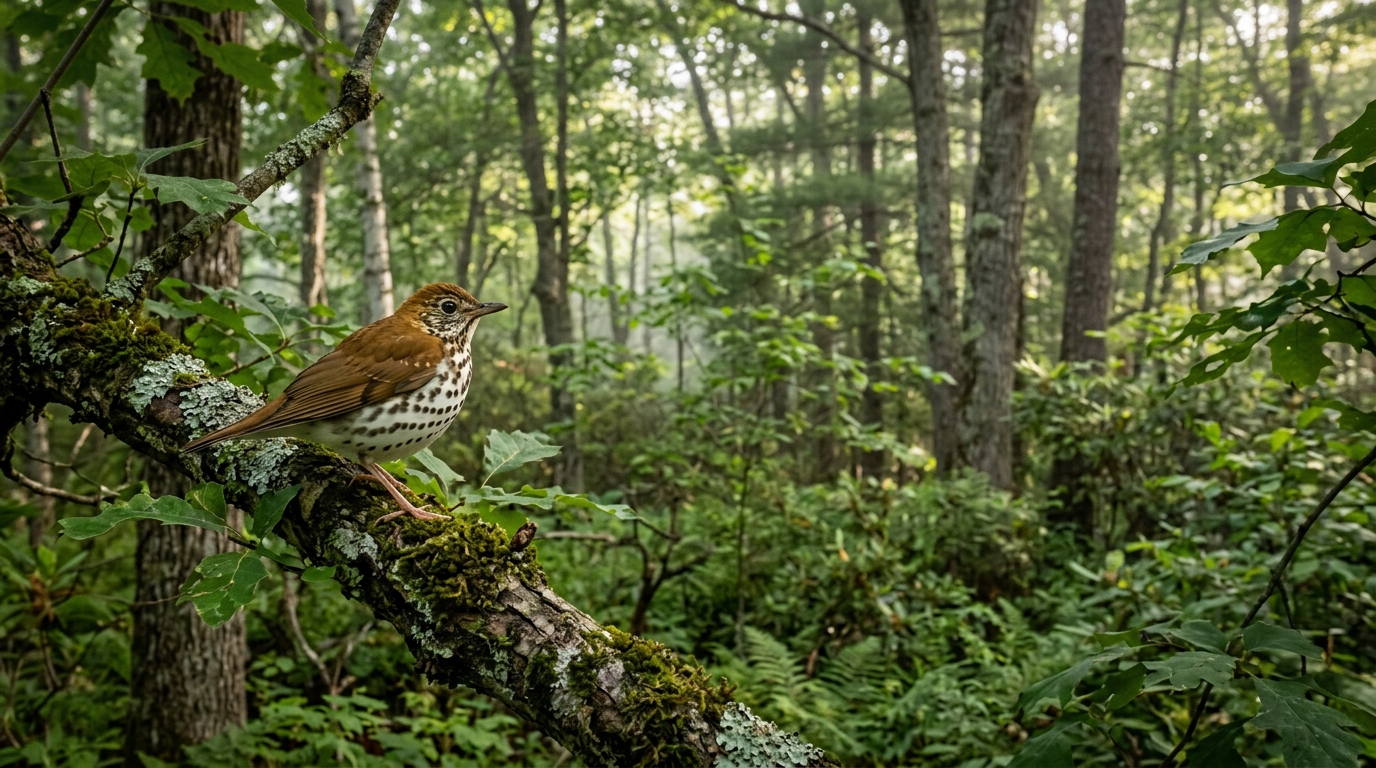
A comprehensive seventeen-year investigation examining forest-associated bird species across eight National Park Service units in the Northeastern United States has revealed that forest characteristics in the surrounding regional landscape often exert a stronger influence on bird occurrence than the structural attributes of the protected reserves themselves. Conducted between 2006 and 2023, the research analyzed how forest structure at three distinct nested spatial scales—local survey stations, entire park territories, and broader surrounding counties—impacted the occurrence probabilities of sixteen breeding bird species. While conservation strategies historically emphasize internal park habitat management or boundary demarcations, researchers determined that regional forest availability and structural attributes across county extents dominated species responses in the examined systems.
Forest-associated avian populations across North America have experienced widespread demographic reductions over the past half-century, prompting ongoing assessments of protected area effectiveness. In the Northeastern United States, continuous bird declines recorded across protected federal woodlands have appeared largely uncorrelated with specific life-history traits, suggesting that broader external landscape pressures operating outside park perimeters could be heavily influencing local population dynamics. Although national parks harbor mature, structurally complex forest tracts compared to surrounding working lands, the protected reserves evaluated in this region are predominantly small historical parks. These units encompass remnant forest parcels within landscapes featuring mixed human development, timber harvesting, and agricultural activities, establishing an empirical setting to evaluate whether internal protection alone can shield avian communities from surrounding landscape dynamics.
To investigate these ecological dynamics, the researchers synthesized seventeen years of annual point-count surveys collected by the Northeast Temperate Network across eight National Historic Sites and National Historical Parks located across seven northeastern states. The evaluated parks ranged in area from 28 hectares at Weir Farm to 1,156 hectares at Saratoga, with an average footprint of roughly 419 hectares, managed by the National Park Service for periods spanning 32 to 92 years. Five other monitored units within the network were deliberately excluded from the study framework due to non-comparable ecological settings, such as Acadia National Park due to its isolated geography, seabird assemblages on island landscapes, non-forested terrain, or linear structures lacking discrete park boundaries.
The study focused on sixteen avian species classified as mature-forest associates exhibiting varied migratory strategies and conservation statuses, including Partners in Flight priority taxa like the wood thrush alongside resident species like the white-breasted nuthatch and downy woodpecker, and Neotropical migrants including multiple warblers, thrushes, and vireos. Auditory point counts conducted during the peak May-to-June breeding season utilized a removal sampling methodology across consecutive intervals to rigorously estimate detection probabilities. Observers tracked avian presences within standardized 50-meter radius stations situated at least 50 meters inside dominant forest interiors and spaced at minimum 250-meter intervals to avoid duplicate counts. In total, auditory detections constituted 91 percent of records, which were subsequently binned into two-minute intervals to parameterize the hierarchical detection process.
Forest structural conditions were quantified across three nested spatial scales utilizing complementary long-term monitoring networks. Local-scale metrics were derived within 400 meters of each avian survey station by calculating distance-weighted averages across up to five neighboring National Park Service forest monitoring plots. Park-scale metrics were generated by averaging all internal park monitoring plots across survey years, while county-scale forest attributes were calculated using repeated plot measurements from the USDA Forest Service Forest Inventory and Analysis program. Across each of these three spatial extents, the research team tracked five key structural covariates: total tree stem density, conifer tree basal area, late-successional tree basal area, shrub percent cover, and total tree basal area, while standardizing all predictors to mean zero and unit variance.
To rigorously identify which spatial scale exerted the dominant influence on avian occurrences without inflating parameter correlations, the researchers implemented a two-step modeling framework utilizing Bayesian latent indicator scale selection, known as the BLISS occupancy model. In the initial step, the hierarchical Bayesian model assigned categorical scale weights across candidate extents, identifying the scale that received dominant posterior support above equal-weight thresholds for each species-covariate combination. In the subsequent step, single-species occupancy models were refitted utilizing solely the top-ranked scale for each covariate to isolate unbiased parameter effect sizes. Across eighty evaluated species-covariate pairings, 54 combinations exhibited clear scale dependency where a single spatial scale captured more than 50 percent of the posterior density.
The empirical scale selection demonstrated that county-scale forest variables emerged most frequently as the dominant scale of effect, selected across 34 species-covariate pairings in the initial step, compared to 25 local-scale selections and 21 park-scale selections. Following the refitted second-step occupancy estimations, 40 species-covariate relationships exhibited 80 percent credible intervals that excluded zero. County-scale variables accounted for 19 significant associations across nine species, local-scale variables accounted for 16 significant relationships across ten species, and park-scale variables accounted for only five significant associations across five species. In total, at least one county-scale forest variable influenced 75 percent of the evaluated avian species, demonstrating that broad landscape context consistently mediated species occurrence.
Species displayed highly heterogeneous responses to structural metrics, reflecting distinct structural niches rather than uniform responses to overall tree cover. Conifer basal area served as a primary axis of habitat divergence across all scales: species such as the black-throated blue warbler, blackburnian warbler, and ovenbird exhibited positive associations with conifer presence, whereas broadleaf-reliant taxa like the downy woodpecker and red-eyed vireo declined as conifer basal area increased. At the county scale, veery occurrence probabilities climbed steeply toward 100 percent as regional conifer basal area reached roughly 12 square meters per hectare, while wood thrush occurrence displayed a weak negative response. Shrub cover also produced divergent outcomes, correlating positively with the black-throated blue warbler and downy woodpecker, but negatively across all three examined thrush species.
Total protected reserve area exerted weak and largely inconsistent effects on species occurrence probabilities across the network. Park size was positively associated with occurrence for only five species—specifically the veery, ovenbird, scarlet tanager, brown creeper, and downy woodpecker—while most focal species showed no statistical relationship to park area, and two species exhibited unexpected negative associations. The authors noted that this lack of strong park-area dependency stems directly from the fact that all eight historical parks are relatively small parcels embedded within a generally well-forested broader landscape. Consequently, while these federal reserves provide high-quality localized breeding territories, regional forest availability and structural connectivity in the surrounding county matrix ultimately govern whether species pools persist to occupy the parks.
The findings emphasize that small protected reserves cannot successfully conserve forest-associated bird assemblages when treated as isolated ecological islands. Because wildlife movements, post-fledging dispersal, and regional source-sink dynamics operate across broad spatial grains, conservation initiatives targeting matrix habitats surrounding parks—such as maintaining canopy connectivity, managing regional forest structure, and establishing private land easements—can yield critical conservation benefits. The researchers noted that while expanding formal park boundaries is frequently constrained by competing land-use priorities in populated regions, cooperative regional landscape management offers a tractable mechanism to enhance the ecological viability of existing protected areas.
Beyond immediate reserve boundaries, regional forest composition reflects four centuries of post-European land-use legacies that favored early and mid-successional second-growth stands. Within the studied parks, modern management generally restricts the harvesting of late-successional timber and preserves natural disturbance regimes from wind, ice, and insect outbreaks. The sole exception in the network is Marsh-Billings-Rockefeller National Historical Park, which maintains active forest stand stewardship to commemorate historic forestry practices. Despite harboring older and structurally more complex woodlands than surrounding lands, these federal properties still contend with pervasive forest regeneration failures. In particular, chronic browsing pressure from overabundant white-tailed deer following predator extirpations, coupled with competitive pressure from non-native invasive plants, continues to alter understory vegetation across the region.
The modeling also illuminated how identical structural metrics convey fundamentally distinct ecological mechanisms across different spatial extents. For instance, tree density exhibited divergent effects at local versus regional scales; local stem density reflects proximate foraging substrates and protective cover, whereas county-scale density primarily serves as an indicator of broader stand age, with high densities denoting younger or less structurally varied woodlands. These structural differences directly mapped onto specialized nesting niches. Black-throated blue warblers, which nested in dense understory shrubs, responded negatively to local late-successional basal area but positively to moderate canopy gaps that stimulate shrub layer regeneration. Conversely, downy woodpeckers depended heavily on mature, fungus-softened broadleaf trees that provide excavatable deadwood for cavities, illustrating why uniform forest management cannot simultaneously optimize habitat across divergent avian guilds.
These empirical relationships provide actionable guidance for regional conservation frameworks across the Northeastern United States, where approximately 29 million acres are formally protected and 61 percent of that protected footprint remains forested. Because reserve enlargement is frequently impeded by residential and commercial development, conservationists increasingly emphasize targeted matrix interventions outside park borders. Working-forest initiatives such as the Forestry for the Birds program, alongside agricultural prairie strips, linear woodland features, and agroforestry orchards, offer practical pathways to enrich county-scale habitat matrix permeability. By enhancing tree retention and structural complexity across mixed-use landscapes, land managers can sustain the regional source populations necessary to replenish bird communities within protected forest remnants.
Subject of Research: Multi-scale analysis of forest structure and forest-associated bird occurrence in Northeastern U.S. protected areas
Article Title: Protecting birds in protected areas: a multi-scale analysis of forest structure and species occurrence
Article References: Amaral, B. R., Doser, J. W., Weed, A. S., Miller, K. M., & Zipkin, E. F. (2026). Protecting birds in protected areas: a multi-scale analysis of forest structure and species occurrence. Landscape Ecology, 41(12), Article 225. https://doi.org/10.1007/s10980-026-02477-x
Image Credits: AI Generated
DOI: 10.1007/s10980-026-02477-x
Keywords: forest-associated birds, protected areas, multi-scale habitat modeling, BLISS model, landscape ecology, Northeastern United States, National Park Service, Northeast Temperate Network, Forest Inventory and Analysis, conifer basal area, shrub density, avian conservation, point count surveys, removal sampling, matrix permeability, forest structure, habitat connectivity, bayesian occupancy modeling
News Source: Drew Townsend. (November 17, 2026). County Forest Structure Often Shapes Bird Occurrence More Than Protected Park Area. Scienmag.