• HOME
  • NEWS
  • EXPLORE
    • CAREER
      • Companies
      • Jobs
    • EVENTS
    • iGEM
      • News
      • Team
    • PHOTOS
    • VIDEO
    • WIKI
  • BLOG
  • COMMUNITY
    • FACEBOOK
    • INSTAGRAM
    • TWITTER
Wednesday, May 20, 2026
BIOENGINEER.ORG
No Result
View All Result
  • Login
  • HOME
  • NEWS
  • EXPLORE
    • CAREER
      • Companies
      • Jobs
        • Lecturer
        • PhD Studentship
        • Postdoc
        • Research Assistant
    • EVENTS
    • iGEM
      • News
      • Team
    • PHOTOS
    • VIDEO
    • WIKI
  • BLOG
  • COMMUNITY
    • FACEBOOK
    • INSTAGRAM
    • TWITTER
  • HOME
  • NEWS
  • EXPLORE
    • CAREER
      • Companies
      • Jobs
        • Lecturer
        • PhD Studentship
        • Postdoc
        • Research Assistant
    • EVENTS
    • iGEM
      • News
      • Team
    • PHOTOS
    • VIDEO
    • WIKI
  • BLOG
  • COMMUNITY
    • FACEBOOK
    • INSTAGRAM
    • TWITTER
No Result
View All Result
Bioengineer.org
No Result
View All Result
Home NEWS Science News Chemistry

Counting photons is now routine enough to need standards

Bioengineer by Bioengineer
December 20, 2019
in Chemistry
Reading Time: 3 mins read
0
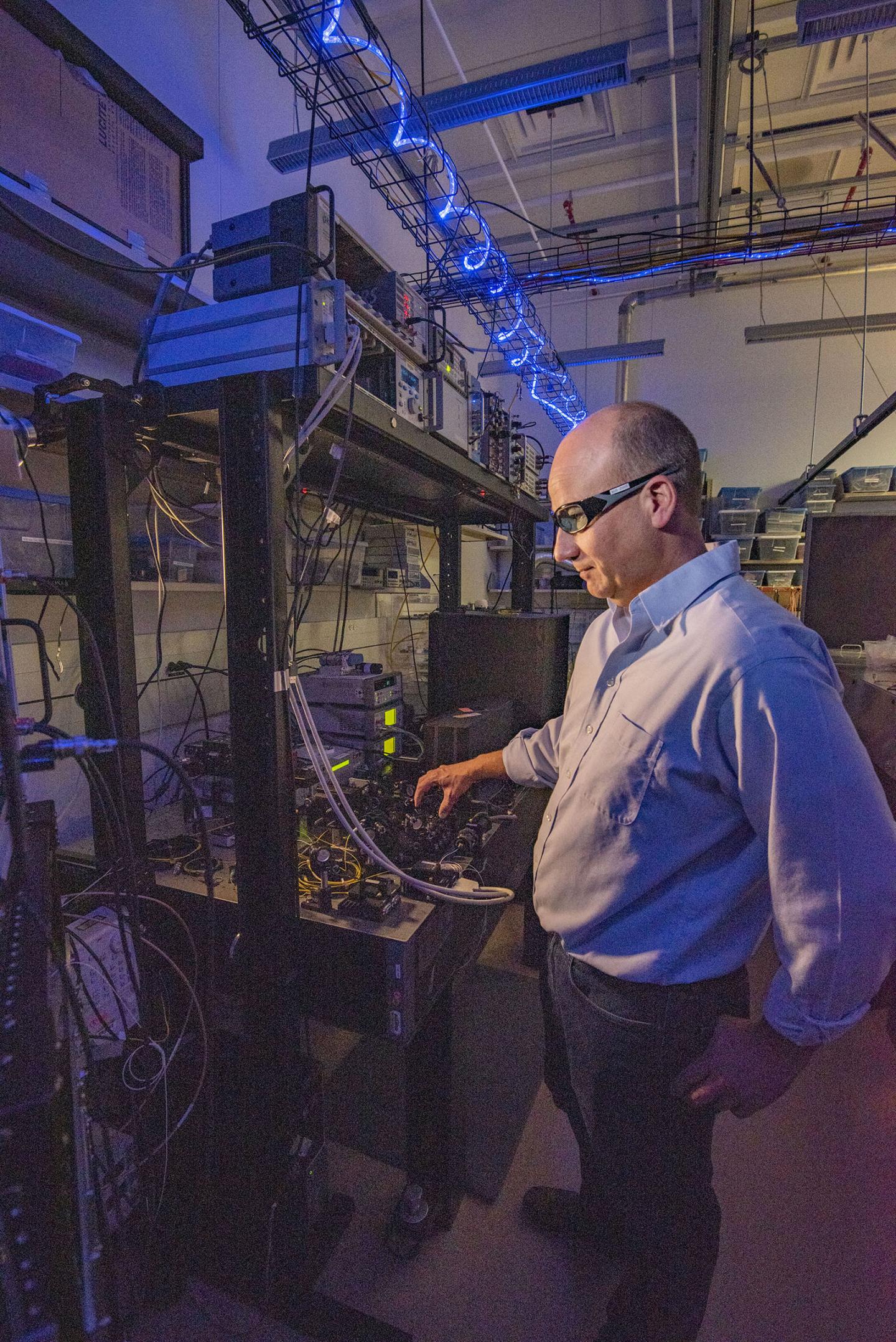
IMAGE
Share on FacebookShare on TwitterShare on LinkedinShare on RedditShare on Telegram

IMAGE

Credit: J. Burrus/NIST


Since the National Institute of Standards and Technology (NIST) built its first superconducting devices for counting photons (the smallest units of light) in the 1990s, these once-rare detectors have become popular research tools all over the world. Now, NIST has taken a step toward enabling universal standards for these devices, which are becoming increasingly important in science and industry.

Single-photon detectors (SPDs) are now key to research areas ranging from optical communications and astrophysics to cutting-edge information technologies based on quantum physics, such as quantum cryptography and quantum teleportation.

To ensure their accuracy and reliability, SPDs need to be evaluated and compared to some benchmark, ideally a formal standard. NIST researchers are developing methods to do that and have already started to perform custom calibrations for the handful of companies that make SPDs.

The NIST team has just published methods for measuring the efficiency of five SPDs, including one made at NIST, as a prelude to offering an official calibration service.

“This is a first step towards implementation of a quantum standard — we produced a tool to verify a future single-photon detection standard,” NIST physicist Thomas Gerrits said. “There is no standard right now, but many national metrology institutes, including NIST, are working on this.”

“There have been journal papers on this topic before, but we did in-depth uncertainty analyses and described in great detail how we did the tests,” Gerrits said. “The aim is to serve as a reference for our planned calibration service.”

NIST is uniquely qualified to develop these evaluation methods because the institute makes the most efficient SPDs in the world and is constantly improving their performance. NIST specializes in two superconducting designs — one based on nanowires or nanostrips, evaluated in the new study, and transition-edge sensors, to be studied in the near future. Future work may also address standards for detectors that measure very low light levels but can’t count the number of photons.

In the modern metric system, known as the SI, the basic unit of measurement that’s most closely related to photon detection is the candela, which is relevant to light detected by the human eye. Future SI redefinitions might include photon-counting standards, which could offer a more accurate way of measuring light in terms of the candela. Single-photon light levels are less than one-billionth of the amounts in current standards.

The new paper details NIST’s use of conventional technologies to measure SPD detection efficiency, defined as the probability of detecting a photon hitting the detector and producing a measurable outcome. The NIST team ensured the measurements are traceable to a primary standard for optical power meters (NIST’s Laser Optimized Cryogenic Radiometer). The meters maintain accuracy as measurements are scaled down to low light levels, with the overall measurement uncertainty mostly due to the power meter calibration.

The researchers measured the efficiencies of five detectors, including three silicon photon-counting photodiodes and NIST’s nanowire detector. Photons were sent by optical fiber for some measurements and through the air in other cases. Measurements were made for two different wavelengths of light commonly used in fiber optics and communications. Uncertainties ranged from a low of 0.70% for measurements in fiber at a wavelength of 1533.6 nanometers (nm) to 1.78% for over-the-air readings at 851.7 nm.

###

Media Contact
Ben P. Stein
[email protected]
301-975-2763

Original Source

https://www.nist.gov/news-events/news/2019/12/counting-photons-now-routine-enough-need-standards

Related Journal Article

http://dx.doi.org/10.1088/1681-7575/ab4533

Tags: Atomic/Molecular/Particle PhysicsChemistry/Physics/Materials SciencesOptics
Share12Tweet8Share2ShareShareShare2

Related Posts

Advancing In Vivo and In Situ Monitoring: Science Bulletin Highlights Host-Based Antifouling Gold Nanotube Sensor for Selective Detection of Mechanically Sensitive Serotonin Release in Intestinal Mucosa — Chemistry

Advancing In Vivo and In Situ Monitoring: Science Bulletin Highlights Host-Based Antifouling Gold Nanotube Sensor for Selective Detection of Mechanically Sensitive Serotonin Release in Intestinal Mucosa

May 20, 2026
How Magnetic Orientation Could Influence the Building Blocks of Life — Chemistry

How Magnetic Orientation Could Influence the Building Blocks of Life

May 20, 2026

Breaking a 200-Year-Old Belief: Novel Surface Design Achieves Two Distinct Wetting States on One Substrate

May 20, 2026

Unveiling Sound Waves: Scientists Discover Hidden Behaviors in Acoustic Phenomena

May 20, 2026
Please login to join discussion

POPULAR NEWS

  • blank

    New Study Reveals Plants Can Detect the Sound of Rain

    733 shares
    Share 292 Tweet 183
  • Research Indicates Potential Connection Between Prenatal Medication Exposure and Elevated Autism Risk

    846 shares
    Share 338 Tweet 212
  • ESMO 2025: mRNA COVID Vaccines Enhance Efficacy of Cancer Immunotherapy

    296 shares
    Share 118 Tweet 74
  • Breastmilk Balances E. coli and Beneficial Bacteria in Infant Gut Microbiomes

    58 shares
    Share 23 Tweet 15

About

We bring you the latest biotechnology news from best research centers and universities around the world. Check our website.

Follow us

Recent News

UM School of Medicine Secures $2.9 Million Federal Grant to Enhance Advanced Microscopy for Accelerating Neuroscience Breakthroughs

From Whole-Body to Organ-Specific Age Clocks

Scientists Harness Quantum Mathematics to Unlock the Secrets of the Emotional Mind

Subscribe to Blog via Email

Enter your email address to subscribe to this blog and receive notifications of new posts by email.

Join 82 other subscribers
  • Contact Us

Bioengineer.org © Copyright 2023 All Rights Reserved.

Welcome Back!

Login to your account below

Forgotten Password?

Retrieve your password

Please enter your username or email address to reset your password.

Log In
No Result
View All Result
  • Homepages
    • Home Page 1
    • Home Page 2
  • News
  • National
  • Business
  • Health
  • Lifestyle
  • Science

Bioengineer.org © Copyright 2023 All Rights Reserved.