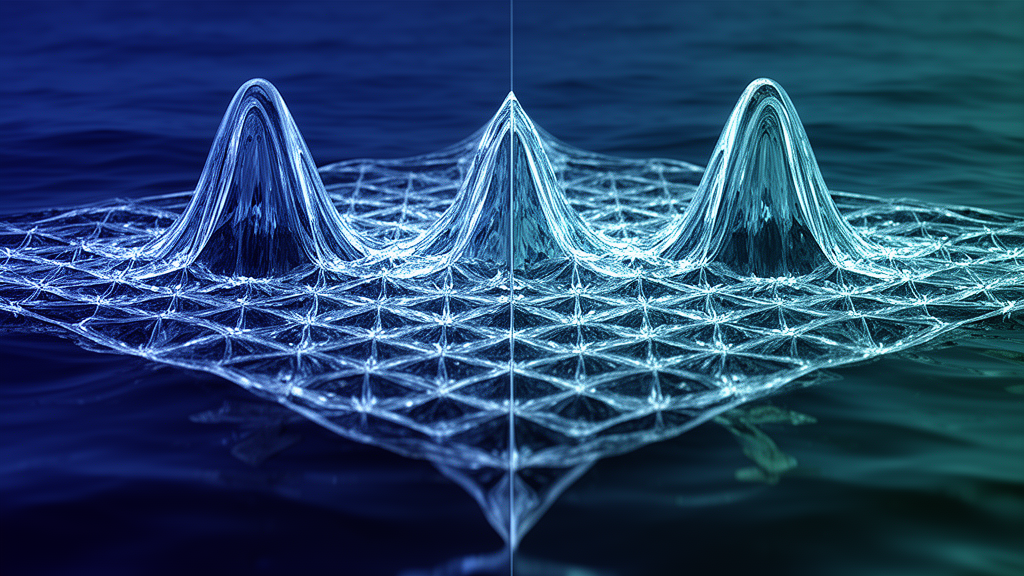
In a newly published computational study, researchers Milan Petrović, Aleksandra Strinić, and Nađa Petrović have investigated the complex dynamical interactions that occur when two counterpropagating Akhmediev-like breathers collide within a nonlinear medium. Using detailed numerical simulations, the research team demonstrated that counterpropagating rogue-wave structures can generate distinct nonlinear Talbot carpets characterized by remarkable spatial regularity. Under low-intensity conditions, the interacting counterpropagating waves establish highly organized periodic recurrence profiles across their propagation trajectories. When both the propagation distance and the excitation strength are increased, the system gives rise to more intricate yet exceptionally robust interference configurations, including previously unreported dipole-type and tripole-type spatial structures. The authors established that these novel multi-peaked breather arrangements remain structurally stable over extended propagation distances, thereby revealing previously unexplored parameter regimes where nonlinear interference patterns can sustainably exist during bidirectional wave propagation.
The theoretical framework underpinning this investigation is the one-dimensional cubic nonlinear Schrödinger equation, which stands as a cornerstone in modern nonlinear science for describing diverse wave localization phenomena across hydrodynamics, optics, plasma physics, and molecular biology. Ever since the seminal analytical soliton solutions derived by Zakharov and Shabat, the mathematical treatment of localized wave structures has remained central to understanding extreme dynamics, particularly in systems where solitons propagate upon a finite background. Solitons on a finite background, notably the Akhmediev breather family, serve as canonical analytical prototypes for capturing such localized energy concentrations. While individual forward-propagating solitons have been extensively explored, analyzing the collision dynamics of two counterpropagating rogue-wave solutions presents an intricate physical problem where interacting wave envelopes mutually modulate their propagation environments.
To contextualize their numerical findings, the authors examined the fundamental mechanisms governing the classical Talbot effect, a recurring self-imaging phenomenon discovered experimentally in 1836 by Henry Fox Talbot and subsequently formulated mathematically in 1881 by Lord Rayleigh. In classical optics, when a periodic grating is illuminated by collimated planar light, the diffracted wavefront reconstructs an exact self-image of the initial grating at regular longitudinal intervals defined as the Talbot length. This lensless spatial recurrence phenomenon has found wide applicability across photolithography, optical computing, image preprocessing, and spectrometry, while also being demonstrated in quantum optics, atomic optics, photonic lattices, waveguide arrays, Bose-Einstein condensates, X-ray imaging, and fullerene molecule interferometry. While nonlinear Talbot effects have previously been reported in unidirectional settings—such as linear diffraction originating from a nonlinear wave or rogue-wave self-imaging—extending this recurrence phenomenon to counterpropagating nonlinear waves introduces complex bidirectional boundary conditions that fundamentally reshape the recurrence landscape.
A critical initial finding highlighted by the researchers is that ideal mathematical rogue-wave solutions cannot sustain stable composite structures when launched in opposing directions under conventional boundary constraints. Specifically, exact solutions of the cubic nonlinear Schrödinger equation configured on a uniform background amplitude equal to one fail to maintain structural stability during bidirectional propagation, as mathematical conditions cause the counterpropagating structures to break apart rapidly. To resolve this limitation, the authors discovered that setting the uniform background amplitude to a value strictly less than one allows the counterpropagating input beams to form enduring, coherent wave patterns. Consequently, the team formulated an engineered input configuration by scaling a representative Akhmediev breather solution with a reduced background amplitude parameter, thereby establishing a realistic physical regime capable of stabilizing bidirectional breather interactions over significant propagation ranges.
The analytical foundation of the model begins with the scaled cubic nonlinear Schrödinger equation, which relates the evolution of a complex wave function across normalized propagation distance and normalized temporal coordinates. Within this governing equation, the Akhmediev breather solution on a finite background is parameterized by a structural variable that depends on the characteristic modulation frequency and a growth rate coefficient. To construct a representative and mathematically tractable rogue-wave profile, the authors set the internal parameter to one-fourth, which yields an exact transverse spatial period equal to pi times the square root of two. This particular parameter choice establishes a well-defined localized breather waveform that serves as the analytical building block for generating forward- and backward-traveling wave inputs at the boundaries of the computational medium.
To describe the mutual interactions of these opposing beams, the authors adopted a bidirectional waveguide model formulated under the paraxial approximation. This coupled system consists of two simultaneous partial differential equations tracking the forward-propagating envelope and the backward-propagating envelope as they travel through the Kerr-type self-focusing medium. The forward beam is introduced at the entrance boundary where the normalized distance equals zero, while the backward beam enters from the opposing boundary where distance equals the total propagation length, with each boundary profile modulated by an amplitude background strictly below unity.
To execute the computational experiments with high precision, the investigators implemented a numerical split-step scheme accelerated by the fast Fourier transform algorithm, utilizing a fourth-order symplectic integration technique to maintain numerical stability and phase accuracy throughout propagation. Forward and backward beams were introduced from opposite boundaries of the nonlinear medium with their transverse positions aligned to ensure symmetrical overlap. To prevent artificial reflections and computational boundary errors from contaminating the physical dynamics, the numerical time domain was confined to a window spanning from negative 20.5 transverse periods to positive 20.5 transverse periods, while the underlying computational domain was expanded considerably beyond these limits. This numerical setup allowed the researchers to systematically track the evolution of optical field intensities across normalized distance and time coordinates under diverse physical initial conditions.
In the low-intensity regime, the simulations revealed the emergence of pristine nonlinear Talbot carpets characterized by perfect self-imaging periodicity. For an input background amplitude of 0.2 and a total propagation length of 18.75, modulational instability induces a periodic spatial recurrence where the incident wave profile accurately reconstructs itself at exact multiples of the longitudinal period. In this benchmark configuration, the self-imaging period along the propagation direction was measured to be 6.25, establishing an effective Talbot length of exactly 6.25 such that the medium length corresponds to three full Talbot lengths. At half-integer multiples of this Talbot length, the optical field reproduces the original profile with an exact pi-phase shift. The authors emphasized that this observed self-imaging represents a fully nonlinear Talbot effect, as it arises intrinsically from the eigenmodes of the nonlinear Schrödinger equation evolving in a self-focusing nonlinear medium.
When both the input beam intensity and the total propagation distance were increased, the interaction dynamics transitioned into more complex yet remarkably robust structural configurations. Setting the background amplitude to 0.29 while varying the medium length demonstrated that higher intensities generate stable nonlinear Talbot carpets featuring dipolar arrangements at a propagation length of 26 and tripolar configurations at a length of 28. In an intermediate regime corresponding to a length of 27, the counterpropagating interaction settled into the formation of an orderly soliton train. The emergence of these multi-peaked dipole and tripole patterns stems from internal propagation modes supported within the nonlinear self-focusing medium, which selectively trigger localized modulational instabilities. Furthermore, the numerical results revealed that these dipole and tripole Talbot carpets exhibit not only clear primary and secondary reconstructed images, but also distinct, periodic fractional Talbot images possessing well-defined regular geometry.
The study also examined the role of temporal boundaries and edge effects by narrowing the temporal confinement window to a domain spanning from negative 5.5 to positive 5.5 transverse periods under a background amplitude of 0.35. At a short propagation length equal to one Talbot length, the system retained a clean nonlinear Talbot carpet displaying the expected pi-phase shift at half the Talbot distance. However, when the propagation length was doubled to two Talbot lengths, the reduced number of interacting beams within the narrower time window lessened both the modulational instabilities and the mutual repulsive forces between counterpropagating beams, causing the system to organize into a stable soliton train. Broadening these comparisons across varying distances up to 35 in wider domains demonstrated that while transverse periodicity is rigorously imposed at the input boundaries, strong nonlinear coupling, beam bending, and edge effects eventually disrupt longitudinal recurrence, indicating that regular Talbot carpets dominate at lower intensities and shorter distances before complex instabilities overtake extended propagation.
Subject of Research: Nonlinear Talbot effect and spatial recurrence dynamics of counterpropagating Akhmediev-like breathers
Article Title: The nonlinear Talbot effect of counterpropagating rogue waves
Article References: Petrović, M., Strinić, A., & Petrović, N. (2026). The nonlinear Talbot effect of counterpropagating rogue waves. Applied Physics B, 132(6), Article 71. https://doi.org/10.1007/s00340-026-08685-2
Image Credits: AI Generated
DOI: 10.1007/s00340-026-08685-2
Keywords: Nonlinear Talbot effect, Counterpropagating rogue waves, Akhmediev breathers, Nonlinear Schrödinger equation, Modulational instability, Self-imaging recurrence, Dipole Talbot carpet, Tripole Talbot carpet, Soliton trains, Bidirectional waveguides, Split-step Fourier method, Symplectic algorithm, Paraxial approximation, Optical field intensity, Spatial recurrence, Wave envelope interactions, Finite background solitons
News Source: Denise Maddox. (November 12, 2026). Counterpropagating Rogue Waves Form Stable Nonlinear Talbot Carpets in Numerical Simulations. Scienmag.